Your cat is fluffy. Adorable. It has a soft little belly that's so pleasant to stroke. In photos it racks up hearts — "cutie!", "chubby little purrer!". Except that this "fluffy" cat probably has a serious health problem — and you're not aware of it. Because one in three owners of obese cats believes their cat is at an ideal weight.
This isn't a matter of aesthetics. It's an epidemic that shortens feline lives by years and drives diseases many owners have never heard of. And — hardest of all — in many cases it's us, the loving owners, who are the cause.
What the BCS scale is and how to read it
Before we get into the detailed data, we need to explain the concept of BCS (Body Condition Score). It's a visual-and-tactile scale for assessing an animal's body condition, used by vets worldwide to precisely estimate the level of body fat. The most commonly used version is the 9-point scale:
- 1-3 — underweight (from extreme emaciation to mild underweight)
- 4-5 — ideal weight. The ribs aren't visible to the naked eye, but they can be felt easily under your fingers (like the back of your hand through a thin glove). Looking from above, there's a clear tuck at the waist.
- 6 — overweight. The ribs are already much harder to feel, and the waist tuck is slowly disappearing.
- 7-9 — obesity. The ribs are completely impossible to feel under a thick layer of fat, the belly sags, and a score of 9 means extreme, immediately life-threatening obesity.
Thanks to this scale, a vet diagnoses actual adiposity rather than relying on dry kilograms alone, which can be misleading depending on the cat's size and skeletal build.
The scale: two-thirds of cats aged 11-14 are overweight
In February 2025 the largest epidemiological study of obesity in dogs and cats to date was published, in Preventive Veterinary Medicine. It covered 4.9 million dogs and 1.3 million cats examined at Banfield Pet Hospital clinics in the USA between 2020 and 2023.
66.5%
In the category of mature cats (11-14 years), two-thirds are overweight or obese. Among adults (7-10 years) it's 61%. This isn't a fringe — it's the norm.
| Life stage | Overweight | Obese | Total |
|---|---|---|---|
| Young adult (1-6 years) | 36.2% | 3.6% | 39.8% |
| Adult (7-10 years) | 47.2% | 13.9% | 61.1% |
| Mature (11-14 years) | 44.8% | 21.7% | 66.5% |
| Senior (15+ years) | 32.0% | 12.6% | 44.6% |
Saavedra et al. (2024), in a review in the Journal of Feline Medicine and Surgery, estimate the global prevalence of obesity in cats at 40-63%, depending on the country.
Compute your cat's diet — BARF calculatorOpen calculator"My cat is just fluffy" — the perception gap
This is one of the most frustrating aspects of feline obesity for vets — and one of the best documented. Owners systematically underestimate their cat's condition (incorrectly assessing the BCS discussed above).
Colliard et al. (2009) showed that 20.8% of cats assessed by a vet as overweight were classified by their owners as being at a normal weight. The Association for Pet Obesity Prevention (2022) report gives even starker figures: 32% of owners of overweight or obese cats classify their cat as "normal", "ideal", or even "slim".
Why does this happen? Teng et al. (2020), in a study on attitudes toward feline obesity, point to a mechanism of visual normalization. Obese cats are increasingly common — in clinics, on the streets, on social media. When most of the cats you see are fat, "fat" becomes "normal". And the media promote obese cats as cute and funny — which further distorts our perception. It's exactly the same mechanism that drives the human obesity epidemic.
Bjørnvad 2026: the more we love, the more we overfeed
In March 2026 a landmark study from the team of Charlotte Bjørnvad (University of Copenhagen) was published in Frontiers in Veterinary Science.
The researchers visited cats in their homes on Zealand (Denmark). The cats underwent a physical examination and BCS assessment, while owners completed the LAPS attachment questionnaire (Lexington Attachment to Pets Scale) and answered questions about feeding practices.
Owners of overweight or obese cats were significantly more strongly attached to their cats than owners of cats at a normal weight. The association held after accounting for confounding variables, including living strictly indoors.
— Based on Bjørnvad et al., 2026 — Frontiers in Veterinary Science
Why does love overfeed?
The mechanism is psychological, not biological. The four best-documented pathways:
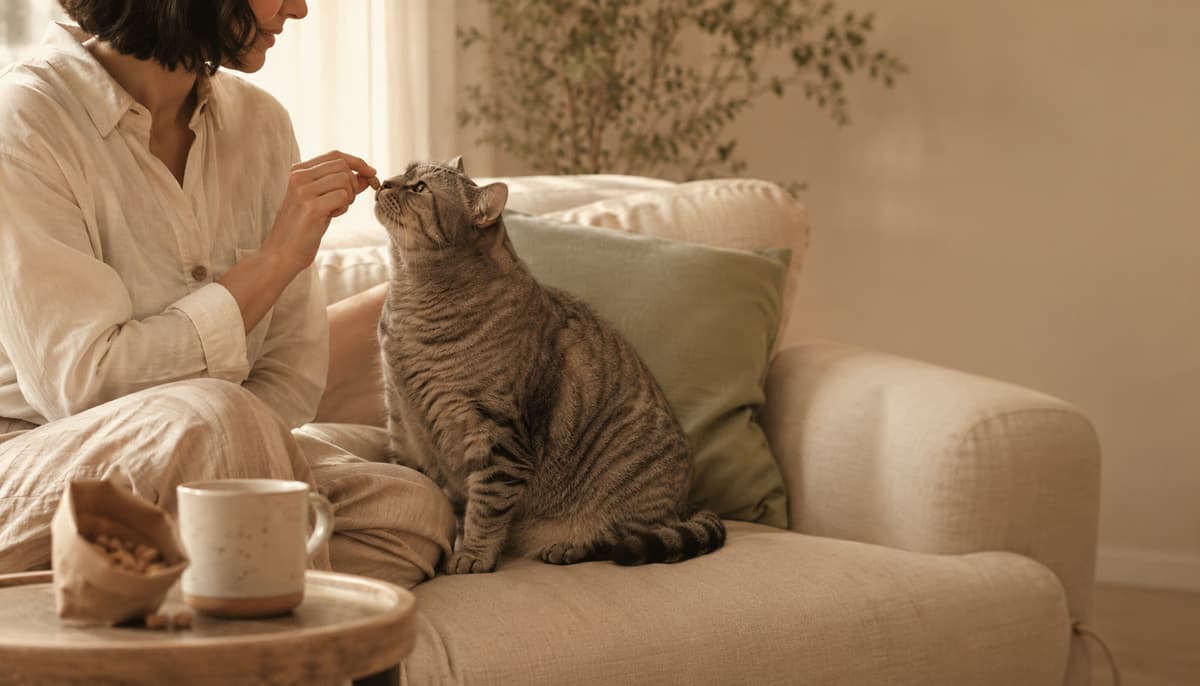
1. Food = love. Strongly attached owners more often give treats "because the cat asks so nicely", feed from the table "because it tastes good to them", fill the bowl "so the cat won't be hungry while I'm away", and respond to meowing with food. For a cat, an extra 10 kcal a day (one small treat) translates into half a kilogram a year.
2. Anthropomorphism. Rodrigues et al. (2021, Animals) describe how the more we treat a cat as human — attributing emotions or human preferences to it — the more readily we feed it "for comfort". Cats don't eat emotionally. Their owners do.
3. Lack of movement compensated with food. Strongly attached owners over-protect their cats (keeping them indoors) but don't replace their natural hunting activity with play. Food becomes the cat's only "entertainment".
4. Free feeding (ad libitum). A full bowl of kibble all day long is the strongest behavioral risk factor for obesity documented in the literature.
Neutering: the single strongest risk factor
Neutering is unquestionably right from a health perspective. But after the procedure the cat's diet must change — and most owners don't know this.
Wei et al. (2014, PLOS ONE) resolved a key question: do neutered cats gain weight because they move less, or because they eat more? The answer: the weight gain results from increased food intake, not from a drop in energy expenditure. Changes in hormonal balance make the feline brain receive a "eat more" signal.
The hormonal mechanism
Sex hormones don't only regulate reproduction — they also control metabolism and how the brain perceives hunger signals. After neutering, an avalanche of changes follows:
Estradiol drops. This sex hormone (present in both sexes) naturally suppresses appetite in the brain's satiety center. Its sudden drop after gonad removal literally "switches off" that physiological brake — the cat loses control over its appetite and wants to eat more.
IGF-I rises (insulin-like growth factor). A higher level of this polypeptide stimulates the body to action, intensifying the synthesis of new fat cells and changing how the body stores the energy it takes in.
Ghrelin rises. Ghrelin is the popularly named "hunger hormone", secreted mainly by the stomach. Its higher level after neutering literally tricks the feline brain, sending it constant, insistent "I'm hungry" signals, even if a meal disappeared from the bowl just moments earlier.
The risk of leptin resistance rises (the leptin paradox). Leptin is the "satiety hormone", produced by the fat tissue itself. In a healthy cat it informs the brain: "we're full, the body has enough energy". The paradox is that after neutering and a rapid increase in fat tissue (which secretes even more leptin), the nervous system becomes so over-stimulated by it that it goes completely "deaf" to it. As a result, although the cat's body is drowning in fat reserves, its brain is convinced the animal is dramatically starving and drives it to constantly seek food.
Backus et al. (2007) showed something even more important: neutering combined with high dietary fat caused the greatest body-weight gain. The conclusion: a neutered cat on overly fatty food is doubly at risk.
In practice
A cat's energy requirement after the procedure drops by about 24-33%, while its appetite rises. This means you absolutely must reduce portions by about 20-30% in the first weeks after the procedure — and closely monitor weight for the following year. Discuss the plan with your vet.
The cascade of diseases
Obesity in a cat triggers a cascade of clinically documented diseases.
Diabetes
Each additional kilogram = a ~30% drop in insulin sensitivity. A 4 kg cat that gains weight to 6 kg loses over half of its insulin sensitivity. Obese cats have a 2-4× higher risk of diabetes (Clark & Hoenig 2021). Most importantly: a high-protein, low-carbohydrate diet can reverse this disease. We wrote about the mechanisms in detail in Does BARF help cats lose weight — what science says.
Lower urinary tract disease (FLUTD)
Piyarungsri et al. (2020, Scientific Reports) showed a statistically significant association between overweight and idiopathic cystitis (FIC). An obese cat is less active → urinates less often → urine stagnates longer; fat around the urethra can compress it; obesity increases mineral excretion (a higher risk of stones). On top of that, such cats more often "eat away" stress, closing a vicious circle.
Joints and lameness
Bonecka et al. (2023, Animals) studied 64 cats with osteoarthritis of the knee joint (OA). The result comes with a nuance: severe OA occurred at a similar frequency in overweight, normal-weight, and underweight cats — but the clinical symptoms (stiffness, reluctance to jump) were more clearly visible in obese cats. In other words: overweight doesn't so much "cause" degenerative changes as it masks pain signals and mechanically burdens the joints, aggravating everyday discomfort.
Lifespan — and an important nuance
Teng et al. (2018) tracked 2609 cats. The result is most often cited in a distorted form. The actual findings:
- BCS < 5 and BCS 9 → significantly shorter survival
- BCS 6, 7, 8 → the longest survival and lifespan
That is: extreme obesity (BCS 9) shortens life, but mild overweight (BCS 6-7) appears protective — most likely because it provides an energy reserve in case of illness. The practical takeaway: don't panic at BCS 6, but BCS 8 is the last call to act.
Hepatic lipidosis
Obese cats are at extreme risk of fatty liver if they suddenly stop eating. The liver can't keep up with processing the released floods of fat without dietary protein present.
Never starve an obese cat
The maximum rate of weight loss is 0.5-1% of body weight per week (30-60 g/week for a 6 kg cat). Faster = a risk of lipidosis, a life-threatening condition. The paradox: the cat needs to lose weight, but losing it too fast can kill it.
What you can do today
1. Weigh your cat. A kitchen scale (for small cats), a bathroom scale (weigh yourself holding the cat, then yourself alone), or — what works perfectly and is incredibly accurate — a baby scale. Without a starting point you can't measure progress.
2. Check the BCS. Try to feel the ribs under the fat tissue and assess the waist tuck. The 1-9 scale is available on the WSAVA website.
3. Change the language of love. Instead of another treat — 15 minutes of active wand play as a form of "hunting". To your cat it's the same currency of attention.
4. Correct the diet. Choose a food with a high meat content and eliminate free access to kibble. After neutering, mandatorily reduce portions by ~20-30%. We described the full feeding protocol (protein, carbohydrates, digestibility, BARF as the natural option) in the article Does BARF help cats lose weight — what science says.
5. Schedule a vet visit. Diagnostics (bloodwork with an electrolyte panel, a thyroid/kidney profile) must take place before starting a rigorous diet, to rule out hidden diseases and set a safe rate of weight loss.
Summary
Your cat's obesity is rarely a matter of "laziness" (cats don't know the concept). It's most often the consequence of an intertwining of four factors, none of which on its own is anyone's fault:
- After neutering the appetite rises, and we feed the same as before
- We don't see the problem — because feline obesity has been normalized all around us
- The language of love is food — strong attachment most often manifests as a treat
- The home environment doesn't replace hunting — we compensate for the lack of movement with the bowl
Your cat doesn't need another treat. It needs your time, play, and conscious decisions at the bowl. Every one of those four factors is under your control, today.
Love isn't a full bowl. Love is a healthy cat that runs around the house at 18 years old.
References
- Bjørnvad C.R., Mortensen C.B., Tams M.L.S., Jørgensen F.K., Sandøe P., Lund T.B. (2026). Feline obesity is associated with stronger owner attachment, while indoor confinement increases risk of obesity at an early age in domestic shorthaired cats, Frontiers in Veterinary Science 13:1757719↗
- Forster G.M. et al. (2025). Overweight and obese body condition in ~4.9 million dogs and ~1.3 million cats seen at primary practices across the USA, Preventive Veterinary Medicine 235:106398↗
- Saavedra C., Pérez C., Oyarzún C., Torres-Arévalo Á. (2024). Overweight and obesity in domestic cats: epidemiological risk factors and associated pathologies, Journal of Feline Medicine and Surgery 26(11), review↗
- Teng K.T., McGreevy P.D., Toribio J.L.M.L., Raubenheimer D., Kendall K., Dhand N.K. (2020). Positive attitudes towards feline obesity are strongly associated with ownership of obese cats, PLOS ONE 15(6):e0234190↗
- Teng K.T., McGreevy P.D., Toribio J.L.M.L., Raubenheimer D., Kendall K., Dhand N.K. (2018). Strong associations of nine-point body condition scoring with survival and lifespan in cats, Journal of Feline Medicine and Surgery 20(12):1110-1118↗
- Wei A., Fascetti A.J., Liu K.J., Villaverde C., Green A.S., Manzanilla E.G., Havel P.J., Ramsey J.J. (2014). Early effects of neutering on energy expenditure in adult male cats, PLOS ONE 9(2):e89557↗
- Backus R.C., Cave N.J., Keisler D.H. (2007). Gonadectomy and high dietary fat but not high dietary carbohydrate induce gains in body weight and fat of domestic cats, British Journal of Nutrition 98(3):641-650↗
- Rodrigues D.F.P. et al. (2021). Anthropomorphism and Its Adverse Effects on the Distress and Welfare of Companion Animals, Animals 11(11):3263↗
- Hoenig M. (2012). The cat as a model for human obesity and diabetes, Journal of Diabetes Science and Technology 6(3):525-533↗
- Clark M., Hoenig M. (2021). Feline comorbidities: Pathophysiology and management of the obese diabetic cat, Journal of Feline Medicine and Surgery 23(7):615-633↗
- Piyarungsri K., Tangtrongsup S., Thitaram N., Lekklar P., Kittinuntasilp A. (2020). Prevalence and risk factors of feline lower urinary tract disease in Chiang Mai, Thailand, Scientific Reports 10:196↗
- Bonecka J., Skibniewski M., Zep P., Domino M. (2023). Knee Joint Osteoarthritis in Overweight Cats: The Clinical and Radiographic Findings, Animals 13(15):2427↗
- Association for Pet Obesity Prevention (2022). 2022 State of U.S. Pet Obesity Report, petobesityprevention.org
Frequently asked
My cat is just 'fluffy' — how do I know it's overweight?
Check the ribs and waist. In a cat at a healthy weight you should be able to **feel the ribs** under a thin layer of fat (like the back of your hand through a thin glove), and looking from above you should see a **slight tuck at the waist**. No palpable ribs + a round belly visible from the side = overweight. The simplest tool: the 1-9 BCS scale (search 'WSAVA Body Condition Score cat') — your vet will assess your cat at your next visit.
Why is my cat gaining weight when it eats so little?
Because the problem often isn't quantity but the *composition* of the diet and the *context* of feeding: neutering increases appetite by ~20-30%, dry food has low digestibility (it's more calorically loaded than it seems), and a full bowl all day long leads to grazing. We covered this in detail in the article [Does BARF help cats lose weight](/en/blog/does-barf-help-cat-weight-loss).
Can I love my cat 'too much'? Is that how the Bjørnvad study works?
It's not about the amount of love, but about its *language*. Bjørnvad (2026) showed that stronger emotional attachment correlates with a higher BCS — most likely because a strongly attached owner feeds more 'out of love' (treats on demand, food from the table, an always-full bowl). Change the language: instead of a treat, offer 5-15 minutes of wand play. To your cat it's the same currency of attention.
How fast can an obese cat safely lose weight?
At most 0.5-1% of body weight per week. For a 6 kg cat that's 30-60 g/week. Faster reduction risks hepatic lipidosis (fatty liver) — an immediately life-threatening condition, especially in obese cats. **Never starve a cat** as part of a diet. Always set the plan with a vet — it requires bloodwork + electrolyte panel + thyroid/kidney profile to rule out hidden disease.
Is being a little overweight really that bad?
Teng et al. (2018), studying 2609 cats, showed that cats with a BCS of 6, 7 *and even 8 out of 9* had the **longest survival and lifespan** — longer than very lean cats (BCS <5). Only BCS 9 (extreme obesity) was unambiguously harmful. The takeaway: a modest fat reserve may be protective (e.g. in case of illness), but past a certain threshold the problem becomes serious.