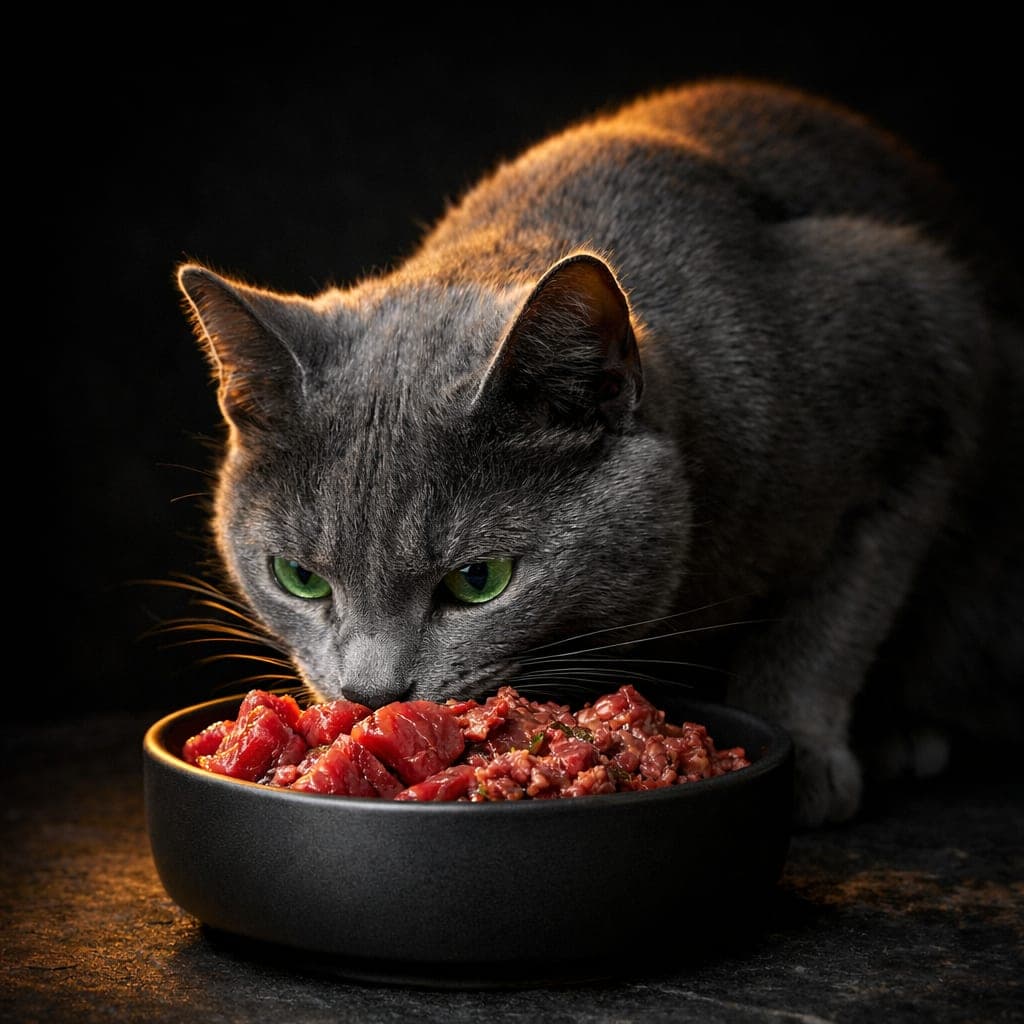
The BARF diet is without doubt the healthiest way to feed a cat — on one condition: it has to be properly balanced. Raw meat alone, even of the highest quality, isn't enough. A house cat doesn't eat its prey whole — with the skin, feathers, stomach contents, and bones. That's why the responsibility falls on you to supply what's missing.
Supplementation is a topic that scares many owners, yet in reality it's logical, predictable, and absolutely essential. Let's go through it step by step.
Why is supplementation essential?
Imagine feeding your cat nothing but muscle meat — chicken thighs, beef tenderloin, turkey. Sounds good? Unfortunately, it's a recipe for a nutritional disaster. Muscle meat is rich in phosphorus but extremely low in calcium. Without added calcium, the Ca:P ratio drops to 1:15 or worse, which within a few weeks leads to nutritional hyperparathyroidism — the cat's body starts "pulling" calcium out of its own bones to maintain blood levels.
4-8
That's how long it takes for feeding raw meat alone, without supplementation, to develop measurable deficiencies. Clinical symptoms may not appear until months later.
Calcium is just the start of the list. Meat alone doesn't supply enough iodine (crucial for the thyroid), vitamin D (which a cat doesn't produce from sunlight), vitamin E (essential as an antioxidant), B-group vitamins (destroyed by freezing), or omega-3 fatty acids (present only in trace amounts in farmed meat).
A BARF diet without supplements is not a BARF diet — it's random raw-meat feeding that can do more harm than commercial food. The difference between a great diet and a dangerous one lies precisely in supplementation.
— Lonsdale, Billinghurst, and other BARF classics
The good news? Supplementing a cat on BARF doesn't require a degree in biochemistry. You just need to understand a few key ingredients, know the standards, and stick to trusted sources.
Calcium (Ca) and phosphorus (P)
This is by far the most important supplement in a BARF diet — or rather, the most important ratio. Calcium and phosphorus work in tandem: both build bones and teeth, regulate muscle function, take part in blood clotting, and conduct nerve impulses. The problem is that raw muscle meat contains plenty of phosphorus (1500-2500 mg/kg) and practically no calcium (50-80 mg/kg).
The target Ca:P ratio in a cat's diet should be from 1.0:1 to 1.5:1, with the ideal at 1.15:1. This means that for every gram of phosphorus there should be about 1.15 grams of calcium. Deviations in either direction are dangerous: too little calcium = bone demineralization, too much = impaired absorption of zinc and other minerals.
Calcium sources
- Raw ground bone — the most natural source. Chicken bones contain calcium and phosphorus in a ratio of about 2:1, which perfectly balances the meat. Bone should make up 5-15% of the diet (calculated as bone alone, without the meat). Too much bone = hard, white stools and constipation.
- Eggshell powder — an excellent alternative to bone. One teaspoon (about 5 g) supplies roughly 1800 mg of calcium. Easy to prepare at home: dried shells ground to a fine powder in a grinder. A pure form of calcium carbonate, with almost no phosphorus.
- Calcium carbonate (CaCO3) — the pharmaceutical equivalent of eggshell powder. Precise dosing, no bacterial risk. A good choice for those who value accuracy.
- Calcium citrate — better absorbed than carbonate, especially in cats with low stomach acidity. Slightly more expensive, but worth considering for older individuals.
How much exactly? It depends on the bone content of the recipe. If the recipe contains 7-10% ground bone, additional Ca supplementation is usually minimal or unnecessary. If the finished meal is boneless, you need about 1 g of calcium carbonate per 100 g of meat (as a rough guide). Always calculate the Ca:P ratio across the whole recipe.
Taurine
Taurine is an amino acid that most mammals can synthesize from methionine and cysteine. Cats can't. The house cat is obligatorily dependent on dietary taurine, which makes it one of the most important supplements in a BARF diet. Discovering this fact in the 1980s was a breakthrough in feline nutrition — before that, thousands of cats fed foods based on dog food suffered from blindness and dilated cardiomyopathy (DCM).
The consequences of taurine deficiency are dramatic
- Retinal degeneration (CRD) — progressive loss of vision leading to complete blindness. The changes are irreversible.
- Dilated cardiomyopathy (DCM) — enlargement and weakening of the heart. It can lead to heart failure and death. Unlike retinal changes, taurine-dependent DCM is reversible once taurine is restored.
- Reproductive problems — fetal resorption, low kitten birth weight, developmental disorders.
- Weakened immunity — taurine affects the function of white blood cells.
The best sources of taurine
The richest natural source of taurine is hearts — especially turkey hearts (about 1780 mg/kg) and chicken hearts (about 1100 mg/kg). That's why heart should make up at least 10-15% of a BARF diet. Dark muscle meat (thighs) contains more taurine than light meat (breast). Seafood (mussels, squid) is also rich in taurine, but it's rarely used in feline diets.
Even with a high heart content in the diet, however, taurine supplementation is recommended. Why? Taurine is heat-sensitive — even thawing and gentle warming can reduce its content. Freezing meat also lowers it. A safe supplemental dose is 500-1000 mg daily for an adult cat. Taurine is water-soluble and any excess is simply excreted in urine, so overdosing is practically impossible.
Iodine
Iodine is a trace element on which proper thyroid function depends — the gland that regulates metabolism, thermoregulation, growth, and development. The standard for a cat is about 184 µg (micrograms) per kilogram of body weight. Both deficiency and excess of iodine are dangerous, which makes this supplement one of the more "temperamental" to dose.
- Iodine deficiency — hypothyroidism, slowed metabolism, weight gain, lethargy, skin and coat problems.
- Iodine excess — hyperthyroidism, especially dangerous in older cats. Symptoms: weight loss despite increased appetite, hyperactivity, rapid pulse, vomiting.
Iodine sources
- Kelp (seaweed meal) — the most popular source of iodine in BARF supplementation. The iodine content varies considerably between batches, however (from 400 to 4000 µg/g), which is why it's crucial to use a product with a declared, standardized iodine content. Dose carefully — too large a pinch of kelp can easily exceed the standard.
- Iodized salt — a precise, repeatable source of iodine. Iodized table salt contains about 25-30 µg of iodine per gram. Easy to dose, but it requires an accurate kitchen scale.
- Sea fish — cod, salmon, and sardines naturally contain iodine, but in amounts that are hard to estimate precisely.
Remember: iodine is a supplement where more is not better. Always calculate the dose against the cat's body weight and use a trusted source of known content.
Vitamin D
Most mammals — including humans and dogs — produce vitamin D in the skin under UVB radiation. Cats can't. Their skin lacks enough of the enzyme (7-dehydrocholesterol) that enables this synthesis. A cat's vitamin D must come exclusively from food.
Vitamin D regulates calcium-phosphorus balance — without it, even with an adequate calcium supply, the body can't absorb it properly. Deficiency leads to rickets in kittens and osteomalacia in adult cats. The vitamin D standard for a cat is about 92 IU per kilogram of body weight.
Vitamin D sources
- Cod liver oil — the classic, proven source. It contains vitamins D3 and A. It requires precise dosing, because it also contains a lot of vitamin A (toxic in excess!).
- Salmon oil — a gentler source of vitamin D, with the added benefit of omega-3 fatty acids.
- Egg yolks — naturally rich in vitamin D3. One raw chicken yolk contains about 20-40 IU of vitamin D.
- Fatty fish — salmon, mackerel, sardines. A great source, but used as part of the diet, not as a supplement.
Vitamin E
Vitamin E (tocopherol) is a key antioxidant that protects cell membranes from oxidative damage. In a BARF diet it takes on particular importance when you feed your cat fish. Fish rich in polyunsaturated fatty acids (PUFAs) increase the requirement for vitamin E — without it, steatitis (yellow fat disease) can develop, a painful inflammation of fatty tissue.
The vitamin E standard is about 37 IU per kilogram of body weight. Supplementation is especially important when:
- The diet contains fish (especially fatty fish such as salmon or mackerel)
- The meat has been frozen for a long time (freezing degrades vitamin E)
- The cat is older or has inflammatory conditions
The best supplemental source is natural d-alpha-tocopherol (not the synthetic dl-alpha-tocopherol, which is 50% less bioavailable). Vitamin E capsules are readily available and cheap.
B-group vitamins
The B-group vitamins are eight essential team players: B1 (thiamine), B2 (riboflavin), B3 (niacin), B5 (pantothenic acid), B6 (pyridoxine), B7 (biotin), B9 (folic acid), and B12 (cobalamin). They are all water-soluble, which means the cat's body doesn't store them in reserve — they must be supplied regularly.
In the context of a BARF diet, vitamin B1 (thiamine) is particularly significant. It is exceptionally sensitive to heat and oxidation — freezing meat can reduce thiamine content by as much as 50%. Thiamine deficiency in a cat shows up as neurological disturbances: loss of appetite, seizures, and in extreme cases — death. The standard for B-group vitamins is about 15 mg per kilogram of body weight (the B-complex combined).
50%
Vitamin B1 is exceptionally sensitive to heat and oxidation. Freezing meat can cut its content by half — supplementation is real, not theoretical.
B vitamin sources
- Nutritional yeast (brewer's yeast) — the best natural source of the B-complex. Rich in thiamine, riboflavin, niacin, and B6. Most cats accept its taste. Note: use inactivated yeast (nutritional/brewer's yeast), NOT baker's yeast.
- Liver — an excellent source of B12, B9, and B2. But liver is a vitamin A supplement, not a B one — its amount must be limited to a maximum of 5% of the diet.
- Heart — a good source of B vitamins, especially B12.
- A liquid or tablet B vitamin supplement — the most reliable way to cover the requirement, especially in winter, when meat is frozen for longer.
Iron
Iron is essential for producing hemoglobin — the protein in red blood cells that carries oxygen. Deficiency leads to anemia: weakness, pale gums, shortness of breath, apathy. The iron standard for a cat is about 18 mg per kilogram of body weight.
In a BARF diet, iron is usually not a problem if you supply an adequate amount of internal organs. Spleen is by far the richest natural source of iron — one of the most "blood-rich" organs, full of heme iron (the most bioavailable form). Liver, heart, and kidneys also supply significant amounts.
If for some reason you don't supply organs (e.g. the cat won't accept them), supplementation with an iron preparation is necessary. The most bioavailable form is iron chelate (iron bisglycinate) — gentle on the stomach and well absorbed. Avoid iron sulfate — it can cause gastric upset.
Omega-3 fatty acids
Omega-3 fatty acids — specifically EPA (eicosapentaenoic acid) and DHA (docosahexaenoic acid) — are anti-inflammatory components, crucial for the health of skin, coat, joints, brain, and eyes. Cats can't efficiently convert plant-based ALA (from flaxseed oil) into EPA/DHA, which is why they must receive them from animal sources — that is, from fish.
The standard is about 200 mg of EPA+DHA per kilogram of body weight. The problem is that the meat of farmed animals (chicken, turkey, beef) contains plenty of omega-6 and almost no omega-3. This unfavorable ratio of omega-6 to omega-3 (often 20:1 or more in farmed meat) promotes inflammation.
Omega-3 sources
- Wild salmon oil — the gold standard. Rich in EPA and DHA, well tolerated by cats. Use oil in a dark bottle and store it in the refrigerator after opening.
- Sardine / anchovy oil — an alternative to salmon, less burdened with heavy metals (smaller fish = less bioaccumulation).
- Small whole fish (sardines, sprats) — served 2-3 times a week as part of the diet, not as a supplement. Remember the extra vitamin E when feeding fish.
Avoid cod liver oil as your only source of omega-3 — it contains very high levels of vitamins A and D, and an excess of both is toxic. For omega-3 supplementation, pure fish oil is better.
Premixes — a convenient alternative
If "ingredient-by-ingredient" supplementation feels overwhelming, there's a simpler solution: ready-made premixes, blends of supplements designed specifically for a BARF diet. You add one measured portion to the meal and you've covered all (or almost all) of the deficiencies.
Popular premixes on the market
- TC Feline — one of the most highly regarded premixes for cats on a raw diet. It contains calcium, taurine, vitamins A, D, E, the B-complex, iodine, manganese, and more. It requires only adding meat and water. Created by Natasha Lester, a pioneer of raw feeding for cats.
- Felini Complete — a German premix with a composition similar to TC Feline. Readily available in Europe. It contains synthetic taurine and a full vitamin-mineral complex.
- Alnutrin — an American premix available in "with bone" and "boneless" versions (the latter contains additional calcium). A transparent composition and well-documented dosing.
The advantages of premixes: convenience, repeatability, minimal risk of error. The drawbacks: higher cost compared to buying supplements separately, and less flexibility in adjusting doses to a cat's individual needs. Premixes are an excellent choice for beginner owners who want to start BARF without the risk of supplementation errors. Over time, as you gain experience, you can switch to "à la carte" supplementation.
Summary
Supplementing a BARF diet is not optional — it's an absolute necessity. The table below lays out the most important supplements, with standards converted to a per-kilogram-of-body-weight basis:
| Supplement | Standard / kg body weight | Main sources |
|---|---|---|
| Calcium (Ca:P) | Ratio 1.15:1 | Bone, eggshell, CaCO3 |
| Taurine | ~734 mg | Hearts, supplement |
| Iodine | ~184 µg | Kelp, iodized salt |
| Vitamin D | ~92 IU | Salmon oil, cod liver oil, yolks |
| Vitamin E | ~37 IU | d-alpha-tocopherol |
| B vitamins | ~15 mg | Brewer's yeast, liver |
| Iron | ~18 mg | Spleen, iron chelate |
| Omega-3 | ~200 mg | Salmon oil |
Four rules of supplementation
- More is not always better — vitamins A and D and iodine are toxic in excess. Dose precisely, ideally with a kitchen scale accurate to 0.1 g.
- Consistency is key — water-soluble supplements (taurine, B vitamins) must be given daily, because the body doesn't store them.
- Freshness matters — freezing, thawing, and storage degrade many components. Supplement even when, in theory, the meat "should" cover the requirement.
- Every cat is different — kittens, nursing queens, older cats, and cats with chronic conditions have different requirements. Consult a veterinarian who specializes in nutrition.
Supplementation is the pillar on which the whole BARF diet stands. Without it, even the highest-quality meat isn't enough. With it, your cat receives complete, balanced nutrition that supports its health at every stage of life. And if calculating doses seems complicated — use the mrumi calculator, which does it for you in a few minutes.
Sources
- National Research Council (2006). Nutrient Requirements of Dogs and Cats. National Academies Press, Washington DC.
- Pion P.D., Kittleson M.D., Rogers Q.R., Morris J.G. (1987). Myocardial failure in cats associated with low plasma taurine: a reversible cardiomyopathy. Science, 237(4816), 764-768. PMID: 3616607.
- How K.L., Hazewinkel H.A.W., Mol J.A. (1994). Dietary vitamin D dependence of cat and dog due to inadequate cutaneous synthesis of vitamin D. General and Comparative Endocrinology, 96(1), 12-18. PMID: 7843559.
- Plantinga E.A., Bosch G., Hendriks W.H. (2011). Estimation of the dietary nutrient profile of free-roaming feral cats: possible implications for nutrition of domestic cats. British Journal of Nutrition, 106, S35-S48.
- FEDIAF (2024). Nutritional Guidelines for Complete and Complementary Pet Food for Cats and Dogs. European Pet Food Industry Federation.
Frequently asked
Is BARF safe without supplements?
No. Raw muscle meat has a Ca:P ratio of around 1:15 and is extremely low in iodine, vitamin D, and heat-labile taurine. Deficiencies develop within 4-8 weeks, though clinical symptoms may not appear until months later.
What Ca:P ratio should a cat's diet have?
Ideally 1.15:1, within a safe range of 1.0:1 to 1.5:1. Muscle meat has an inverted ratio (1:15), so without bone or eggshell powder you can't achieve it. Chicken bones have a ratio of about 2:1 and balance out the meat.
Can I overdose on taurine?
Practically no. Taurine is water-soluble, and any excess is simply excreted in urine. A safe supplemental dose is 500-1000 mg daily for an adult cat — even exceeding that several times over does no harm.
Does a premix replace all supplements?
Almost — premixes of the TC Feline, Felini Complete, or Alnutrin class cover calcium, taurine, vitamins A/D/E, the B-complex, iodine, and trace elements. You only need to add meat, and possibly omega-3 from salmon oil. It's a good solution for beginners.
Is iodine really dangerous in excess?
Yes. Iodine has a narrow therapeutic window. Deficiency = hypothyroidism, excess = hyperthyroidism (especially dangerous in older cats). Kelp has a variable content (400-4000 µg/g!) — use products with a standardized declared content, or iodized salt.