„Your cat doesn't love you. Your cat loves its bowl."
It's one of the most-repeated sentences in the whole history of the human–animal relationship. Cats are selfish. Cats are independent. Cats tolerate you because you feed them. If they could open the can themselves — they wouldn't even glance your way.
Sound familiar?
Science says something completely different. And it has hard data to back it up — from controlled experiments, from behavioural analysis, from trials in which cats THEMSELVES CHOSE between food and a human.
Spoiler: the human won.
1. Cats are attached to humans — like infants to their parents
Vitale et al. (2019) — Current Biology
This is probably the most important study on the cat–human relationship ever conducted.
Kristyn Vitale and her team at Oregon State University used the Secure Base Test (SBT) — the very method psychologists have used for decades to study the attachment of infants to their parents and of dogs to their owners.
How did the experiment work?
Three phases, two minutes each:
- Phase 1: The cat and owner enter an unfamiliar room. They stay together for 2 minutes.
- Phase 2: The owner leaves. The cat is left ALONE in the unfamiliar room for 2 minutes.
- Phase 3: The owner returns. The researchers observe the cat's reaction.
How the cat reacts to the owner's return reveals everything about its attachment style.
Results
70 kittens and 38 adult cats were tested.
| Attachment style | Kittens | Adult cats | Human infants |
|---|---|---|---|
| Secure | 64.3% | 65.8% | 65% |
| Insecure (anxious) | 35.7% | 34.2% | 35% |
Read that table again. The distribution of attachment styles in cats is almost identical to that in human infants. About 65% are securely attached — in children and in cats. The same proportion. That's no coincidence.
What does „secure attachment" mean?
A cat that is securely attached to its owner:
- Uses the owner as a „secure base" — happily explores new surroundings but returns to the human to calm down.
- After the owner returns, it relaxes and goes back to playing.
- Seeks contact, but isn't a „clingy" cat — it keeps a balance between closeness and independence.
A cat with an insecure (anxious) attachment style:
- Ambivalent (84% of the insecure group): clings to the owner, won't explore, is overly „clingy" and uneasy.
- Avoidant (12%): ignores the owner, doesn't seek contact.
- Disorganised (4%): contradictory behaviour — wants closeness but is also afraid.
What does it mean for owners?
Your cat isn't with you „because you feed it." It's with you because you are its secure base — the person it returns to when it feels uncomfortable, uncertain or scared. Exactly the way a child runs back to mum when something frightens them at the playground.
2. Cats prefer humans over food
Vitale Shreve, Mehrkam & Udell (2017) — Behavioural Processes
If any single study could shatter the „a cat loves you for the bowl" myth, this is it.
How did the experiment work?
Cats (both pets and shelter cats) were deprived of access to four categories of stimuli for several hours. Then they were given a free choice — they could spend time with whatever they wanted:
- Human contact — petting, talking to the cat.
- Food — favourite treats.
- Toy — something to get them moving.
- Scent — an attractive aroma (e.g. catnip).
The researchers measured what each cat spent the most time with.
Results
| Preferred stimulus | Rank |
|---|---|
| Human contact | 1st — highest |
| Food | 2nd |
| Toy | 3rd |
| Scent | 4th |
Most cats chose human contact over food.
Not „some cats." Most. And not just pet cats (which had grown used to their owners) — shelter cats too. Animals with no permanent home, after a few hours of isolation, preferred contact with a complete stranger over a full bowl.
Why does this matter so much?
Because it demolishes the foundation of the „selfish cat" myth. A cat that has a choice between a pouch of food and your company — chooses you. Not because it isn't hungry. Because social contact is biologically more important to it than calories.
Of course, some cats went straight for the bowl — every animal is different. But at the population level, the human beat the food.
Compute your cat's diet — BARF calculatorOpen calculator3. Cats recognise their own name — but don't always feel like reacting
Saito et al. (2019) — Scientific Reports
Every cat owner knows the scene: you call „Whiskers!" — and nothing. You call „treats!" — and the cat sprints into the kitchen and lands at your feet.
Does that mean the cat doesn't know its name? Absolutely not.
How did the experiment work?
77 cats were tested over three years. The researchers used the habituation–dishabituation method: they repeatedly said various words (ordinary nouns, the names of other animals) until the cat got bored and stopped reacting. Then they suddenly said the test cat's name — and measured the response.
Results
Cats reacted to their own name much more strongly than to other words — moving their ears, head or tail, or meowing. They recognised it even when a stranger said it, not just their owner. Interestingly, cats from single-cat homes distinguished their names better than cats from cat cafés (which are noisy, with people calling many animals at once).
A further discovery (2022)
A follow-up study by the same team (Takagi et al. 2022) found something even more remarkable: cats recognise the names of OTHER cats they live with. When the researchers showed a cat a photo of its furry housemate and deliberately said the WRONG name, the test cat reacted with surprise (staring at the screen for much longer). A cat knows exactly what its buddy is called.
What does it mean?
Your cat knows its own name. It knows the name of the other animal in the home. It even knows who is talking to it. It just doesn't always think it's worth reacting. That's not a failure to understand — it's a deliberate, feline choice.
4. The slow blink is a cat kiss — and you can return it
Humphrey et al. (2020) — Scientific Reports (University of Sussex)
This study changed the way we think about communicating with cats.
Experiment 1: Do cats blink back?
21 cats took part. The owner sat about a metre from the cat and slowly blinked while holding eye contact. Cameras recorded both faces.
Result: Cats narrowed their eyes and blinked significantly more often in response to the owner's slow blinking than when the person simply looked at them.
Experiment 2: Does blinking build trust?
This time the researcher — a complete stranger to the cat — either slow-blinked at the animal or kept a neutral expression.
Result: Cats were significantly more willing to approach the stranger who blinked at them than the one with the neutral face.
The scientific explanation
The researchers compared cats' eye-narrowing to the Duchenne smile in humans — a genuine smile that engages not just the mouth but also crinkles the corners of the eyes. In us, it's an unconscious signal of trust and affection. In cats, the slow blink serves exactly the same function.
How to use it
Next time your cat looks at you — blink slowly. Don't do it fast (fast blinking is a sign of agitation). Do it calmly, closing your eyelids for a long second. If the cat blinks back — you've just exchanged a cat kiss. This isn't anthropomorphism. It's a scientifically confirmed conversation between two species.
5. Cats have as many as 276 facial expressions
Scott & Florkiewicz (2023) — Behavioural Processes
„Cats don't have facial expressions, their faces don't show anything." That myth collapsed spectacularly in 2023.
How did the experiment work?
The researchers spent 10 months filming 53 cats at a cat café in Los Angeles and analysed nearly 200 interactions between the animals. They used the Cat Facial Action Coding System (catFACS) — a scientific tool for mapping facial-muscle activity, developed specifically for cats.
Results
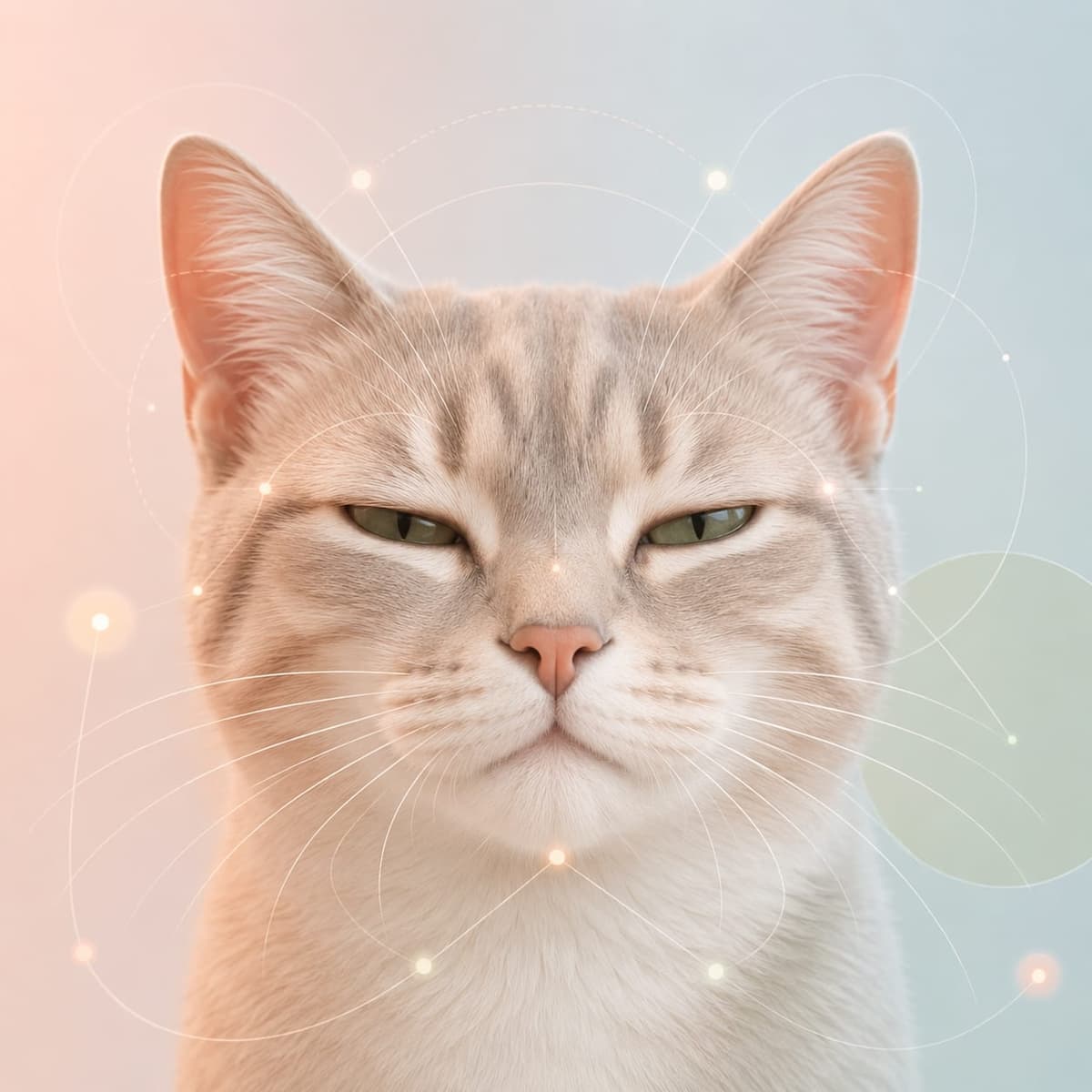
They identified as many as 276 distinct facial expressions, made up of 26 muscle movements: ear position, blinking, nose-licking, whisker and lip movements.
| Category | Share of facial expressions |
|---|---|
| Friendly | 45% (126 distinct expressions) |
| Aggressive | 37% |
| Ambiguous | 18% |
How to recognise a friendly cat?
- Ears and whiskers pointed TOWARD the other cat or person — a signal of openness and interest.
- A relaxed face — no muscle tension.
- Eye-narrowing — a signal of trust (Humphrey 2020!).
How to recognise an aggressive or frightened cat?
- Ears and whiskers turned BACK — a wish to withdraw, to defend.
- Constricted pupils — readiness for a possible attack.
- Lip-licking — a sign of strong stress and tension.
What does it mean?
Your cat isn't „expressionless." It has an extraordinarily rich repertoire of facial expressions — 276 combinations is more than the average person consciously uses day to day. The problem isn't that the cat fails to communicate its feelings. The problem is that we, humans, rarely manage to read them correctly.
An evolutionary curiosity
The authors point out that domestication enormously expanded cats' facial expressiveness. Wild cats probably have a far poorer repertoire, because they don't need to „get along" with humans day to day. Domestic cats evolved to communicate with us better.
How do these studies fit together?
Each of these studies is a great curiosity on its own. But together they paint a picture that completely changes the way we should look at cats:
The cat IS attached to you as its base (Vitale 2019)
  ↓
The cat PREFERS your company to food (Vitale Shreve 2017)
  ↓
The cat UNDERSTANDS when you speak to it (Saito 2019)
  ↓
The cat COMMUNICATES its feelings with blinks and facial expressions (Humphrey 2020; Scott & Florkiewicz 2023)
  ↓
BUT it does so in ITS OWN LANGUAGE, which you have to learn
The problem was never that cats don't love humans. The problem was that we looked for dog love in a cat's body — we expected a joyfully wagging tail, jumping up in greeting and face-licking. Cats express attachment far more subtly:
- A slow blink instead of jumping up to greet you.
- Calmly being in the same room (but on its own terms) instead of insistently demanding to be petted.
- Exposing the belly (a sign of huge trust — and not an invitation to pet it!) instead of licking your hands.
- Meowing — a vocal signal developed SOLELY to talk to humans (adult cats living in the wild barely meow at each other).
What does any of this have to do with feeding?
At first glance: not much. After all, these are studies about behaviour, not diet. But one powerful word connects them: stress.
Stress weakens attachment, and improper feeding is one of its main triggers.
A cat fed from a single bowl next to a dominant companion lives in stress, which erodes its sense of safety. A cat starved „to hold it over" loses trust in its owner. A cat fed just twice a day feels intense frustration at an empty bowl, which leads to behavioural problems.
We've written at length about this in our articles on multi-cat feeding, meal frequency and lipidosis (a very dangerous fatty degeneration of the liver caused, among other things, by starvation). Now you can clearly see WHY these rules matter not only for physical health, but also for the relationship with the owner.
A cat that feels safe at its bowl — feels safe with you too.
Summary: what we know
- About 65% of cats treat their owner as a „secure base" — an identical result to that in human infants (Vitale 2019).
- Most cats prefer spending time with humans to eating treats — this even applies to shelter cats (Vitale Shreve 2017).
- Cats know perfectly well what their name is (and know the names of their feline housemates); they simply decide for themselves when to react (Saito 2019; Takagi 2022).
- The slow blink is a scientifically confirmed cat kiss and a sign of trust worth answering in kind (Humphrey 2020).
- Cats have as many as 276 facial expressions, nearly half of them used to express friendly intentions (Scott & Florkiewicz 2023).
- Meowing is a language that evolved specifically for humans, not for conversations between cats.
Your cat doesn't merely tolerate you out of charity. Your cat isn't using you. In all likelihood it is attached to you just as strongly as a small child is to its mother. It simply uses different gestures to tell you so.
Next time your companion lies down on the sofa across from you and slowly closes its eyes — know that this isn't indifference. It's pure, feline love.
References
- Vitale, K.R., Behnke, A.C. & Udell, M.A.R. (2019). Attachment bonds between domestic cats and humans, Current Biology, 29(18), R864-R865doi:10.1016/j.cub.2019.08.036
- Vitale Shreve, K.R., Mehrkam, L.R. & Udell, M.A.R. (2017). Social interaction, food, scent or toys? A formal assessment of domestic pet and shelter cat (Felis silvestris catus) preferences, Behavioural Processes, 141(3), 322-328doi:10.1016/j.beproc.2017.03.016
- Saito, A., Shinozuka, K., Ito, Y. & Hasegawa, T. (2019). Domestic cats (Felis catus) discriminate their names from other words, Scientific Reports, 9, 5394doi:10.1038/s41598-019-40616-4
- Takagi, S., Saito, A., Arahori, M. et al. (2022). Cats learn the names of their friend cats in their daily lives, Scientific Reports, 12, 6155doi:10.1038/s41598-022-10261-5
- Humphrey, T., Proops, L., Forman, J., Spooner, R. & McComb, K. (2020). The role of cat eye narrowing movements in cat-human communication, Scientific Reports, 10, 16503doi:10.1038/s41598-020-73426-0
- Scott, L. & Florkiewicz, B.N. (2023). Feline faces: Unraveling the social function of domestic cat facial signals, Behavioural Processes, 213, 104959doi:10.1016/j.beproc.2023.104959
- Bradshaw, J.W.S. (2013). Cat Sense: The Feline Enigma Revealed, Allen Lane
Frequently asked
Does my cat really love me, or does it just want food?
Science is on the side of love. In the experiment by Vitale Shreve et al. (2017), cats — including shelter cats with no permanent home — more often chose contact with a human over food after a few hours of isolation. And Vitale et al. (2019) showed that about 65% of cats treat their owner as a „secure base”, i.e. display a secure attachment style — the same proportion as in human infants. Your cat isn't with you „for the bowl”.
How do I tell my cat „I love you” in its own language?
With a slow blink. When your cat looks at you, calmly close your eyelids for a long second (not quickly — fast blinking is a sign of agitation). In the study by Humphrey et al. (2020), cats blinked back at their owners more often, and were even more willing to approach strangers who slow-blinked at them. It's a scientifically confirmed „cat kiss”.
How do I know whether my cat is securely attached to me?
A securely attached cat uses you as a „secure base”: it happily explores its surroundings but returns to you to calm down, and after you come back it quickly relaxes and goes back to playing. It seeks contact but isn't clingy. Excessive clinging and anxiety, or completely ignoring you, are signs of an insecure (anxious) attachment.
Why doesn't my cat react when I call its name?
Because it doesn't want to — not because it doesn't understand. Saito et al. (2019) showed that cats recognise their own name and respond to it more strongly than to other words, even when a stranger says it. For a cat, reacting to its name is a choice, not an obligation. What's more, cats also know the names of the cats they live with (Takagi et al. 2022).