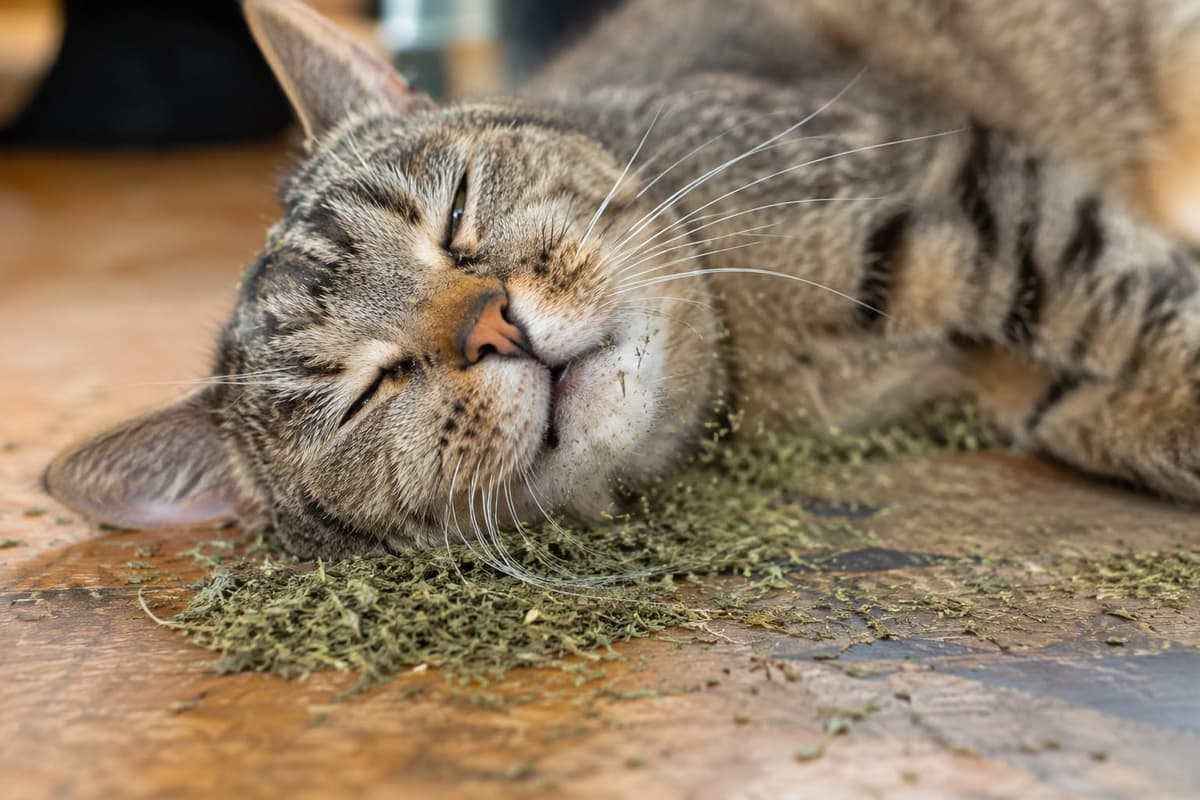
You buy a bag of dried catnip at the store. You sprinkle a pinch on the floor.
And the show begins: the cat throws itself down, rolls, rubs its muzzle and cheeks against the spot, drools, spins through a series of pirouettes. From the outside it looks like a genuine frenzy.
The internet has a ready-made story for this: "my cat is high." Videos of cats "under the influence" of catnip are one of the most popular genres of animal content out there.
Except it isn't true.
In January 2021, a team of Japanese scientists led by Reiko Uenoyama published a study in the prestigious Science Advances that explained, for the first time in history, why cats do this. And the answer is far more interesting than "kitty drug."
Your cat isn't getting high. Your cat is manufacturing and applying a mosquito repellent.
One chemical compound. Three entirely different receptor mechanisms — in the cat's brain, in the mosquito's body, and (or rather, not) in humans. One evolutionary masterstroke. Let's break it down.
1. The core discovery — it's a repellent, not a drug
Uenoyama's team started with silver vine (Actinidia polygama, also called matatabi) — a plant that affects cats much like catnip, often even more strongly. Using gas chromatography coupled with mass spectrometry (a method that pinpoints chemical composition), they isolated the compound responsible for the response: nepetalactol.
Then they checked who reacts to it:
| Animal group | Rolling response |
|---|---|
| Domestic cats (laboratory) | 100% |
| Free-roaming cats | 57% |
| Wild felids (Amur leopard, jaguar, lynx) | all responded |
| Domestic dogs | 0% |
| Laboratory mice | 0% |
The response turned out to be specific to the cat family alone. Not a single dog, not a single mouse.
The test that changed everything
The crucial experiment involved the tiger mosquito (Aedes albopictus) — an insect that is a vector (carrier) of dangerous diseases: dengue, Zika virus, and heartworm, a parasitic disease of the heart that attacks dogs and cats.
The researchers applied nepetalactol to the heads of live cats and counted the mosquitoes. The result:
Treated heads attracted about 50% fewer mosquitoes than the control group.
So a cat that has rolled in catnip is literally protected from bites. This is not a side effect. This is the entire point of the behavior.
How do we know it's pleasure, not compulsion?
Here comes the second half of the mechanism. Nepetalactol raises the level of β-endorphin in the cat's brain — a natural opioid the body produces itself, responsible among other things for feelings of bliss.
The scientists proved this link with an elegant test using naloxone — a substance that blocks opioid receptors (an antagonist). After naloxone was administered, the cats stopped rolling entirely. Cut off the reward system, and the behavior disappears.
So the full cascade looks like this:
- The cat smells the plant.
- The brain releases β-endorphin.
- Pleasure receptors (µ-opioid) activate.
- The cat rolls and rubs its face.
- The compound transfers from the plant onto its fur.
- The cat gains protection from mosquitoes.
Nature fused pleasure with a protective function into a single loop. The cat does it because it feels good — and "incidentally" coats itself in armor.
Compute your cat's diet — BARF calculatorOpen calculator2. Why do cats chew the leaves if they don't eat them?
A year later, the same team published a follow-up (Uenoyama et al. 2022, iScience), answering a puzzle every cat watcher has noticed: a carnivore chews leaves it doesn't swallow. Why?
The answer: because chewing is dosing.
Damaging a leaf — with teeth or mechanically — dramatically increases the emission of active compounds into the air:
- silver vine: emission rises 10-fold,
- catnip: emission rises more than 20-fold.
Chewing is behavioral optimization. The cat doesn't just apply repellent to its fur — it actively thickens the cloud of "deterrent" around itself. What's more, saliva and crushed tissue create what's called an iridoid cocktail (a blend of many related compounds) that acts on mosquitoes faster and more strongly than a single pure substance.
In other words: a cat chewing a catnip leaf is doing exactly what we do when we rub a mint leaf between our fingers to release its scent. Only it's doing it to defend against insects.
3. The chemistry of plant defense — iridoids
The substances in question belong to a group called iridoids — plant compounds that plants make mainly to defend against herbivores and insects. The two most important ones:
- Nepetalactone — dominant in catnip (Nepeta cataria),
- Nepetalactol — dominant in silver vine (Actinidia polygama).
Fascinatingly, these two molecules differ by a single oxygen atom. Nearly identical chemistry, the same effect. Related to them is actinidine, found among other places in valerian root — which is where valerian's "feline" reputation comes from.
What makes these compounds remarkable is two radically different receptor mechanisms packed into one molecule:
- For the cat — reward. The compound triggers an endorphin release and lights up pleasure centers (confirmed by the naloxone test).
- For the mosquito — escape. The compound activates the insect's TRPA1 receptor — the so-called irritant receptor — provoking an escape reflex. An independent team showed this (Melo et al. 2021, Current Biology): mosquitoes and fruit flies with the TRPA1 gene knocked out stop reacting to catnip.
And now the part that matters most to you: the same compound does NOT activate the human version of the TRPA1 receptor. That's why catnip is entirely safe for us and mostly odorless. Chemistry built for cats and against mosquitoes simply bypasses us.
4. Mosquitoes, DEET, and thieves of chemical weapons
If iridoids repel mosquitoes — how do they stack up against what we buy at the pharmacy?
Surprisingly well. Research (including Reichert et al. 2019) indicates that nepetalactone can be several times more effective at repelling mosquitoes than synthetic DEET when compared at equal concentrations. It works differently, too: nepetalactone repels mainly at a distance (through vapor), whereas DEET requires almost direct contact with the insect.
And here we reach the most beautiful part of this story. Cats are not the only species that steals ready-made chemical weapons from plants (and other organisms). The phenomenon has a name: self-anointing.
The classic example is capuchin monkeys. In the rainy season they catch millipedes (which secrete toxic benzoquinones) and rub them into their fur (Weldon et al. 2003). The effect? Protection from mosquitoes — exactly as in cats.
The pattern is always the same:
One organism produces a chemical weapon for its own defense → a mammal "steals" it and applies it to itself → attacking insects are blocked.
A cat rolling in catnip thus joins an elegant club of animals that learned to outsource repellent production.
5. What about cats that "feel nothing"?
If your cat ignores catnip, it isn't broken — it's simply in a genetic minority. About 30% of cats inherit non-responsiveness to catnip (Todd 1962; Villani 2011). It's an innate trait, not a matter of character or upbringing.
But no response to catnip does not mean no response to everything. In Bol et al. (2017), cats indifferent to catnip were tested with other plants:
| Plant (for cats indifferent to catnip) | Share responding |
|---|---|
| Silver vine (matatabi) | 71% |
| Tatarian honeysuckle | 32% |
| Valerian root | 19% |
The practical takeaway: if catnip does nothing, silver vine is an excellent alternative — it works on 7 out of 10 "indifferent" cats.
A few extra curiosities:
- Tigers are an anomaly. About 65% of tested tigers show no reaction to catnip at all — an exception within the cat family, where most wild species do respond.
- It's about smell, not the Jacobson's organ. Surgically removing the olfactory bulb abolishes the catnip response entirely, while damaging the vomeronasal organ does not. It's purely a matter of the sense of smell (Hart and Leedy 1985).
- Age and pregnancy dampen the response. Kittens under 6 months and pregnant females usually react much more weakly.
6. What it means in practice — your home
Offering a cat catnip or silver vine isn't just play. It's environmental enrichment — one of the simplest and cheapest forms of behavioral therapy, one that cats themselves chose over the course of evolution. A few rules to do it well:
- Match the plant to the cat. If catnip does nothing, reach for silver vine sticks or powder. That covers most "non-responsive" cats.
- Don't overdo the frequency. At most 2-3 times a week. Offering it too often dulls the intensity of the response (the cat "habituates").
- Dose sensibly. About a tablespoon of dried herb on the floor, or one stick of silver vine to chew, is plenty.
- Mind the Tatarian honeysuckle. For home use, give only the wood (sticks). The plant's leaves and berries are toxic — don't give them to your cat.
- Think of outdoor cats. For them, rolling in catnip carries an extra, literal benefit: a lower risk of bites from disease-carrying mosquitoes.
In summary: a predator, not a junkie
Next time you see your cat doing pirouettes and "going wild" over an unremarkable plant — look at it with admiration, not pity.
This is not an intoxicated animal. This is a superb predator that, over millions of years of evolution, learned to harness natural chemistry to coat its own fur in protective armor. Its behavior is a masterful linkage of three things: the reward system in its brain, the defensive compounds hidden in the plant, and the escape receptors in the body of the mosquito attacking it.
Pure chemistry, physiology, and evolution. And that is a perfect reason for this brief, feline frenzy.
References
- Uenoyama, R., Miyazaki, T., Hurst, J.L. et al. (2021). The characteristic response of domestic cats to plant iridoids allows them to gain chemical defense against mosquitoes, Science Advances, 7(4), eabd9135doi:10.1126/sciadv.abd9135
- Uenoyama, R., Miyazaki, T., Adachi, M. et al. (2022). Domestic cat damage to plant leaves containing iridoids enhances chemical repellency to pests, iScience, 25(7), 104455doi:10.1016/j.isci.2022.104455
- Melo, N., Capek, M., Arenas, O.M. et al. (2021). The irritant receptor TRPA1 mediates the mosquito repellent effect of catnip, Current Biology, 31(9), 1988-1994doi:10.1016/j.cub.2021.02.010
- Bol, S., Caspers, J., Buckingham, L. et al. (2017). Responsiveness of cats (Felidae) to silver vine, Tatarian honeysuckle, valerian and catnip, BMC Veterinary Research, 13, 70doi:10.1186/s12917-017-0987-6
- Lichman, B.R., Godden, G.T., Hamilton, J.P. et al. (2020). The evolutionary origins of the cat attractant nepetalactone in catnip, Science Advances, 6(20), eaba0721doi:10.1126/sciadv.aba0721
- Reichert, W., Ejercito, J., Guda, T. et al. (2019). Repellency assessment of Nepeta cataria essential oils and isolated nepetalactones on Aedes aegypti, Scientific Reports, 9, 1524doi:10.1038/s41598-018-36814-1
- Todd, N.B. (1962). Inheritance of the catnip response in domestic cats, Journal of Heredity, 53(2), 54-56
- Villani, N.A. (2011). Heritability and characteristics of catnip response in two domestic cat populations, UC Davis (praca dyplomowa)
- Hart, B.L. & Leedy, M.G. (1985). Analysis of the catnip reaction: Mediation by olfactory system, not vomeronasal organ, Behavioral and Neural Biology, 44(1), 38-46
- Weldon, P.J., Aldrich, J.R., Klun, J.A. et al. (2003). Benzoquinones from millipedes deter mosquitoes and elicit self-anointing in capuchin monkeys (Cebus spp.), Naturwissenschaften, 90(7), 301-304doi:10.1007/s00114-003-0427-2
- McElvain, S.M., Bright, R.D. & Johnson, P.R. (1941). The constituents of the volatile oil of catnip. I. Nepetalic acid, nepetalactone and related compounds, Journal of the American Chemical Society, 63(6), 1558-1563
Frequently asked
Does catnip drug a cat like a narcotic?
No. It is not a psychoactive substance in any addictive or harmful sense. Catnip triggers a short (usually 5-15 minute) release of β-endorphin — a natural opioid the cat's own brain produces — and activates pleasure centers. After that, the cat becomes immune to a fresh dose for a few hours. There is no risk of overdose, addiction, or a 'hangover.' It's safe environmental enrichment, not a drug.
My cat doesn't react to catnip at all. Is something wrong?
No, it's completely normal and written in the genes. About 30% of cats inherit non-responsiveness to catnip (Todd 1962). On top of that, kittens under 6 months often don't react yet. If your cat is indifferent, reach for silver vine (matatabi) — in Bol et al. (2017) it elicited a response in 71% of cats unresponsive to catnip. Tatarian honeysuckle wood and valerian root are further alternatives.
Why does a cat chew catnip leaves if it doesn't eat them?
Because chewing is dosing. Damaging a leaf releases far more active compound into the air — for catnip, emission rises more than 20-fold; for silver vine, 10-fold (Uenoyama et al. 2022). Saliva and mechanical crushing also create a richer 'cocktail' of compounds that repels mosquitoes faster and more strongly than a single molecule. The cat is unwittingly optimizing its chemical armor.
Does catnip really protect a cat from mosquitoes?
Yes, and measurably so. In Uenoyama et al. (2021), cat heads treated with nepetalactol attracted roughly 50% fewer tiger mosquitoes than controls. The active compound is among the strongest known plant repellents — sometimes compared to synthetic DEET. For an outdoor cat exposed to mosquitoes that carry diseases such as heartworm (a dangerous parasitic heart condition), rolling in catnip is a real, evolutionarily chosen form of protection.