
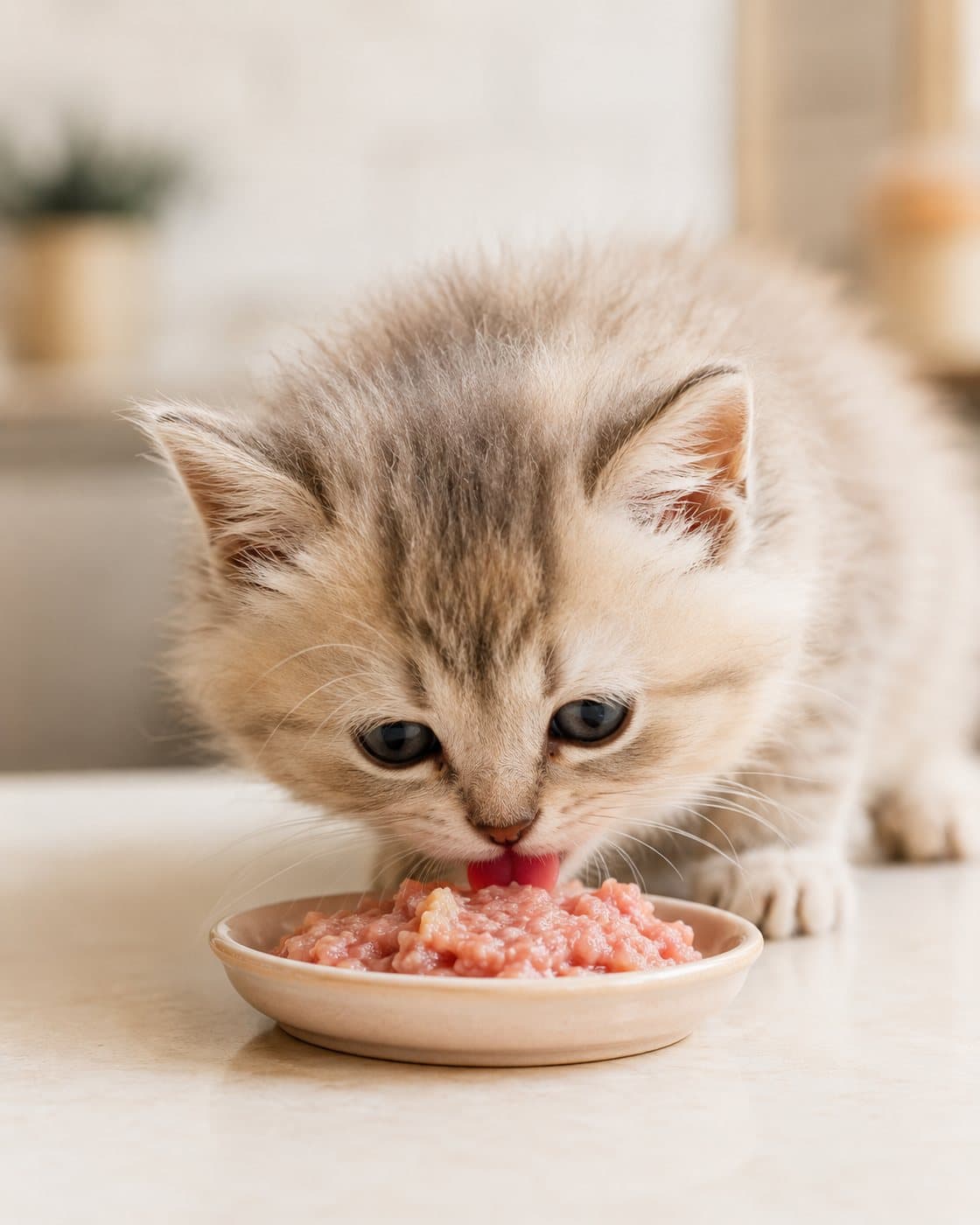
The decision to feed kittens raw food is one of the best investments in their future health. Kittens that get to know natural, unprocessed food from the start grow into strong, resilient cats with glossy coats and healthy teeth.
But how do you do it properly? When do you start? How much do you give? This guide will walk you through every stage — from the first spoonfuls of raw meat to the full-fledged BARF diet of an adult cat.
When to start raw feeding for kittens?
The answer may surprise you: far earlier than you think. Kittens can begin exploring raw food as early as around 4-5 weeks of age, i.e. at the moment of natural weaning from the mother. At this age they begin to take an interest in what mom is eating, and they instinctively try to snatch food from her bowl.
This is a huge advantage if the mother cat is herself on a raw diet. Kittens learn by observation — they watch the mother eat raw meat, sniff it, lick it, and eventually start trying it themselves. This natural process of imitation means that kittens raised on raw feeding from the start have a far easier transition than adult cats that have eaten commercial food their whole lives.
If you adopt a kitten at 8-12 weeks that previously ate wet or dry food, don't worry — young cats are generally far more open to new flavors and textures than adults. The younger the cat, the more easily it accepts raw food. The key, though, is patience and gradualness.
Never introduce a raw diet overnight. Even in kittens the transition process should take at least 7-10 days, slowly replacing the current food with the new one.
— The golden rule of the raw diet
The first portions — what to serve?
A kitten's first encounter with raw meat is a moment that calls for proper preparation. You don't toss the little one a chunk of raw thigh and wait to see what happens. Instead, you start with very finely ground or scraped meat that has a consistency close to pâté.
The best choice to start with is chicken thigh — meat that's mild in flavor, easy to digest, and economical. Grind it through a mincer with the finest plate, or scrape it thoroughly with a knife until you get a silky, pâté-like consistency. At first the meat should be so fine that the kitten doesn't have to chew it — it simply licks it up.
To the first portions it's worth adding a small amount of heart (chicken or turkey) — the most natural, richest source of taurine, an amino acid absolutely crucial for cats. Heart should make up about 10-15% of the initial portion. Grind it finely too and mix it with the muscle meat.
What to avoid at the start
- Bone — even ground, at the very beginning it can be too much of a challenge for the delicate digestive system. Introduce it only 2-3 weeks after starting raw feeding.
- Internal organs (liver, kidneys) — they're very rich and can cause diarrhea. Add them gradually, after a few weeks, starting with minimal amounts.
- Fish — introduce it only once the kitten stably tolerates the basic meats. Fish has a strong flavor that can be off-putting, but it can also cause indigestion in kittens.
- Too many ingredients at once — start with one type of meat. Once the kitten accepts it and digests it well (2-3 days), add heart. Introduce subsequent ingredients one at a time, every few days.
Proportions and portion size
Here lies the fundamental difference between feeding kittens and adult cats. Kittens eat proportionally far more relative to their body weight — and this is completely normal. They grow at an express pace, doubling their body weight every few weeks, and they need enormous amounts of energy and building blocks for that.
8-10%
That's how much a kitten eats at the peak of growth — twice as much as an adult cat proportionally. Spread across 5-6 small meals, because the little one's stomach can't hold a large portion.
Approximate daily amounts by age:
| Age | Daily portion | Number of meals |
|---|---|---|
| 4-8 weeks | 8-10% of body weight | 5-6 |
| 8-16 weeks | 6-8% of body weight | 4-5 |
| 4-6 months | 5-6% of body weight | 3-4 |
| 6-12 months | 3-5% of body weight | 2-3 |
| Adult cat (12+ months) | 2-4% of body weight | 2 |
These values are a starting point — observe your kitten. If it leaves food behind, the portions are too big. If it devours everything in seconds and is clearly looking for more, increase the amount. Kittens in the phase of intensive growth (3-6 months) can eat a surprising amount. Don't artificially restrict them — a growing body knows what it needs.
Short intervals between meals in young kittens
Kittens should have access to food more often than adult cats. Their tiny stomachs can't hold a large portion at once, and long intervals between meals can lead to hypoglycemia (a drop in blood sugar), which in very young kittens can be dangerous.
When to introduce bone?
Bone is an essential element of the BARF diet — it supplies calcium, phosphorus, and other minerals crucial for building a strong skeleton. But with kittens you have to approach it with particular care.
From 8-10 weeks of age you can start adding finely ground bone to the meat — ideally chicken necks run through a meat grinder with a fine plate. Ground bone should make up about 5% of the portion at first, and over time you can increase it to 7-10%. Watch the kitten's stool: if it becomes whitish and dry, you're giving too much bone; if it's too loose, add a little more.
From around week 12 most kittens are ready for their first attempts with small, soft whole bones. The ideal choice is:
- Quail necks — by far the best start. Tiny, delicate, soft as cartilage. Even a 12-week-old kitten will handle them with no trouble.
- Quail wings — similarly small and safe, slightly more demanding than necks.
- Chicken necks cut into rings — from weeks 14-16. A neck cut into 3-4 pieces is an excellent chewing exercise for a slightly older kitten.
Always supervise the kitten while it eats bone. Young cats are only just learning proper chewing technique. Some try to swallow pieces whole — that's dangerous. If you see the kitten not chewing but trying to gulp, go back to ground bone for a while and try again in a week or two.
Supplementation for kittens
Kittens have different nutritional requirements than adult cats — and this is a fundamental issue that many beginner owners forget. A growing body needs proportionally more calcium (building the skeleton), more taurine (development of the heart and vision), more calories (energy for growth), and more protein (the building material for muscle and tissue).
Key supplements for kittens
- Calcium — this is the absolute priority. Kittens need more calcium than adult cats because they're building their entire skeleton from scratch. If you aren't giving enough bone, you have to supplement calcium (e.g. ground eggshells or calcium citrate). Calcium deficiency in kittens leads to serious bone and joint deformities that can be irreversible.
- Taurine — an amino acid that cats can't synthesize on their own. Kittens need a lot of it — an appropriately large amount of heart in the diet (15-20% of the total) usually provides enough. When in doubt, supplement — taurine has no toxic upper dose.
- Vitamin D — essential for proper calcium absorption. Cats (unlike humans) don't produce vitamin D from sunlight, so they must obtain it from food. Cod liver, salmon, and egg yolks are good sources.
- Omega-3 fatty acids — support the development of the brain and nervous system. Salmon or sardine oil is a proven way to supply them. Dose carefully — too much fat can cause diarrhea.
- B-group vitamins — crucial for energy metabolism. Liver is their best natural source, but with kittens introduce it very slowly (see the section on problems).
Common problems
Transitioning kittens to raw feeding rarely goes perfectly smoothly. Here are the most common problems and how to handle them:
Diarrhea
The most common cause is introducing new ingredients too quickly, especially internal organs. Liver and kidneys are extremely rich in vitamins and minerals — introducing them suddenly in large amounts can overload a kitten's delicate digestive system. The solution: step back, return to muscle meat alone for 2-3 days, then introduce the new ingredient in a minimal amount (literally half a teaspoon).
Constipation
Hard, white, or very pale stool is a sign that there's too much bone in the diet. Cut the amount of bone in half and increase the share of muscle meat. Also add a bit more organ meat (especially liver, which has a naturally laxative effect). If the constipation lasts more than 2 days, contact a vet.
Refusal to eat
Some kittens — especially those accustomed to commercial food — initially refuse raw meat. It's frustrating, but patience is key. Try gently warming the meat (to room temperature, don't cook it!), sprinkle on a bit of freeze-dried treats, or mix it with a small amount of the current food. Most kittens give in eventually — natural instinct is stronger than habit.
The kitten won't chew bone
This is completely normal at first. Kittens learn to chew gradually — just as human children learn to eat solid food. If the mother cat is on a raw diet, the little one learns by observation. If not — you have to be the patient teacher. Start with ground bone, then move to very small bones (quail), and give the kitten time. Some kittens master chewing in a few days, others need weeks.
Feeding schedule — an age-by-age guide
The schedule below is an approximate plan to help you guide a kitten through the successive stages of raw feeding. Remember that every kitten develops at its own pace — treat these guidelines as a reference point, not a rigid rulebook.
4-8 weeks — exploring raw food
Kittens are still drinking the mother's milk but starting to take an interest in solid food. Serve very finely ground muscle meat (chicken thigh) with a pâté-like consistency. Offer it 5-6 times a day, in small amounts. Add ground heart (10% of the portion). No bone, no organs, no supplements — the mother's milk fills in whatever is missing. Toward the end of this period, gradually introduce finely ground bone (5% of the portion).
8-16 weeks — building the diet
This is a key period in which the kitten transitions from the mother's milk to a full raw diet. Increase the texture of the meat (more coarsely ground, then finely diced). Keep 4-5 meals a day. Introduce ground bone permanently (7-10% of the portion). Start adding minimal amounts of liver (1-2% of the portion, increasing to 5% over a few weeks). Introduce a second meat (e.g. turkey or beef). Toward the end of this period — the first attempts with whole quail bones.
4-6 months — intensive growth
The kitten grows the fastest and eats proportionally the most. The diet should already be fully balanced: muscle meat (65-70%), heart (15%), bone (10%), organs (5% liver + 5% other). Reduce to 3-4 meals a day. Introduce supplements: fish oil (omega-3), and possibly vitamin E. Offer a variety of meats (chicken, turkey, rabbit, beef). Provide regular portions of meaty bones for chewing — chicken necks, wings.
6-12 months — maturing
The growth rate slows, the appetite stabilizes. Reduce portions to 3-5% of body weight. Move to 2-3 meals a day. Continue the full supplementation profile. This is a good moment to introduce fish (once a week). Monitor condition — the kitten should be lean but not skinny, with ribs palpable under a thin layer of fat. After turning 12 months, switch to the nutritional requirements for an adult cat.
Summary
Kittens raised on a raw diet from weaning are an investment that pays off throughout their lives. Research and breeders' experience consistently show that cats fed natural, unprocessed food from a young age enjoy better condition, healthier teeth, a stronger immune system, and a more beautiful coat than their peers on commercial foods.
Yes, it takes more effort than opening a can. You have to grind meat, calculate proportions, keep an eye on supplementation, and patiently introduce new ingredients. But when you look at your adult cat — full of energy, with a shining coat and perfect teeth — you know that every minute spent preparing its meals was worth it.
Start slowly. Be patient. Observe your kitten. And remember — nature equips cats with instincts that mesh perfectly with raw feeding. Your role is just to gently guide the little one in the right direction. Biology itself does the rest. If you need to precisely calculate amounts for a growing kitten, the mrumi calculator has a separate profile for kittens with higher calcium and taurine requirements.
Sources
- National Research Council (2006). Nutrient Requirements of Dogs and Cats. National Academies Press, Washington DC.
- FEDIAF (2024). Nutritional Guidelines for Complete and Complementary Pet Food for Cats and Dogs. European Pet Food Industry Federation.
- AAFCO (2024). Official Publication: Cat Food Nutrient Profiles for Growth and Reproduction. Association of American Feed Control Officials.
- Verbrugghe A., Hesta M. (2017). Cats and Carbohydrates: The Carnivore Fantasy? Veterinary Sciences, 4(4), 55. PMID: 29056696. PMC: 5753635.
- Plantinga E.A., Bosch G., Hendriks W.H. (2011). Estimation of the dietary nutrient profile of free-roaming feral cats: possible implications for nutrition of domestic cats. British Journal of Nutrition, 106, S35-S48.
Frequently asked
From what age can I start feeding a kitten BARF?
As early as 4-5 weeks of age, i.e. at the moment of natural weaning from the mother. The first portions are finely ground meat with a pâté-like consistency — at first the kitten simply licks it up, it doesn't chew. The earlier it begins exploring raw food, the easier the later transition will be.
How much should a kitten eat?
It depends on age: 4-8 weeks — 8-10% of body weight per day across 5-6 meals; 8-16 weeks — 6-8% across 4-5 meals; 4-6 months — 5-6% across 3-4 meals; 6-12 months — 3-5% across 2-3 meals. Kittens eat proportionally far more than adult cats — that's normal.
Do kittens need different supplementation than adult cats?
Yes. Kittens need proportionally more calcium (building the skeleton from scratch), more taurine (development of the heart and vision), more calories, and more protein. Calcium deficiency can lead to irreversible bone deformities. Keep the Ca:P ratio in the upper range (1.2-1.4:1).
What do I do when a kitten refuses raw meat?
Patience. Try gently warming the meat to room temperature (don't cook it), sprinkle on freeze-dried treats, or mix it with a little of the current food. Most kittens give in eventually — natural instinct is stronger than habit. The younger the cat, the more easily it accepts new flavors.
Is the mother's milk enough in the first weeks?
Yes — the queen's milk supplies everything a kitten needs up to week 8. Introducing raw food around weeks 4-5 is an exploratory addition, not a replacement. A full BARF diet only makes sense once the kitten is stably weaned (8+ weeks).