The kittens are three weeks old, and the queen starts stretching, calling and slipping away from the nest. The first thought is often that something is wrong with her. The second is that it's impossible — she's nursing, after all.
It is possible, though, and not even that rare. It's just that for years nobody counted it — the phenomenon lived on as breeders' observations, repeated on forums and in conversations, but absent from the numbers.
Why it's surprising at all
In most mammals, lactation suppresses fertility. As a rule it's an energy-saving mechanism: a female that is nursing generally doesn't start another pregnancy at the same time, because her body might not cope with both at once. Studies from the 1980s indicated that queens work the same way — nursing may inhibit the development of ovarian follicles and the secretion of ovarian and pituitary hormones (Schmidt et al. 1983, cited in Furthner 2023).
The return to oestrus after giving birth has been described anywhere from one to twenty-eight weeks, with an average of about eight weeks. That's roughly two to three weeks after weaning — exactly what logic suggests: the kittens stop suckling, the brake is released, the queen returns to her cycle.
It's worth recalling how a queen's cycle works in the first place, because it explains the rest. Cats are seasonally polyoestrous — during the season they go through one cycle after another, and outside it they usually don't come into heat. The season is set by day length, which is why cats are long-day breeders: they start cycling as the days get longer. Fourteen hours of continuous artificial light can keep a queen cycling all year. And the third thing, key for a breeder: cats are induced ovulators, which means they essentially ovulate in response to mating, usually repeated mating (Johnson 2022).
The first study to count it
LOOF, the official French feline pedigree registry, sent a questionnaire to 14,768 registered breeders asking about their last three litters. The link was opened by 937 people, and 108 breeders responded, providing data on 238 litters from 23 breeds. After removing incomplete answers and separating out successive litters from the same queens (analysed separately), 195 independent births went into the main analysis (Furthner 2023).
49%
What the timing shows is even more interesting. Queens with lactational oestrus came into heat on average 40 days after giving birth, with a range of 2 to 86 days. Queens without it returned to oestrus only after 122 days on average. That's not a shift of a few days — these are two completely different situations.
Worth noting
Four queens came into heat in the first week. Twelve did so within two weeks of giving birth, and twenty within three. That's when the kittens either haven't opened their eyes yet or have only just opened them, and are entirely dependent on their mother's milk.
What it meant for the kittens
In 37 of 96 cases — 38% — breeders linked the oestrus to something that was happening in the litter.
Most often — in twenty cases — it was a loss of interest in the litter. In thirteen, less milk. In three, clotted milk (milk with a changed, lumpy consistency resembling spoiled milk), and in two a change in milk quality.
On the kittens' side: diarrhoea in nine litters, weight loss in six, vomiting in four, nausea in two — and kitten deaths in four. In two litters the kittens had to be switched to bottle feeding, and in four weaned earlier than planned. In one, the breeder felt that socialisation had suffered because the mother stopped staying with the kittens early.
One of the descriptions in the survey is worth quoting, because it says more than a table: a breeder wrote that they did not realise in time that the change in the mother's behaviour could harm the kittens — and that delay ended in the kittens' deaths.
What these numbers can't tell us
This is a survey, and it has to be read as one. 11.5% of the people who opened the link responded. The sample was a convenience sample, not a random one — and the paper itself states plainly that the 49% figure may be an overestimate, because breeders who had never seen lactational oestrus had less reason to fill in a questionnaire about it.
The links to symptoms in kittens were perceived by breeders, not measured. Diarrhoea in the litter and oestrus in the mother may simply have occurred at the same time by chance. Furthner makes this point separately: the consequences described may be coincidences rather than effects.
Some breeders also counted oestrus differently — some considered oestrus around weaning time as lactational, others didn't. And breeders differ in how well they recognise oestrus.
So what stands firm? That the phenomenon exists, is common and has been described in numbers for the first time. How common exactly, and whether it really harms kittens — that needs a study in which someone measures rather than asks.
When the risk goes up
Two factors came out as significant.
A small litter. Of 32 litters of one or two kittens, lactational oestrus occurred in 23 — seven in ten. In litters of three or more kittens it occurred in 74 of 162, just under half. The difference is statistically significant.
Giving birth between February and April. That's the start of the breeding season in France, when the days are clearly getting longer. Here's something easy to miss: a queen that gives birth in March was mated two months earlier — that is, out of season. Furthner doesn't advise against out-of-season matings — the paper only notes that breeders should be aware they may be linked to an earlier return of oestrus during nursing.
And what made no difference? Neither the queen's age nor her breed. Seven breeds represented by at least ten queens were checked — Bengal, British Shorthair, Maine Coon, Norwegian Forest Cat, Ragdoll, Birman and Siberian — and there were no significant differences.
There is, however, an individual tendency. Among twenty queens with data from several successive litters, seven never came into lactational oestrus. Seven others came into heat during every lactation, despite normal-sized litters and regardless of the season. And all four that had a small litter during that time came into lactational oestrus.
Where it comes from — a hypothesis, not an answer
The simplest explanation that suggests itself with small litters goes like this: fewer kittens means less suckling, and less suckling means a weaker brake.
It sounds reasonable and has support in another species. In pigs this has been studied closely, because the farming calendar depends on when sows return to oestrus. When piglets were kept away from the sow for ten hours a day, 51 to 64% of sows returned to oestrus while still lactating (Soede et al. 2012, cited in Furthner 2023).
But this hasn't been tested in cats. It's a hypothesis that Furthner points to as a direction for future research — not a confirmed mechanism.
What to do in practice
The recommendations from this paper are surprisingly simple, and none of them requires specialist equipment — an ordinary kitchen scale is enough.
First: notice it. If a queen starts behaving as if in heat three weeks after giving birth, it isn't a whim or a quirk — it's a signal to take a closer look at the litter.
Second: check the milk. Breeders in this study described clotted or clearly changed milk in five litters.
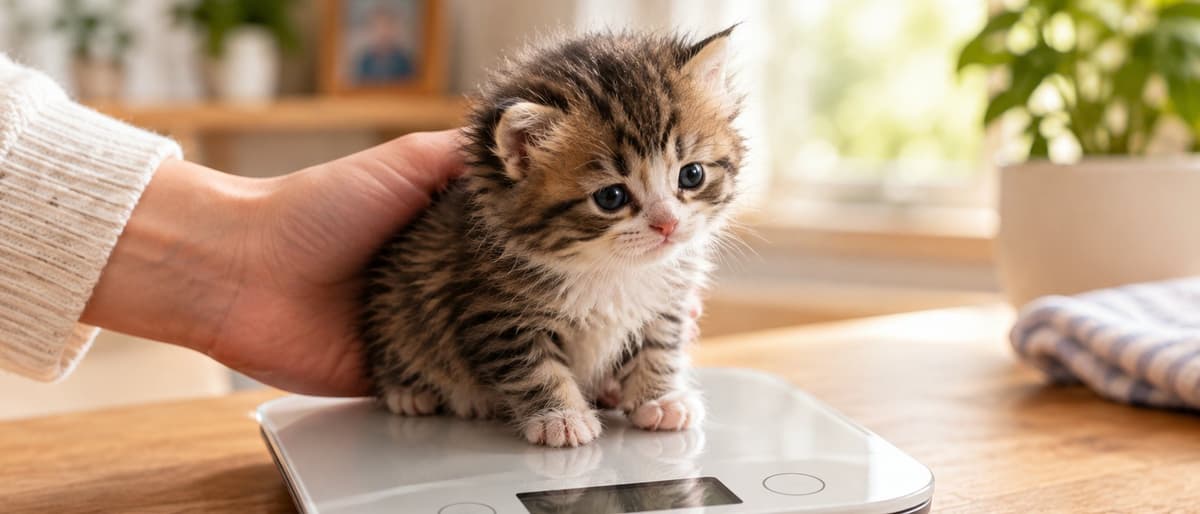
Third, and most important: weigh the kittens. Daily weight gain helps spot at-risk litters and is considered a good indicator of a drop in milk quantity or quality — it's a number, not an impression. It's a tool that costs a minute a day.
If the problem is caught early, supplementing with a kitten milk replacer can be considered, and with a sufficiently older litter, earlier weaning. With clotted milk, or with diarrhoea and vomiting in the kittens, it stops being a breeding issue and becomes a veterinary one: that's the moment for the clinic, not for home experiments.
And prevention?
Here we're entering territory where the decision belongs to the vet, so I'll only give what the data show.
Furthner suggests that contraception can be considered for queens that come into lactational oestrus systematically, have small litters or give birth from February to April. An earlier study by the same team collected field data from French breeders — 140 purebred cats from 38 catteries, including 83 queens (Furthner et al. 2020). It did not involve nursing queens.
Melatonin implant, 18 mg: in 33 of 42 queens it suppressed oestrus for 86 days on average, with a huge range of 21 to 277 days and a peak return to oestrus in March. Twelve of these queens later had a litter. Breeders reported no side effects. Melatonin works in line with physiology here — it is the internal short-day signal that switches off cycling in cats (Kutzler 2015).
Deslorelin implant, 4.7 mg (not discussed as an option for nursing queens in the lactational oestrus paper): in 26 of 41 queens it suppressed oestrus for 16 months on average, ranging from 8 to 38. But side effects were recorded here: in two queens oestrus persisted and the implant had to be removed, two started lactating, one developed fibroadenomatosis, and one was spayed because of cystic endometrial hyperplasia.
What we don't know
Nobody has described the effect of melatonin given to a nursing queen on her milk or her kittens. Furthner calls this direction promising and lists the arguments in favour — melatonin naturally passes into milk (these are human data), in ewes the implant improved milk quality, and very high doses given to pregnant ewes and rodents caused no toxicity — but cautions that its safety during lactation needs to be studied.
In other words: it's a direction, not a ready-made procedure. The conversation about it belongs with a vet who knows the individual queen.
Three numbers worth remembering
40 versus 122. That's how many days after birth, on average, oestrus returned in queens with lactational oestrus and in the rest. Not a subtle difference, but two different scenarios.
One or two. With a litter that size, the risk of oestrus during nursing rises most clearly — and that's exactly the litter that's easiest to overlook, because a small litter is seen as an easy one.
Every day. That's how often it's worth weighing kittens in the first weeks. It's the only tool on this list that works regardless of whether oestrus occurs at all.
References
- Furthner, E. (2023). Prevalence of lactational oestrus in cats and consequences for kittens, Journal of Feline Medicine and Surgery, 25(1), 1098612X221141817doi:10.1177/1098612X221141817
- Johnson, A.K. (2022). Normal feline reproduction: The queen, Journal of Feline Medicine and Surgery, 24(3), 204–211doi:10.1177/1098612X221079706
- Furthner, E., Roos, J., Niewiadomska, Z., Maenhoudt, C. & Fontbonne, A. (2020). Contraceptive implants used by cat breeders in France: a study of 140 purebred cats, Journal of Feline Medicine and Surgery, 22(10), 984–992doi:10.1177/1098612X19901023
- Kutzler, M.A. (2015). Alternative methods for feline fertility control: Use of melatonin to suppress reproduction, Journal of Feline Medicine and Surgery, 17(9), 753–757doi:10.1177/1098612X15594988
- Schmidt, P.M., Chakraborty, P.K. & Wildt, D.E. (1983). Ovarian activity, circulating hormones and sexual behavior in the cat. II. Relationships during pregnancy, parturition, lactation and the postpartum estrus, Biology of Reproduction, 28(3), 657–671doi:10.1095/biolreprod28.3.657
- Soede, N.M., Laurenssen, B., Abrahamse-Berkeveld, M. et al. (2012). Timing of lactational oestrus in intermittent suckling regimes: consequences for sow fertility, Animal Reproduction Science, 130, 74–81doi:10.1016/j.anireprosci.2011.12.015
Frequently asked
Can a queen come into heat while nursing kittens?
Yes, and it is not rare. In the first study to count it (Furthner 2023), 96 of 195 queens — 49% — came into oestrus while nursing. These queens came into heat on average 40 days after giving birth, with a range of 2 to 86 days. The study was a survey and the paper itself cautions that the percentage may be overestimated, but the phenomenon itself is well documented.
Does oestrus during lactation harm the kittens?
It can. In 37 of 96 cases (38%), breeders linked the oestrus to problems in the litter — most often loss of maternal interest and less milk, and in the kittens diarrhoea, weight loss and vomiting. In four litters, breeders linked it to kitten deaths. Bear in mind, though, that these are associations noticed by breeders, not measured ones — some may have been coincidences in timing.
Which queens are most at risk of lactational oestrus?
Those with small litters and those giving birth between February and April. With litters of one or two kittens, lactational oestrus occurred in 23 of 32 cases — seven in ten — and with larger litters in just under half. There is also an individual tendency: some queens came into heat during every lactation, regardless of litter size or season. The queen's age and breed made no difference.
What should I do when a nursing queen comes into heat?
Look closely at the litter, check the milk and weigh the kittens every day. Daily weight gain helps spot an at-risk litter. If the problem is caught early, supplementing with kitten milk replacer can be considered, and with an older litter, earlier weaning. Clotted milk, or diarrhoea and vomiting in the kittens, mean a trip to the vet.
Can lactational oestrus be prevented?
Furthner (2023) suggests that for queens that come into heat during lactation systematically, have small litters or give birth from February to April, contraception such as a melatonin implant can be considered. However, nobody has described the effect of melatonin given to a nursing queen on her milk or kittens, so this is a direction, not a ready-made procedure. The decision belongs to a vet who knows the individual queen.