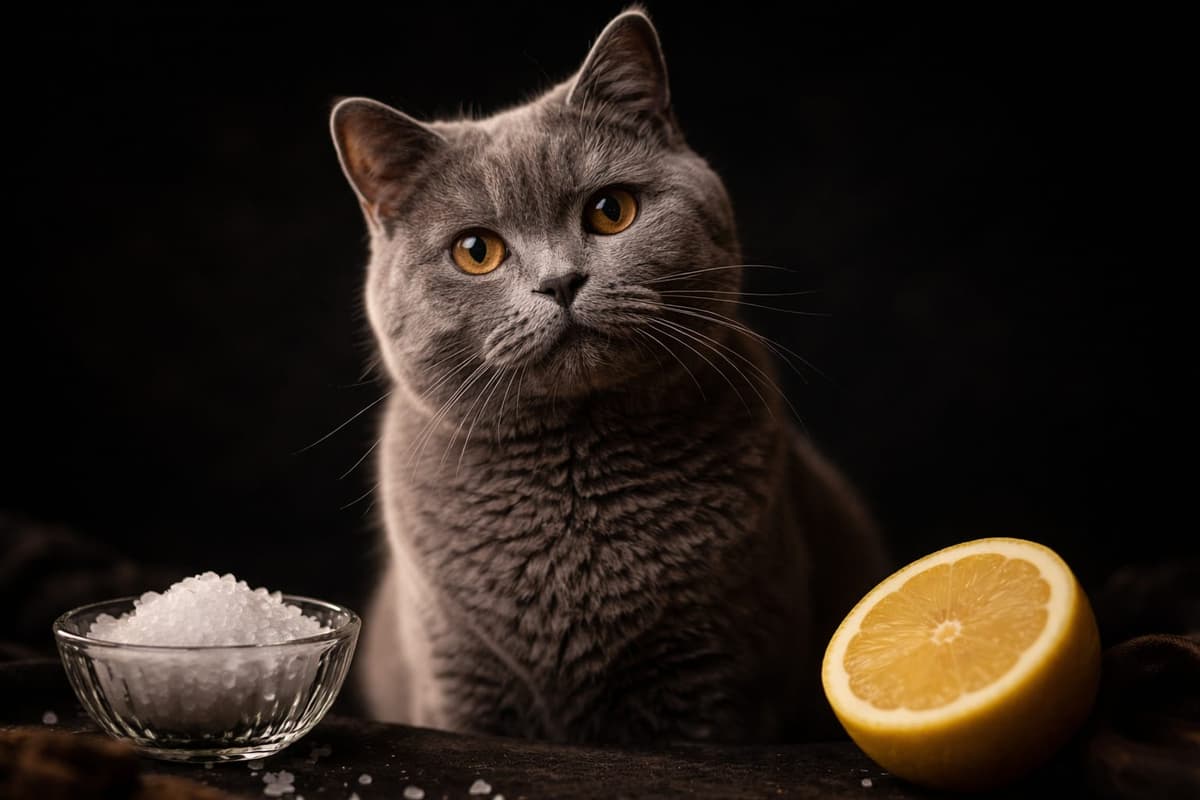
Much is said about the fact that cats can't taste sweetness. Umami — the feline taste of meat — has had its own dedicated articles. Bitterness as an alarm system against spoiled food has been covered too. But there are two more tastes that almost nobody writes about: salty and sour.
And it turns out the story of these two tastes in cats is fascinating — because it overturns several intuitive assumptions and shows just how radically differently the feline brain processes taste information compared with ours.
How many tastes does your cat sense?
Let's start with the full picture. Humans have five basic tastes: sweet, umami, bitter, salty, sour. Cats — in theory four, because sweet is switched off. But in practice their taste hierarchy looks completely different from ours:
| Taste | Status in the cat | Main function |
|---|---|---|
| Sweet | Switched off (Tas1r2 pseudogene) | — |
| Umami | Primary appetitive taste | "This is fresh meat — eat it" |
| Bitter | Alarm system | "This meat is spoiled / toxic — spit it out" |
| Salty | Present, but no preference | "?" |
| Sour | Present, responds to acids | "?" |
The question marks next to salty and sour aren't accidental. For decades scientists knew that cats respond to these stimuli — but they didn't fully understand why an obligate carnivore would need these two tastes. The latest research is beginning to put the puzzle together.
Salty taste: the cat senses salt, but doesn't want it
The discovery that surprised the researchers
In 1997, Yu, Rogers and Morris from the University of California, Davis ran an experiment whose result surprised even them. They tested whether kittens — both with normal sodium levels and with an induced deficiency — would show a preference for food with added salt.
The methodology was simple: a two-bowl test. Two identical diets, differing only in sodium content. The kittens could choose freely.
Concentrations tested:
- 0.1 g Na/kg — deficient diet (control)
- 2 g Na/kg — adequate diet
- 10 g Na/kg — high-sodium diet
The result? Zero preference. Neither the kittens with normal sodium nor the kittens with a confirmed deficiency (verified through blood aldosterone testing) chose the diet with adequate sodium over the deficient one. They didn't distinguish between them — or they did, but it made no difference to them.
What's more, both groups actively rejected the high-sodium diet (10 g/kg). It wasn't that they couldn't sense the difference — high sodium was clearly aversive. But a "normal" sodium level had no influence whatsoever on their choice.
We conclude that kittens do not possess an innate sodium appetite and that a sodium appetite is not induced in sodium-depleted kittens.
— Yu, Rogers and Morris, 1997 — Appetite
Why is this surprising?
Because in almost ALL other mammals studied, a sodium deficit triggers a strong, instinctive appetite for salt. Rodents, ruminants, primates — all of them actively seek out and choose sources of sodium when their bodies need it. It's one of the strongest dietary instincts in the animal kingdom.
Cats? Nothing. In them, a sodium deficit simply does not trigger a salt appetite.
0
No mechanism for seeking out salt under deficiency conditions has been documented in cats. Yu and colleagues note that a sodium appetite has not been demonstrated in carnivores generally — so this is not a quirk of the cat alone.
The evolutionary explanation
The answer lies in the diet. Raw meat — the cat's natural diet — contains sodium in amounts that fully cover its requirements. Blood, tissue fluids, muscle — all of it is naturally "salty" from a sodium-balance standpoint. A cat living on mice and birds has never in its evolutionary history experienced a sodium deficiency.
That's why evolution never needed to develop a "seek out salt" mechanism. There was no selective pressure for it. Unlike herbivores, which eat low-sodium plants and must actively top up their sodium — the cat gets it automatically from meat.
What does this mean in practice?
Salt is not a flavor enhancer in cats. This is a fundamental difference from humans and dogs. Adding salt to a cat's food won't make it eat more eagerly. It may even trigger rejection.
At the same time — and this matters — cats tolerate a wide range of dietary sodium without health consequences. A review by Nguyen and colleagues (2017), prepared for the scientific FEDIAF committee, showed:
- No evidence of harm from sodium up to 740 mg/MJ of metabolizable energy — many times more than the minimum requirements (NRC: 40 mg/MJ, FEDIAF: 45 mg/MJ).
- No study has shown a link between increased dietary sodium and a rise in blood pressure in cats — regardless of whether the cats were healthy, older, or had impaired kidney function.
- In commercial foods, sodium ranges from 110 mg/MJ (renal diets) to 820 mg/MJ (urolithiasis diets — high sodium stimulates drinking and dilutes the urine).
Cats don't need salt for flavor, but metabolically they handle it well. It's another example of how evolution "switched off" a behavioral mechanism (the salt appetite) without switching off the metabolic mechanism (sodium processing).
Compute your cat's diet — BARF calculatorOpen calculatorSour taste: a pH meter inside the cat's mouth
The neurons that connect two worlds
This is where the story gets really interesting. Because it turns out that in the feline brain, salty taste and sour taste are probably exactly the same sensory experience (the same sensory modality).
In the 1970s, John Boudreau from the University of Houston conducted a series of groundbreaking electrophysiological experiments. Put more simply: he hooked up microelectrodes and recorded the activity of individual neurons directly from the facial nerve — to literally "eavesdrop" on what the cat's tongue was telling its brain.
Boudreau identified three groups of taste neurons:
| Group | What it responds to | Human-taste equivalent |
|---|---|---|
| Group I | Acids (citric, malic, HCl) + NaCl | Sour + Salty together |
| Group II | Amino acids + nucleotides | Umami |
| Group III | Bitter compounds (alkaloidal) | Bitter |
Note Group I: the same neurons respond to both acids and salt. In humans, salty and sour are two separate channels with separate receptors, separate neurons, and separate processing in the cerebral cortex.
In the cat? One channel. "Ionic/acidic" — as an integrated signal.
It's as if the feline brain had a single sensor labeled "ionic environment in the mouth" instead of two separate sensors for "salt" and "acid." From an obligate carnivore's perspective, that's logical. Meat has a relatively constant sodium level but a variable pH depending on freshness. A single integrated ionic sensor is enough to assess both parameters.
Citric, malic, hydrochloric — the cat senses every acid
The Group I neurons in cats responded to a wide range of acids:
- Citric acid — present in some tissues and fruits
- Malic acid — present in muscle tissue
- HCl (hydrochloric acid) — a representative strong mineral acid
- Other organic and inorganic acids
Interestingly, the same neurons also responded to compounds with a specific chemical structure (with a so-called imidazole ring) — and one of the most important such compounds is histidine. The same amino acid that McGrane (2023) identified as the main activator of the feline umami receptor and the reason for the cat's obsession with tuna.
This suggests that the cat's taste system is deeply integrated — the boundaries between tastes are more fluid than in humans. Acidity, saltiness, and the presence of certain amino acids are, for the cat, aspects of one complex signal: "what is this and is it safe."
Water has a flavor
One of the most surprising discoveries in the history of feline taste research dates from 1971. Bartoshuk and colleagues published a paper in Science that turned the assumption that water is tasteless upside down.
It turns out that pure water activates a cat's taste neurons. Deionized water generates an electrophysiological response — probably because Group I receptors (sour/salty) respond to the low ion concentration in water as a change in the ionic environment on the tongue.
The experimental evidence: when small amounts of NaCl were added to the water, the "water flavor" was blocked. And when the water flavor was blocked — the cats began drinking sucrose solutions more readily. This suggests that the water flavor was masking other tastes.
The practical consequences of this discovery explain several "strange" feline behaviors:
- Why your cat drinks from a fountain more eagerly than from a bowl — the movement of the water changes its ionic composition (aeration, evaporation).
- Why it prefers standing water over fresh (or vice versa) — a different ionic profile.
- Why it sometimes refuses water from a new bowl — the bowl material affects the ions (metal, ceramic, plastic release different amounts of ions).
Sour taste and meat freshness
pH as a code for freshness
Here we reach the practical application of the feline sour taste — and the answer to why an obligate carnivore would need an acidity receptor.
Meat changes its pH during aging and decomposition:
| State of the meat | pH | What's happening | The cat's interpretation |
|---|---|---|---|
| Live animal | 7.0-7.2 | Neutral | — |
| Fresh (just after slaughter) | 6.5-7.0 | Onset of rigor mortis | "Fresh, but not yet optimal" |
| Properly aged | 5.4-5.8 | Lactic acid from glycolysis, relaxed muscle | "Perfect — ready to eat" |
| Onset of decomposition | 6.0-6.5 | pH rises (bacteria consume the acid) | "Hmm, something's changing…" |
| Spoiled | >6.5-7.0 | Protein breakdown, biogenic amines | "NO" (bitter taste + smell) |
5.4-5.8
The range in which post-mortem rigor has resolved, the muscle is relaxed, and the proteins are partly broken down enzymatically (not bacterially). The sour receptor says: "just right."
The feline sour-taste receptor probably serves as a biological pH meter — it lets the cat judge whether meat is at the optimal stage of aging. Too high a pH (>6.5) = suspect, possibly spoiled. Too low a pH (<5.0) = something unnatural (added acid, fermentation). The 5.4-5.8 range = "just right."
OTOP1 — the likely receptor
Studies in mice (Teng et al. 2019, Current Biology) identified the proton channel OTOP1 as the sour-taste receptor in mammals:
- Located in type III cells of the taste buds.
- Selective for H⁺ ions — it responds directly to lowered pH.
- In mice with the OTOP1 gene knocked out, the response to citric acid and HCl almost completely disappeared — with no effect on other tastes.
- Blocked by zinc (Zn²⁺).
Cats possess functional type III cells in their taste buds — confirmed histologically. They probably have a working OTOP1, although direct studies in Felis catus have not yet been carried out. This is one of the gaps in feline taste science still waiting to be filled.
Glutamic acid — rejected, but not via the umami taste
A curious finding from the McGrane (2023) study sheds additional light on the feline sour taste.
L-glutamic acid — the one that in humans is the quintessence of umami (MSG, monosodium glutamate) — is rejected by cats. But not because it tastes "bad" to them as umami. The feline umami receptor simply does not respond to glutamate — it has altered amino acids at key positions (170 and 302), which renders glutamic acid and aspartic acid completely inactive.
So why do cats reject it? Probably because of its acidic pH in solution. A glutamic acid solution has a low pH — and that pH activates the sour-taste receptors, signaling "this is too acidic." The cat doesn't reject glutamate "as umami" — it rejects it "as an acid."
This is a beautiful example of how integrated the feline taste system is — the rejection of a single amino acid arises not from the umami receptor (which doesn't register it) but from the sour receptor (which responds to its pH).
Mild acidity — why cats like "slightly soured" food
Fermentation and pH
Since optimal meat has a pH of 5.4-5.8, this explains yet another observed behavior: some cats prefer food with a slightly lowered pH.
The review Taste preferences and diet palatability in cats (2020) noted that "foods that are or have been acidified have a strong appeal" — food that is, or has been, mildly acidified is strongly appealing to cats.
Why? Mild acidity is a signal of:
- Freshly aged meat (lactic acid from glycolysis)
- Enzymatic fermentation (the natural breakdown of proteins into more digestible peptides and free amino acids)
- No bacterial decomposition (the pH rises during decomposition, it doesn't fall)
The feline sour-taste receptor says: "this meat is at the ideal stage — lactic acid present, proteins partly broken down, bacteria not yet in control."
Practical application: fermented treats
This explains why some cats love:
- Kefir (mildly sour, fermented) — but will refuse milk (neutral pH).
- Plain yogurt (lactic acid from fermentation) — mild acidity + fat.
- Cured meat in some BARF traditions.
Why do cats drink water "their own way"?
Water has a flavor — and that has consequences
Bartoshuk's discovery (1971) that water has a flavor for the cat explains a whole range of "strange" behaviors at the water bowl.
Fountain vs. standing bowl: water in a fountain is in constant motion — aerated, with a shifting ionic profile. Standing water in a bowl slowly changes its composition (evaporation concentrates the ions, the bowl material releases trace amounts of substances). The two have a different flavor for the cat — the preference is individual.
The bowl material matters:
- Metal bowl — trace amounts of metal ions (iron, chromium, nickel).
- Ceramic bowl — more stable, fewer ions.
- Plastic bowl — can release organic compounds.
- Glass bowl — the most neutral.
Each of these materials changes the "water flavor" for the feline Group I receptors — the same ones that respond to sour and salty.
Tap vs. filtered vs. bottled water: tap water contains chlorine, fluorides, minerals — each of these alters the ionic profile. Filtered water has a different profile. Bottled — different again. Your cat isn't "fussy about water" — it simply has 200 million olfactory receptors and a taste receptor that treats water as chemical information, not as a neutral carrier.
What does this mean for a BARF diet?
1. Salt in BARF? Trust nature
Raw meat has plenty of sodium
A complete and balanced BARF diet is by design built on natural ingredients, including bone and blood. Natural mineral sources are far better absorbed by the feline body than synthetic preparations. Adding salt to BARF is entirely unnecessary — it won't improve palatability (the cat has no appetite for salt), and in large amounts it will trigger aversion.
Exception: if for some reason your BARF mix contains neither bone nor blood (e.g. on elimination diets or with kidney problems), then the sodium balance needs to be checked in the calculator and possibly topped up with the appropriate supplement.
2. Pay attention to the pH of the meat
Properly aged meat (pH 5.4-5.8) will be more palatable to the cat than meat that's "too fresh" (pH 7.0, just after slaughter) or suspiciously old (pH rising above 6.5). In practice: meat from the butcher that has "rested" for 1-2 days in the cooler is optimal for flavor.
3. Temperature affects pH perception
Warmer meat releases more volatile acids — the feline sour receptor gets a stronger signal. With fresh meat that's good (it reinforces the "aged" signal); with oxidized meat it's bad (it reinforces the "something's wrong" signal). It's another reason to serve meat gently warmed to body temperature (37°C).
4. Water next to the BARF bowl
Cats on BARF drink less — raw meat is ~70% water. But if you do offer water, make sure of:
- A ceramic or glass bowl — the most neutral "water flavor."
- Fresh, changed daily — standing water changes its ionic profile.
- Not next to the food — cats instinctively don't drink at the food source (in the wild, water by a carcass = contaminated).
5. The calculator doesn't know pH, but your cat does
The mrumi BARF calculator computes the balance of macro- and micronutrients — calcium, phosphorus, taurine, vitamins. But it doesn't measure the pH of the meat or its profile of volatile acids. Your cat makes that assessment — its 200 million olfactory receptors and Group I taste receptors. If the meat is perfect in the calculator but the cat rejects it — listen to the cat. The problem may not be the balance, but the freshness.
Summary: a map of the feline palate
After five articles on feline tastes — from sweet through umami, bitter, salty, and sour — we can draw a complete map of the cat's palate:
| Taste | Receptor | Status | Function |
|---|---|---|---|
| Sweet | Tas1r2 (pseudogene) | SWITCHED OFF | — |
| Umami | Tas1r1-Tas1r3 | PRIMARY | Detection of fresh meat |
| Bitter | 12 Tas2r genes | ALARM | Detection of spoiled meat and toxins |
| Salty | ENaC (probably) | PRESENT, NO PREFERENCE | No appetite for salt — meat has enough |
| Sour | OTOP1 (probably) | PRESENT, ASSESSES pH | Biological pH meter — judges meat's ripeness |
Five tastes, of which one is switched off, one dominates, one sounds the alarm, and two — salty and sour — operate in the background as an integrated system for assessing the ionic environment and the pH of meat.
Your cat is not a fussy food critic. It is a highly specialized meat-quality detector, shaped by millions of years of obligate-carnivore evolution. Every taste has its function. Every refusal of food has its reason. And every one of those reasons is written into the genes, receptors, and neurons — not into a feline whim.
Sources
- Yu S., Rogers Q.R., Morris J.G. Absence of a salt (NaCl) preference or appetite in sodium-replete or depleted kittens. Appetite. 1997; 29(1):1-10. PMID: 9268420.
- Nguyen P. et al. Sodium in feline nutrition. J Anim Physiol Anim Nutr. 2017; 101(3):403–420. PMID: 27550521.
- Boudreau J.C. et al. Single unit recordings from the geniculate ganglion of the facial nerve of the cat. Exp Brain Res. 1971; 13:461-488.
- Bartoshuk L.M. et al. Taste of water in the cat: effects on sucrose preference. Science. 1971; 171(3972):699-701. PMID: 5540313.
- Li X. et al. Cats Lack a Sweet Taste Receptor. J Nutr. 2006; 136(7):1932S-1934S. PMC 2063449.
- Teng B., Wilson C.E., Tu Y.H., Joshi N.R., Kinnamon S.C., Liman E.R. Cellular and Neural Responses to Sour Stimuli Require the Proton Channel Otop1. Current Biology. 2019; 29(21):3647–3656.e5.
- McGrane S.J. et al. Umami taste perception and preferences of the domestic cat. Chemical Senses. 2023; 48:bjad026. PMC 10468298.
- White T.D., Boudreau J.C. Taste preferences of the cat for neurophysiologically active compounds. Physiological Psychology. 1975; 3(4):405-410.
- Pekel A.Y. et al. Taste preferences and diet palatability in cats. Journal of Applied Animal Research. 2020; 48(1):281–292. DOI: 10.1080/09712119.2020.1786391.
Frequently asked
Can I add salt to my cat's food?
There's no point. Salt is not a flavor enhancer for cats — the feline salty-taste receptor generates no preference. What's more, high sodium concentrations (10 g/kg in the diet) trigger active rejection. Raw meat already contains enough sodium.
Why does my cat drink from a fountain more eagerly than from a bowl?
Because water has a flavor. Bartoshuk (1971) showed that pure water activates a cat's taste neurons — Group I receptors respond to the ionic profile of the liquid. Fountain water is aerated and has a different ionic composition than standing water in a bowl, which the cat registers as a different taste.
Why would an obligate carnivore need a sour-taste receptor?
It serves as a biological pH meter. Optimal meat (properly aged, with lactic acid from glycolysis) has a pH of 5.4-5.8. Spoiled meat has a pH > 6.5. Thanks to the sour receptor, the cat judges whether meat is at the ideal stage of aging — not too fresh, not spoiled.
Does the bowl material affect how a cat drinks?
Yes. Every material releases different amounts of ions into the water — metal (trace iron, chromium, nickel), plastic (organic compounds), ceramic (stable), glass (most neutral). The Group I receptor registers this as a different water flavor. If your cat refuses water from a new bowl, it's not a whim — it's chemistry.