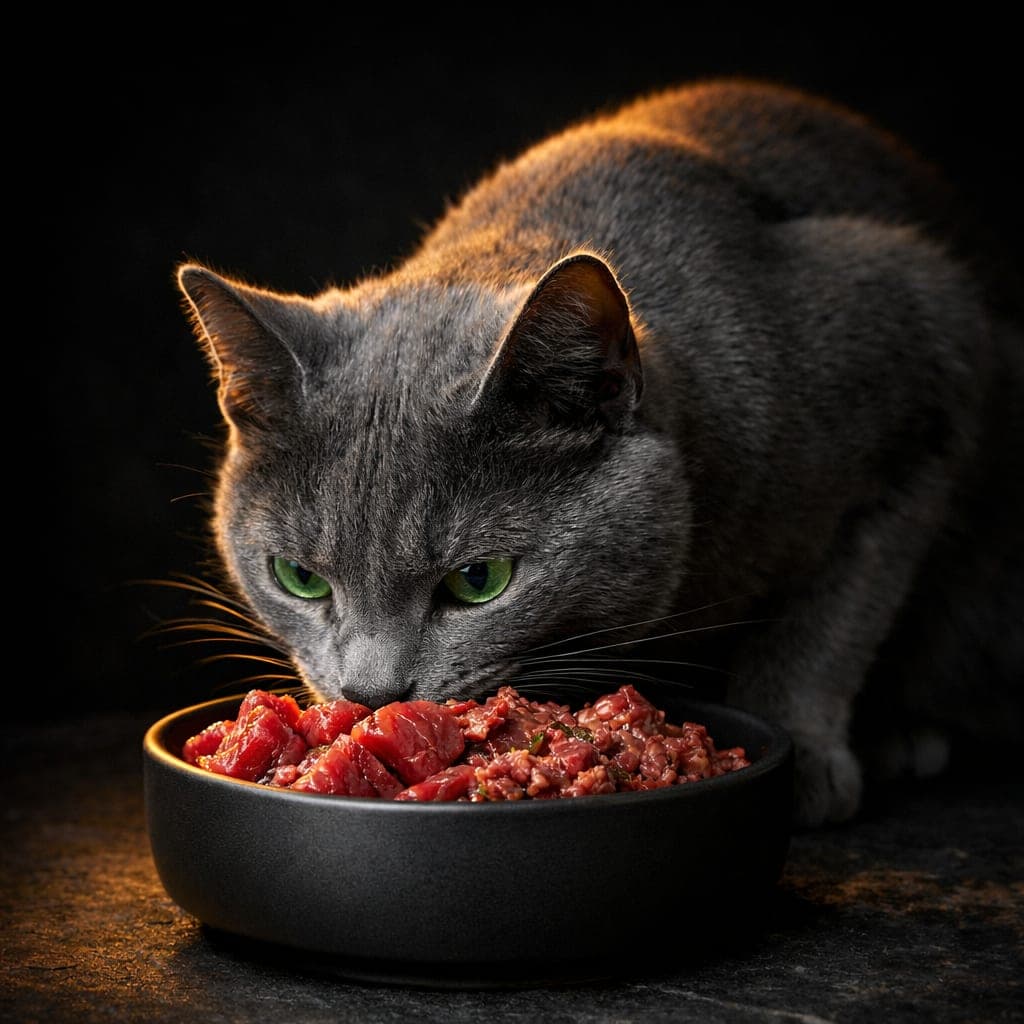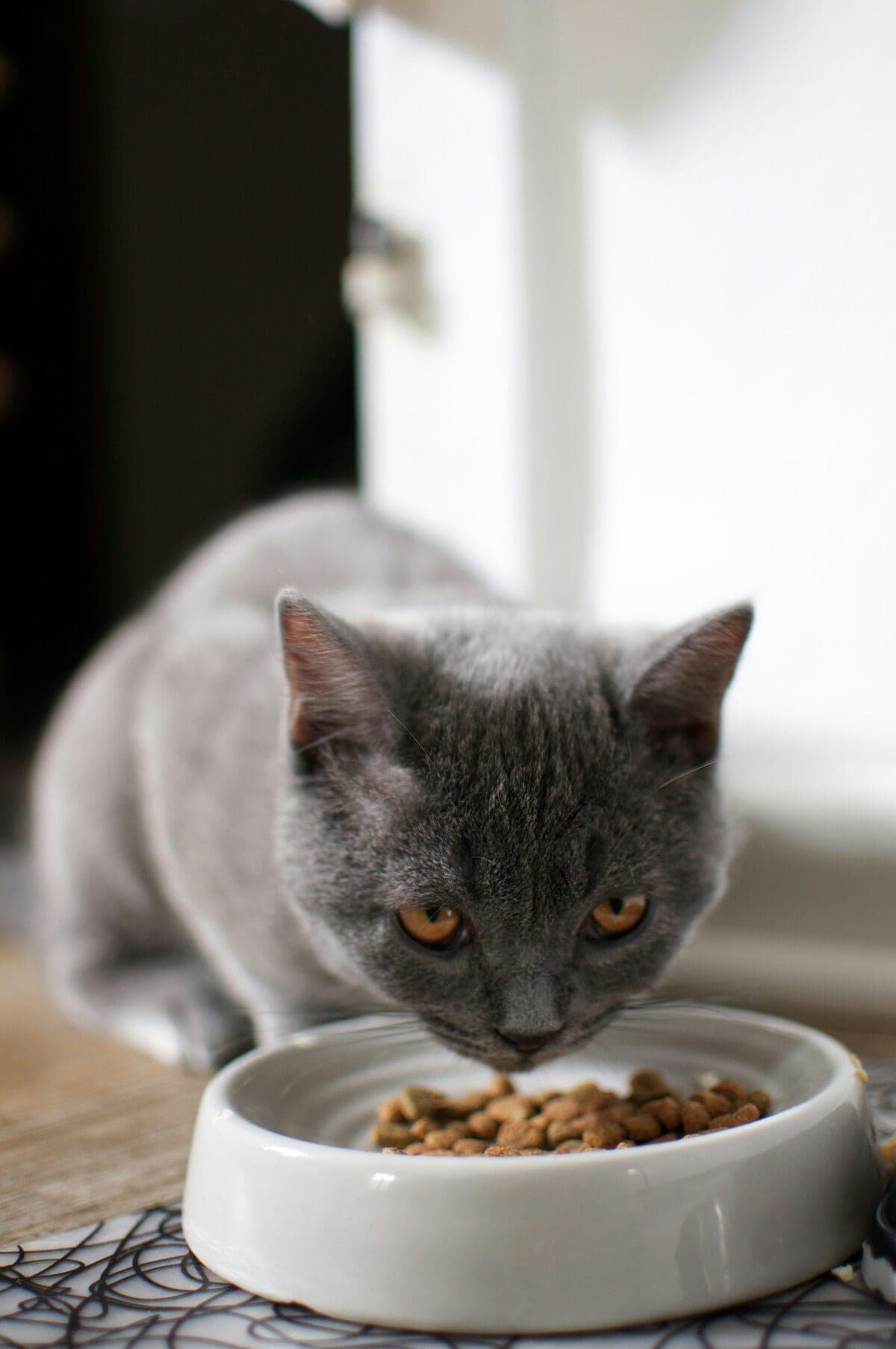
The decision to switch to BARF is one of the best gifts you can give your cat. But between "I want to feed raw" and the first fully balanced meal lies a whole journey — for some cats it's a stroll, for others a marathon lasting weeks. This guide leads you through every stage without stress, without rushing, and with respect for your cat's pace.
Why switch to BARF?
Cats are obligate carnivores. Their bodies evolved over millions of years feeding on raw animals — birds, rodents, lizards. Commercial dry food, though convenient for the owner, is fundamentally far removed from what the feline digestive system can process optimally. BARF (Biologically Appropriate Raw Food) is a return to feeding in line with the species' biology.
The most important difference? Water. Dry food contains a mere 10% or so of moisture. Raw meat — 70-80%. Cats naturally have a weak drinking instinct — in natural conditions they obtain almost all the water they need from their food.
10% / 70%
A cat fed exclusively dry food lives in a state of chronic, subclinical dehydration. This burdens the kidneys, promotes urinary stones, and increases the risk of urinary tract diseases — problems practically unknown in free-living cats.
The benefits of switching to a raw diet often appear within the first few weeks: a glossy coat (dullness and excessive shedding disappear), healthier teeth and gums, better hydration (lighter urine), smaller and less smelly stool (the body absorbs the vast majority of the food, so there's 50-70% less waste), more energy, fewer digestive problems.
Prepare before you start
Switching to BARF isn't an impulsive decision — it's a project. Before you serve your cat its first raw meal, spend at least a week gathering knowledge and supplies.
Get the knowledge
Read a few reliable sources on raw feeding. Understand the proportions: muscle meat, bone, organs (including liver), heart, fish, and supplements. Learn the key requirements — the calcium-to-phosphorus ratio (ideally 1.15:1), the need for taurine, iodine, and vitamins D and E. You don't have to become an animal nutritionist, but you do have to understand the basics before you start preparing meals.
Gather the equipment
- A freezer — raw meat is bought in bulk and frozen in portions. A 2-4 week supply.
- A kitchen scale (accurate to 1 gram) — the foundation of a balanced diet.
- A meat grinder — optional, but useful at the start, when the cat doesn't accept pieces.
- Portioning containers — silicone molds or airtight tubs. Each portion = one meal.
- Basic supplements — taurine (absolutely essential), salmon oil, vitamin E, iodine (kelp or KI).
Find a meat supplier
Local butchers, wholesalers, dedicated BARF shops. Supermarket meat can also be a base, but it's pricier and less varied. The key: freshness, controlled farming, proper storage. Freezing for at least 72 hours at -20°C eliminates most parasites.
Use a calculator
Don't guess the proportions. The BARF calculator automatically balances the components, computing Ca:P, taurine doses, and vitamins and minerals. Manual calculations are possible, but time-consuming and error-prone.
Compute your cat's diet — BARF calculatorOpen calculatorStep 1: From dry to wet
If your cat eats kibble exclusively, don't switch straight to raw meat. A stomach accustomed to crunchy pieces needs time to adapt to a different consistency. The first step is wet food.
For many cats, dry food is an addiction. Manufacturers add liver hydrolysates, animal fats, and artificial flavor enhancers — the kibble becomes irresistibly attractive. A cat accustomed to it often doesn't recognize wet food as food.
Start by swapping one meal a day for wet food — preferably the evening one, when cats are hungriest. Choose a good-quality food (min. 60-70% meat, no grains, corn, or sugar). Gradually increase the share: 25% → 50% → 75% → 100%.
A trick for the stubborn: broth instead of a battle
If your cat totally refuses wet food, pour chicken broth (no salt) or tuna juice in water over the kibble. This gradually teaches the cat that "wet = tasty". Patience, not a battle.
Duration: 1-2 weeks. Some cats transition in 3 days, others need three weeks. Don't rush — this stage is the foundation.
Step 2: From wet to lightly cooked
Your cat eats wet food? The hardest psychological barrier is behind you. Time to introduce real meat — but not yet raw.
Take a fresh piece of chicken breast or thigh and lightly sear it in a dry pan: 20-30 seconds per side, so the surface is pale and the center still pink. Cut it into small pieces and mix with the wet food. To begin, let the meat make up 20-30% of the meal.
Light searing strengthens the aroma — it releases volatile compounds that activate the feline hunting instinct. For a cat that has eaten processed food its whole life, raw meat simply "doesn't smell like food". Searing is the bridge.
Gradually increase the share of meat, reducing the wet food. By the end of this stage the meal is mostly lightly seared chicken. Duration: about a week.
Step 3: From cooked to raw
The strategy is simple: gradually shorten the cooking time. Were you searing for 30 seconds per side? Cut it to 15. Then to barely touching the pan. Then warm the meat in your hands or submerge a bagged portion in warm water. And finally — serve it raw at room temperature.
Some cats get through this stage in a single day. Others need a week. Every cat is different — adjust the pace to the reaction.
Duration: 3-7 days.
Step 4: Introducing ingredients
Your cat eats raw chicken meat — congratulations. But muscle meat alone isn't BARF yet. The key rule: one new ingredient at a time, 3-5 days apart between each. If a problem appears (diarrhea, vomiting, an allergy), you immediately know what caused it.
- Start with one protein — chicken. Muscle meat alone (boneless thigh, breast) for at least 3-5 days. The stool is normal, the cat eats with appetite.
- Add heart. Chicken or turkey heart is a key source of taurine — an amino acid without which cats literally go blind and develop cardiomyopathy. 10-15% of the meal.
- Introduce liver — carefully! Liver is a concentrate of vitamin A and B12. Excess vitamin A is toxic. Start with 1-2 grams, gradually increasing to 5% of the diet.
- Add a calcium source. Ground raw bone (necks, backs) or a supplement (bone meal, calcium citrate). 5-15% of the diet. Start at the lower bound.
- Introduce supplements — one at a time. Taurine, salmon oil, vitamin E, iodine. The BARF calculator will set the doses based on the actual composition of the meal.
- Expand the protein repertoire. Turkey, rabbit, beef. The goal is a rotation of at least 3-4 types of meat.
The easiest way to ruin a BARF diet is to rush. When your cat is purring over a bowl with three proteins, organs, and complete supplementation — you'd like it all to happen in a week. It won't.
— The most common mistake when changing diet
Common problems and solutions
The cat refuses raw meat
The most common problem, especially in cats long fed dry food:
- Warm the meat — submerge a bagged portion in warm water for 5 minutes. Heat releases the aromas.
- Add tuna juice — the intense fishy smell convinces the stubborn.
- Sprinkle on brewer's yeast (nutritional yeast) — cats love its umami flavor. A pinch changes everything.
- Change the consistency — some cats prefer ground, others pieces.
- Crumble a little kibble on top — the familiar smell makes raw seem less suspicious. Gradually reduce it to zero.
Diarrhea
Slightly loose stool for the first 2-3 days is normal — the gut flora is rebuilding. Strong or longer diarrhea = a pace that's too fast. Step back. Too much liver or fat can also be the cause.
Constipation
Hard, white, dry stool = too much bone. Reduce the share of bone, increase the meat. Add a bit of cooked pumpkin (without seasoning) — a natural remedy for constipation in cats.
Vomiting
Undigested meat shortly after a meal — pieces too big. Grind it finer or cut it. Cat eating too fast? Divide the portion into smaller meals. Persistent vomiting calls for a vet visit.
Selective picking
The cat pulls out the meat and heart, leaving the liver and bone behind. Mix the ingredients more thoroughly — grind them together so it can't pick them apart. Over time it will accept everything as one.
What NOT to do
A few rules whose breaking has serious, sometimes fatal consequences:
Never. Ever. Starve.
This is the most dangerous mistake. Cats without food for 24-48 hours (and obese ones even less) can develop hepatic lipidosis — an immediately life-threatening condition requiring hospitalization. If a cat refuses new food, always give it what it knows.
- Don't give up after two days. A marathon, not a sprint. A cat fed kibble for years may need weeks of adaptation.
- Don't mix raw meat with dry food in one meal. Dry food digests in 4-6 hours, raw meat in 2-3. Together in the stomach — fermentation and bacteria. Separate meals, at least 4 hours apart.
- Don't change the diet overnight. Cold turkey is a shock to the digestive system.
- Don't serve an incomplete diet for an extended period. Chicken breast alone isn't BARF. No bone = no calcium. No organs = no vitamins.
Approximate schedule
| Week | Stage |
|---|---|
| 1-2 | Dry → wet food (goal: 100% wet) |
| 3 | Lightly seared meat with wet food (20% → 80%) |
| 4 | Shortening the cooking to 100% raw |
| 5 | Meat + heart (10-15%); discontinuing wet food |
| 6 | Liver (up to 5%) + a calcium source |
| 7 | Full supplementation: taurine, omega-3, E, iodine, D |
| 8 | Second protein (turkey / rabbit / beef) |
The whole process typically takes 4-8 weeks. Cats previously fed wet food — 2-3 weeks. Picky ones, or long on dry — 2-3 months.
Summary
Switching from dry food to BARF is a process, not an event. It calls for patience, consistency, and — above all — respect for your cat's pace. There are cats that enthusiastically devour a raw chicken heart on day one, and ones that for three weeks suspiciously sniff a piece of breast with an expression of indignation on their face. Both reactions are normal.
Four rules to remember: never starve your cat, introduce changes gradually, one new ingredient at a time, use a calculator. The rest is a matter of time, observation, and a little creativity.
And the result? A cat with a shining coat, clean teeth, full of energy, devouring a meal that suits its nature — worth every day of waiting.
Sources
- Billinghurst I. (1993). Give Your Dog a Bone: The Practical Commonsense Way to Feed Dogs for a Long Healthy Life. Self-published.
- Billinghurst I. (2001). The BARF Diet: Raw Feeding for Dogs and Cats Using Evolutionary Principles. Warrigal Publishing.
- Plantinga E.A., Bosch G., Hendriks W.H. (2011). Estimation of the dietary nutrient profile of free-roaming feral cats: possible implications for nutrition of domestic cats. British Journal of Nutrition, 106, S35-S48.
- Center S.A. (2005). Feline hepatic lipidosis. Veterinary Clinics of North America: Small Animal Practice, 35(1), 225-269.
Frequently asked
How long will it take to switch a cat to BARF?
On average 4-8 weeks. Cats that previously ate wet food can transition in 2-3 weeks. Picky cats, or ones long fed dry food, sometimes need 2-3 months — and that's normal.
Can I mix raw meat with dry food in one bowl?
No. Dry food digests in 4-6 hours, raw meat in 2-3 hours — in one bowl the raw food stagnates in the stomach and bacteria multiply. If you must, serve them in separate meals at least 4 hours apart.
What do I do when a cat refuses raw meat?
Warm it in a bag in warm water, add tuna juice or a pinch of brewer's yeast, change the consistency (ground vs. pieces), crumble a little kibble on top. Patience, never starving.
Is diarrhea after switching to BARF a reason to panic?
Slightly loose stool for the first 2-3 days is normal — the gut flora is rebuilding. Strong or longer-lasting diarrhea means the pace is too fast or there's too much liver/fat. Step back.
Do I need a calculator to start?
The first meals — chicken with heart — can be given without one. But from the moment you introduce liver, bone, and supplements, a calculator is a practical necessity: it keeps an eye on Ca:P, the taurine dose, and the 5% liver limit.