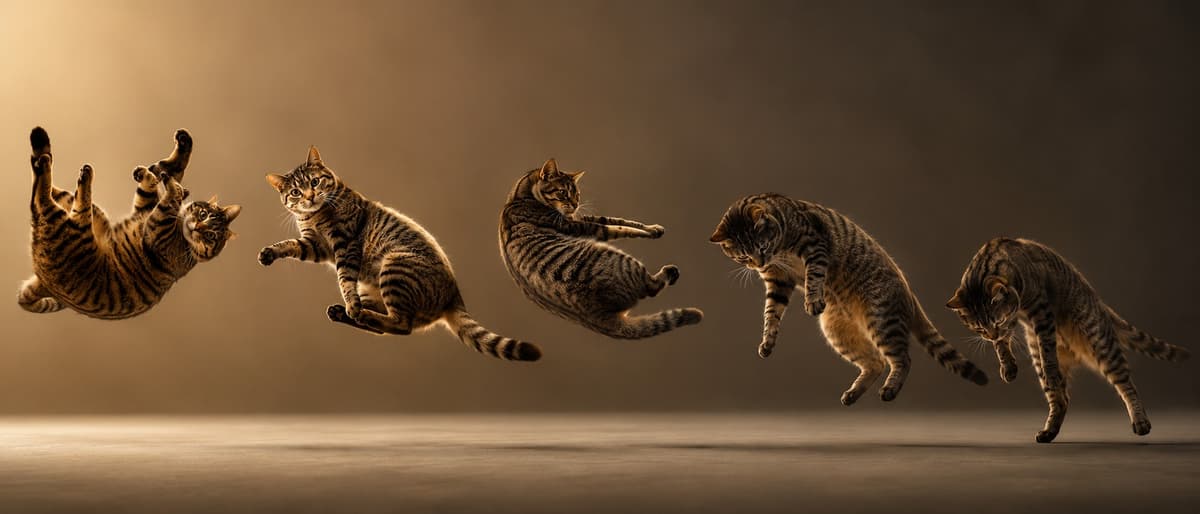
One second of watching is enough: a cat slides off the windowsill belly-up, and by the moment of landing it's already firmly on its feet. It looks like magic. Or a light mockery of the laws of physics. That's exactly how the scientific world saw it for over a hundred years — until the day a certain Frenchman with a fiendishly fast camera shutter proved that no laws had been broken. The cat simply understands the conservation of angular momentum perfectly.
This isn't just an anecdote for fans of the history of science. The mechanism that lets a cat turn over in mid-air has its limits — and ignoring them costs cats their lives every year. Listen to the physics, the anatomy, and what the vets say.
The cat that „broke" the laws of physics
In the late 19th century, physicists had a problem. James Clerk Maxwell, one of the greatest minds of the era, reportedly joked at Cambridge that he dropped cats from various heights to understand how they turned over — but no one could give a theoretical explanation. The principle of conservation of angular momentum is clear: a body spinning in space cannot change its overall direction of rotation on its own — there's nothing to push against, no external force. And yet a cat, apparently starting out belly-up, finishes its turn on its feet. How?
The answer came in 1894 from an inventive Frenchman. Étienne-Jules Marey was the inventor of chronophotography — a technique that allowed a series of photos to be taken at very short intervals (60 frames per second). The same technique transformed sport, biomechanics, and soon cinema. Marey decided to photograph a falling cat.
The results, published in Nature (Marey, 1894), were a revelation. Frame by frame, you could see something invisible to the naked eye: the cat bends at the waist. The front of the body rotates one way, the back the other. The sum of angular momenta stays at zero — physics wasn't broken, it just had to be seen up close.
The mechanism: two cylinders and the figure-skater principle
A full mathematical theory wasn't proposed until 1969, by American physicists. Thomas Kane and M.P. Scher, in A dynamical explanation of the falling cat phenomenon (Kane & Scher, 1969), modeled the cat as a system of two rigidly connected cylinders that can bend in the middle. They showed mathematically that through coordinated bending and extension of the limbs, a cat can rotate 180 degrees — while keeping its total angular momentum equal to zero.
The secret lies in a second nuance: the moment of inertia. The same law that makes a figure skater spin faster when she pulls her arms in to her torso. As the cat rotates the front of its body, it pulls its front paws toward the axis of rotation (small moment of inertia = easy to turn), while it flings its back paws out (the large moment of inertia of the rear acts like an „anchor,” resisting rotation in the opposite direction). The effect: the front turns ~180°, the rear only ~30°. In the second beat the cat reverses the configuration: it flings the front paws out and tucks the back ones in — and this time the rear segment of the body rotates.
The whole orientation reset takes ~0.5 seconds. In that time the cat completes a full turn, sets its body feet-down, and prepares to land — extending its limbs and tensing its shock-absorbing muscles.
Compute your cat's diet — BARF calculatorOpen calculatorA little anatomy of an acrobat
The physical mechanism is one thing. The second question: how does the cat know which way to turn if it has no reference point in the air?
The answer is the vestibular system (labyrinth) — a small organ hidden in the inner ear that can't be seen without specialized examination, but which directs the whole show.
The cat's labyrinth has two key parts:
- Semicircular canals — three in each ear, set in three mutually perpendicular planes. They measure angular acceleration, that is, „which way I'm starting to spin.”
- Otoliths (utricle and saccule) — tiny calcium carbonate crystals sitting on hair cells. They measure linear acceleration, above all gravity, that is, „where is up.”
The signal from the labyrinth reaches the cerebellum — the center of movement coordination. Within milliseconds the cerebellum calculates how to bend and rotate the body to land feet-down. At the same time the whiskers (vibrissae) come into play — acting as supplementary position sensors, feeling changes in the airflow around the body.
And one more anatomical detail that makes the cat an exceptionally flexible acrobat: the absence of a true collarbone. In cats the clavicle is vestigial and doesn't functionally connect to the rest of the skeleton. The shoulder blade „floats" in the muscles, giving the shoulder a much greater range of motion than in a human or a dog. Add to that elastic intervertebral discs and a spine that can bend into a much sharper arc than ours — and you have a biological gymnast, ready from birth... or rather from a few weeks after birth.
Kittens aren't acrobats yet
Everything above applies to a healthy adult cat. Kittens are a different case — and an important, often underappreciated topic for new owners.
The righting reflex is not an innate skill in fully finished form. It matures gradually between weeks 3 and 7 of life. In the 3rd week kittens begin to show their first attempts — clumsy, half-formed. Full reflex proficiency appears only around weeks 6-7, when the vestibular system, cerebellum, and muscular responses are fully synchronized.
This means that a kitten aged 4-5 weeks that falls off a shelf or a bed doesn't turn over in mid-air like an adult cat. It may land on its side, its back, or head-down. Even from a small height that can mean a serious injury.
The second reason kittens are especially vulnerable: their bones and ligaments are still pliable. Greenstick fractures, joint damage, chest injuries — all of these happen far more easily than in adults. A breeder or a new owner of young kittens should pay special attention to securing high surfaces — especially at weeks 3-7, when kittens are already active and curious about the world, but not yet physically ready.
The paradox of the low fall: a lower limit of ~30 cm
Here begins one of the least intuitive consequences of the physics of the feline turn: a very low fall can be more dangerous than a fall from a meter and a half.
Why? Because the whole rotation mechanism needs time — about half a second. If a cat falls from less than ~30 cm, it won't manage a full turn. It will land on its side, its back, or half-turned, resulting in a poor distribution of the impact forces.
In practice: a cat that curls up on a desk and rolls off a low chair is more prone to injury than a cat that jumps from the top shelf of a bookcase. In the first case physics has no time to act. The second case — paradoxically — is sometimes safer.
This doesn't of course mean that higher falls are safe (more on that shortly). But it's worth knowing that a low height is no guarantee of an injury-free landing.
„High-rise syndrome" — a surprise from Manhattan
The most famous study of feline falls was done in 1987 at the Animal Medical Center in Manhattan. Wayne O. Whitney and Cheryl J. Mehlhaff published in the Journal of the American Veterinary Medical Association (Whitney & Mehlhaff, 1987) a retrospective analysis of the records of 132 cats that came to the clinic after accidentally falling from windows and balconies in New York. The fall heights ranged from the 2nd to the 32nd floor.
The result was counterintuitive: cats falling from the 7th floor and above had lower mortality than cats from the 2nd-6th floor. Hence the name: „high-rise syndrome.”
How to explain it? Whitney's hypothesis:
- When falling from a small height, the cat accelerates but still feels gravity as a „down-up" force. The body stays tense, the paws tucked in.
- After exceeding a certain height (~5-7 floors), the cat reaches terminal velocity (~95-100 km/h in a compact position). From that moment acceleration disappears and the cat enters a near-weightless state.
- In this state the defensive tensing reflex fades. The cat relaxes its muscles and spreads its limbs wide — like a flying squirrel or an opening parachute. The larger frontal area further reduces terminal velocity and disperses the impact energy across the whole body, instead of concentrating it in the paws.
Clinically this means a different pool of injuries: cats from lower floors more often had limb fractures (landing on stiff, tensed paws), cats from higher floors — chest and facial injuries (landing flat, with limbs spread).
Statistics don't absolve you of responsibility
„High-rise syndrome" does not mean that falling from high floors is safe. First: the study has a built-in selection effect — only cats that reached the clinic alive were analyzed. Cats killed on the spot may not have made it into the statistics. Second: even the surviving cats from high floors suffered serious injuries requiring intensive care. Third: the study didn't cover the psychological aftermath of the fall or long-term problems. In short: a cat is not indestructible, regardless of the floor.
When the righting reflex fails
The mechanism works reliably only when all its parts are intact. Clinically we observe a range of situations in which the righting reflex is disrupted or abolished entirely:
- Cerebellar hypoplasia. The most common cause: infection of the mother with the panleukopenia virus (FPV) during pregnancy. The virus damages the developing cerebellum of the fetus. The kittens are born with permanent ataxia — a wobbly gait, intention tremor, and a weakened or abolished righting reflex.
- Vestibular disorders — inner-ear infections, nasopharyngeal polyps, idiopathic vestibular disorders in older cats. They disrupt the function of the labyrinth — the cat „doesn't know" where up is.
- Head injuries with damage to the cerebellum or the labyrinth.
- Senior degeneration of the nervous system — the reflex may be slower, less precise.
- Sedatives, anesthesia, intoxication — temporarily switch off part of the system.
If a cat suddenly loses its ability to land on its feet, has a wobbly gait, shakes its head, or tilts it to one side, this is a situation requiring urgent veterinary consultation. It's not about the aesthetics of the gait, but a signal that something in the nervous system or the inner ear needs attention.
Practice for the owner
The last and most important part — because all the physics and neurology above won't replace one thing: a secured window.
A net, not a bug screen
A standard bug screen won't hold the weight of a lunging cat — it's a mesh to keep insects out, not a safety barrier. A cat needs a dedicated net with a fine mesh (2 cm at most) mounted on an aluminum or steel frame, with verified strength. Manufacturers specializing in „petscreen" or „cat nets" declare a strength of several to a dozen or so kilograms per square centimeter. Always check the mounting of the frame, not just the mesh itself.
Other practical rules:
- Balcony = solid barrier + net. The open gaps between the railing bars are enough for a small cat to fall through. The height of the protection — a minimum of 1.5 meters, better up to the ceiling.
- Tilt-and-turn windows are a trap. The „tilted-open at the top" mechanism draws the cat into the gap at the top, where it slides down, gets stuck in the wedge, and often suffers serious chest and pelvic injuries. Close windows in tilt mode when you leave the house — or install the special stoppers sold by window manufacturers.
- High shelves and windowsills in bedrooms — a cat likes to sleep up high, but a fall in its sleep or startled by a sudden noise can end badly. Consider low barriers to block a roll-off.
- Kittens under 8 weeks are a separate category. Don't leave them on high surfaces even for a moment. Full righting-reflex proficiency appears only around week 7.
And if a cat falls anyway and looks unharmed — it's always worth consulting a vet. Chest injuries (pleural pneumothorax, hematoma), hard-palate damage, and small pelvic fractures can be invisible at first glance and only reveal themselves hours later. The rule „the cat landed on its feet, so it's OK" isn't enough.
In summary: not magic, just science
A cat that lands on its feet isn't a miracle of nature in a supernatural sense. It's a miracle of evolutionary precision — the vestibular system, the cerebellum, a flexible spine, the absence of a collarbone, the whiskers, and the conservation of angular momentum all converge in a single fraction of a second to turn a catastrophe into a landing.
Étienne-Jules Marey, photographing a falling cat in 1894, didn't just solve a century-old puzzle of physics. He opened the way to biomechanics, cinematography, and the scientific observation of what is too fast for us. Every frame of that archival footage is a reminder: the world is full of mechanisms that simply work — without our help, without our attention, without our awareness.
Our role as owners is only one thing: not to put that precision to a test it cannot withstand. Not even the best righting reflex can replace a net on the balcony.
References
- Marey É.-J. (1894). Photographs of a tumbling cat, Nature 51:80-81
- Magnus R. (1922). Wie sich die fallende Katze in der Luft umdreht, Pflüger's Archiv für die gesamte Physiologie des Menschen und der Tiere 196:313-323
- Kane T.R., Scher M.P. (1969). A dynamical explanation of the falling cat phenomenon, International Journal of Solids and Structures 5(7):663-670
- Whitney W.O., Mehlhaff C.J. (1987). High-rise syndrome in cats, Journal of the American Veterinary Medical Association 191(11):1399-1403↗
Frequently asked
Can kittens land on their feet from birth?
No. The righting reflex matures gradually. The first, clumsy attempts appear around the 3rd week of life. Full proficiency — the synchronization of the vestibular system, cerebellum, and muscular response — only around weeks 6-7. That's why kittens under 8 weeks are especially prone to fall injuries, even from a low height.
Can falling from a low height be dangerous?
Yes, paradoxically — a low fall (under ~30 cm) can be riskier than a fall from a meter. The whole rotation mechanism needs about half a second. Shorter than that = too little time for a full turn, and the cat lands on its side, back, or half-turned. This doesn't mean high falls are safe — it only means a low height is no guarantee of an injury-free landing.
My cat fell and looks fine. Do I need to go to the vet?
It's worth it. Chest injuries (e.g. pneumothorax, small hematomas), fractures of the hard palate, and micro-fractures of the pelvis can be invisible to the naked eye but only reveal themselves hours later. The rule „the cat looks OK, so it's OK” isn't enough after a fall. The decision about diagnostics is always made by a vet after a clinical exam.
Can all cats turn over in mid-air?
A healthy adult cat — yes, thanks to the built-in righting reflex. The exceptions are: kittens under 7 weeks of age (nervous system still immature), cats with cerebellar hypoplasia (most often after the mother was infected with the panleukopenia virus during pregnancy), cats with vestibular disorders (nasopharyngeal polyps, inner-ear infections, idiopathic vestibular disorders in seniors), cats after head injuries, and cats under the influence of sedatives or anesthesia.
How does a cat know which way is up if it's falling in the dark?
It doesn't need vision. The otoliths — tiny calcium carbonate crystals in the inner ear — act as a natural accelerometer and measure the gravity vector regardless of whether the floor is visible. The semicircular canals measure body rotation. The cerebellum combines this data into a single piece of information: „down is HERE.” That's why a cat turns over just as skillfully in a dark room as in sunlight.