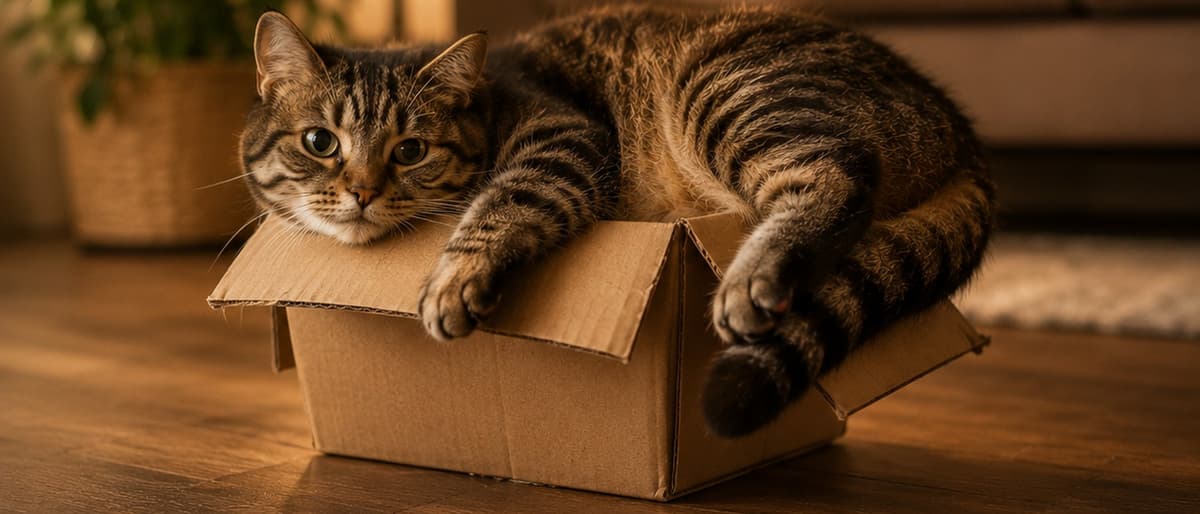
You buy your cat a fancy bed for a small fortune. The cat looks at it with contempt, then climbs into the cardboard box the bed arrived in. This scene plays out in millions of homes and has become an internet classic. But behind the joke „if I fits I sits” lies some genuinely serious science about the feline brain, stress, and thermoregulation. To a cat, a box isn't a toy — it's equipment.
A cat's love of boxes is neither an accident nor a silliness. It's a rational answer to three completely different needs that an ordinary box meets all at once. Let's go through them one by one — and clear up a few overinterpretations along the way.
Reason one: safety, or the cat hides
To understand the box, you have to understand how a cat copes with stress. Faced with a threat, a dog can flee, freeze, or try to „negotiate” with body posture. A cat, as a solitary ambush hunter, has a different default strategy: hiding. It's its main mechanism for coping with fear and novelty, recognized in the feline welfare guidelines (AAFP/ISFM 2013).
A box is ideal for this: it surrounds the cat on all sides, has a single entrance to control, and gives the feeling that nothing can surprise it from behind. This isn't a whim — it's functional equipment for managing stress.
A shelter experiment showed it best. Newly admitted cats were randomly assigned a box to hide in, or given none. The result?
days 3–4
In the study by Vinke et al. (2014) on 19 cats, the group with a hideaway regained its calm faster in the first, hardest days after admission. This is an important nuance: the box doesn't „remove” stress permanently — it speeds up adaptation precisely when the new environment is most frightening.
That hiding really does lower stress is confirmed by physiology, too. In a separate study, cats that could hide had lower cortisol levels (the stress hormone) than cats deprived of a hideaway (Carlstead et al. 1993). A hideaway is therefore not a psychological illusion of comfort — it works at the hormonal level.
A cat that hides isn't an „unsociable” cat
A common fear among owners: „if I give it a hideaway, it'll burrow in and turn feral.” The research says the opposite. Cats with access to a box were calmer and approached people MORE often, and the ability to hide did not reduce their chances of adoption (Kry and Casey 2007). By giving a shy cat somewhere to hide, you help it come out sooner.
Reason two: warmth, or your living room is chilly for a cat
The second building block is purely thermal. We set our homes to about 21–22°C and feel fine. For a cat, that's a slight chill.
~30–38°C
This commonly cited thermal comfort zone for cats (based on NRC data, referenced among others by Stella and Croney 2016) should be treated as an approximation — controlled studies of thermal preference in cats are scarce. But the conclusion is solid: our homes are, if anything, too cool for a cat rather than too warm, which is why it seeks out warmer spots.
Here's where cardboard comes in. Cardboard is a good insulator — it encloses the cat in a small space and traps the heat of its own body, creating a cozy, warmer pocket. It's the same logic behind why a cat picks sunlit windowsills, radiators, and a just-switched-off laptop. So a box isn't only „psychologically” cozy — it's objectively warmer.
Reason three: the cat sees edges that aren't there
And here it gets truly interesting. If it's all about enclosure and warmth, how do we explain cats that solemnly sit inside a square taped out on the floor — flat, with no walls and no bottom?
Scientists tested this in a study with the charming title „If I fits I sits.” Cats were shown, on the floor, a real square, an illusory square (a so-called Kanizsa figure — four corners arranged so that the brain „fills in” a square between them that physically isn't there), and a control arrangement with no illusion. Cats sat inside the real and the illusory square roughly equally often, and inside the control one less often (Smith et al. 2021). So it looks as if the feline brain treats those drawn-in, nonexistent edges as real.
A cat can sit inside a square that physically isn't there — because its brain fills in the missing walls itself. It falls for the same optical illusion we do.
This isn't entirely new — back in 1988 it was shown that cats perceive so-called subjective contours, that is, they „see” edges where there are none in reality (Bravo et al. 1988). The square study, however, was a home-based citizen-science experiment and had a small finish: although over 500 owners signed up, only 30 cats completed the protocol, and just 9 actually sat on one of the figures. It's a charming and suggestive result, but a preliminary one — so let's not say „cats prefer illusory squares,” only „cats can fall for the same illusion we do.”
When a box is more than comfort
It's worth knowing that for cats going through a hard time (a new home, hospitalization, renovation), a hideaway can be more than comfort. Stress genuinely weakens a cat's immunity — and that translates into health. This is why, in shelter settings, giving cats places to hide is sometimes part of care, not just a luxury.
One condition: the box can't take up all the space
A hideaway helps only when it's matched to the space. In a very cramped area, too large a box can actually raise stress by taking away the rest of the cat's territory. The rule is simple: a hideaway should be a shelter, not an occupation of the whole room. At home this is rarely a problem — a box in a quiet corner is enough.
What this means for you
A few practical takeaways, straight from the research:
- Keep at least one box at home. It's the cheapest „therapeutic” piece of furniture you can give a cat: a hideaway plus warmth in one.
- In hard moments, offer your cat a box. A move, a new cat, a return from the vet, guests, a renovation — that's when a hideaway genuinely speeds up adaptation and helps the cat pull itself together.
- Don't drag a hiding cat out by force. Taking away the hideaway doesn't socialize it — it only ramps up stress. Let the cat come out on its own; studies show it comes out faster that way.
- Place the hideaway in a quiet spot, away from traffic, noise, and the litter box, with one entrance and a view of the room.
If you'd like to better understand when your cat is relaxed and when it's tense, our guide to cat body language will help.
In summary: the box isn't a joke, it's a tool
The next time your cat ignores the expensive bed and moves into the cardboard box, don't treat it as a caprice. It's the shrewd decision of a small strategist: a hideaway that gives a sense of safety and control, a warm pocket that insulates the body, and an enclosed space its brain likes so much that it fills it in even from tape alone on the floor. An ordinary box hits three fundamental feline needs at once. It's hard to find better proof that, when it comes to comfort, cats know exactly what they're doing.
References
- Vinke C.M., Godijn L.M., van der Leij W.J.R. (2014). Will a hiding box provide stress reduction for shelter cats?, Applied Animal Behaviour Science 160:86-93doi:10.1016/j.applanim.2014.09.002
- Smith G.E., Chouinard P.A., Byosiere S-E. (2021). If I fits I sits: A citizen science investigation into illusory contour susceptibility in domestic cats (Felis silvestris catus), Applied Animal Behaviour Science 240:105338doi:10.1016/j.applanim.2021.105338
- Kry K., Casey R. (2007). The effect of hiding enrichment on stress levels and behaviour of domestic cats in a shelter setting and the implications for adoption potential, Animal Welfare 16(3):375-383doi:10.1017/S0962728600027196
- Carlstead K., Brown J.L., Strawn W. (1993). Behavioral and physiological correlates of stress in laboratory cats, Applied Animal Behaviour Science 38(2):143-158doi:10.1016/0168-1591(93)90062-T
- Ellis S.L.H., Rodan I., Carney H.C., Heath S., Rochlitz I., Shearburn L.D., Sundahl E., Westropp J.L. (2013). AAFP and ISFM Feline Environmental Needs Guidelines, Journal of Feline Medicine and Surgery 15:219-230doi:10.1177/1098612X13477537
- Bravo M., Blake R., Morrison S. (1988). Cats see subjective contours, Vision Research 28(8):861-865
- Stella J.L., Croney C.C. (2016). Environmental Aspects of Domestic Cat Care and Management: Implications for Cat Welfare, The Scientific World Journal 2016:6296315doi:10.1155/2016/6296315
Frequently asked
Why does my cat climb into every box?
Because a box meets three needs at once: it provides a hideaway (a sense of safety and control), it provides warmth (cardboard insulates, and a cat's thermal comfort zone is higher than ours), and it surrounds the cat on all sides, which cats like. Hiding is the main way a cat copes with stress and novelty.
Won't giving my cat a hideaway make it hide all the time and turn feral?
Quite the opposite. In studies, cats with access to a hideaway were calmer and approached people MORE often, and the ability to hide did not lower their chances of adoption (Kry and Casey 2007). Taking a cat's hideaway away doesn't socialize it — it only raises its stress.
Does a box really help a stressed cat, or is it just cute?
It helps — but realistically. A box speeds up adaptation in the first days after a change (a move, a new home, a return from the vet), when stress is highest. It doesn't „cure” anxiety and doesn't work forever — after a while the cat gets used to things anyway. It's a supportive tool, not a medicine.
How big should a cat's box be?
Big enough for the cat to hide comfortably and turn around, but not so big that it takes up all of the cat's space in a small room. In a cramped cage, too large a hideaway can actually increase stress by taking up room. A simple box on its side, with one entrance, in a quiet corner — works best.