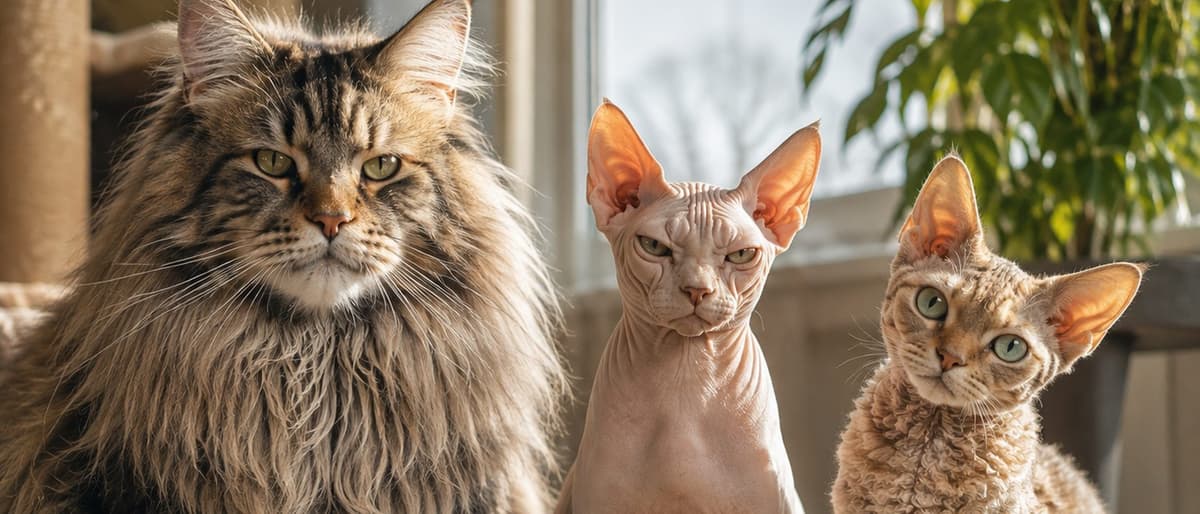
Stroke your cat and think for a moment about what you are actually touching. Not one smooth layer, but a precisely built, multi-layered covering in which every hair has a job. And whether your cat is fluffy like a Siberian, sleek like a Burmese, curly like a rex or almost naked like a Sphynx comes down to a handful of genes — some of which science only decoded in the past two decades.
I have gathered here the anatomy and genetics of the feline coat. The genetics rests solely on peer-reviewed research (work rigorously checked by independent experts before publication), and the structure and physiology of hair on established veterinary knowledge. No myths, but a few facts that will change the way you look at your own cat. I wrote about coat COLOUR separately — here I break the feline pigment down to its parts, and here I go deeper, into silver and gold. Today we deal with the hair itself.
A coat is not one layer — three hair types
Let us start with a surprise: a cat does not have “one coat”. Its fur is made of three different hair types, each with a different role:
- guard hair — the longest and thickest, forming the visible outer layer, shielding against moisture and carrying the coat colour;
- awn hair (intermediate) — medium length, supporting the outer layer and contributing to insulation;
- down hair (undercoat) — the finest and shortest, densely packed, trapping warm air right against the skin.
What is more, these hairs do not grow singly. From one follicle — or rather from one opening in the skin — comes a whole bundle: usually a single thick guard hair surrounded by a dozen or more finer ones. That is why a cat's coat is so dense that thousands of hairs fit into every square centimetre of skin.
3
A whole bundle of hairs grows from one opening in the skin at once — which is why shedding is not the loss of single hairs but the replacement of entire “tufts”.
Some feline hairs are specialised for entirely different tasks. The best example is the vibrissae, or whiskers — the name comes from the Latin vibrare, to quiver. These are thicker, far more deeply anchored sensory hairs packed with nerve endings. Still hair, only reworked by evolution into a precise spatial sensor.
Compute your cat's diet — BARF calculatorOpen calculatorWhat a cat needs fur for — warmth, protection and (surprisingly) cooling
The most obvious role of fur is insulation: the undercoat traps air and works like a thermos, protecting against cold. Fur also shields the skin from sun, abrasion and moisture, and because every hair is mobile and wired to nerve endings, the coat also serves as a vast organ of touch.
It gets more interesting with cooling. A cat barely sweats through its skin — active sweat glands sit almost exclusively in the paw pads (plus the nose and lips). The rest of the body, hidden under fur, hardly sheds heat by sweating at all. So in the heat a cat cools itself mainly through behaviour (seeking cool surfaces, moving less) and through grooming — spreading saliva over the coat and letting it evaporate.
Why a cat does not sweat the way we do
The fur that insulates so well is at the same time an obstacle to cooling by sweat. The cat solved this differently than humans did: instead of sweating over its whole body, it “paints” its coat with saliva and lets it evaporate. Clever, but inefficient — which is why cats tolerate heat far worse than we do and must never be left in hot, stuffy places.
Why some cats are fluffy and others sleek — the FGF5 gene
Now that we know how the coat is built, let us move to the most common question: why is one cat long-haired and another short-haired? It is largely decided by one gene — FGF5 (fibroblast growth factor 5).
FGF5 works like a “stop button” for hair growth: it sends the signal for the hair to stop growing and enter its resting phase. When the gene works properly, the hair stays short. When a mutation disrupts it, the stop button fails to fire in time and the hair grows much longer. This is how long-haired cats arise: the Maine Coon, the Persian, the Siberian and the Norwegian Forest Cat (Kehler 2007).
1
Long hair is a recessive trait: to be fluffy, a cat must inherit a mutated copy of FGF5 from both parents. Two short-haired cats can therefore produce a long-haired kitten if both are carriers.
Interestingly, researchers found four independent FGF5 mutations that lead to the same effect — long hair — in different groups of cats (Kehler 2007). Nature invented long hair separately several times over.
The naked Sphynx that is not naked at all — the KRT71 gene
The extreme case is the “hairless” cats, the Sphynx first among them. Except that the Sphynx is not bald at all — that is one of the more persistent myths.
A Sphynx has fine down (it feels like the skin of a peach, or suede), and often single hairs on the nose, tail and paws. The problem lies elsewhere: because of a mutation in KRT71 — short for keratin, the protein that is the main building block of hair and claws — its hairs lack a properly formed bulb. Without one the hair falls out easily and never forms a dense coat. So the cat produces hair but cannot keep it — hence the impression of nakedness (Gandolfi 2010).
The Sphynx is not a cat without hair, but a cat without bulbs
The Sphynx does not “have no hair” — it grows hair, just without a strong bulb, so it does not stay put. A subtle but important difference: the Sphynx's baldness is a consequence of poorly anchored hair, not of its complete absence.
This anatomy has practical consequences. No coat means no layer to distribute sebum across the skin — which is why a Sphynx's skin tends to be greasier and needs bathing more often. Without insulating fur the Sphynx also feels warmer to the touch and gets cold faster. This is not a disease, just a consequence of build — but worth remembering when planning care.
Cats in curls — the rexes and a genetic surprise
Between the sleek cat and the naked one lies a whole world of curly cats — the rexes. The name itself comes from breeding terminology and historically meant simply animals with a mutated, wavy or curly coat. And here hides a genuinely surprising fact.
The curled coats of different rex breeds arise from different genes:
- Cornish Rex (and the related German Rex) — a mutation in the LPAR6 gene, a small deletion of four DNA base pairs; a recessive trait (Gandolfi 2013);
- Devon Rex — a mutation in KRT71 (the same gene whose other variant gives the naked Sphynx) (Gandolfi 2010);
- Selkirk Rex — yet another variant of KRT71, this time dominant, so one parent is enough for curls to appear (Gandolfi 2013).
Because these curls come from different genes, crossing two different curly breeds does not automatically give curly kittens — mutations in separate genes simply do not “talk to each other” and the offspring may have a straight coat.
The Sphynx and the Devon Rex are genetic relatives
The Sphynx's nakedness variant and the Devon Rex's curl variant sit in the same gene (KRT71) — which is why, historically, the Sphynx was crossed with the Devon Rex. They are two different “settings” of the same keratin switch (Gandolfi 2010).
Shedding — why the coat renews itself, and why indoors it never stops
Fur is not given once and for all — hairs grow in cycles: a growth phase, then rest and shedding, after which a new hair starts growing in the very same follicle. In cats these cycles are mosaic (not all hairs at once), so the coat renews continuously without leaving bald patches.
Seasonal shedding, however, is driven not by temperature, as we usually assume, but by day length (photoperiod — the ratio of daylight to darkness over 24 hours). The changing amount of light acts on the pineal gland and melatonin levels, and these signal the hair follicles. That is why an outdoor cat sheds in two distinct peaks — spring and autumn.
Why an indoor cat sheds all year round
Cats living indoors are exposed to artificial light and a constant temperature, so their shedding clock blurs. Instead of two distinct peaks they shed evenly all year. Regular brushing removes dead hair before it lands on the sofa — and reduces how much fur is swallowed during grooming, and therefore the number of trichobezoars, the compacted hairballs in the stomach that in extreme cases lead to obstruction.
In summary
A cat's coat is not an ornament but a carefully engineered structure: three hair types growing in tufts from a single opening in the skin, a layer that both warms and (rather clumsily) cools, and a handful of genes deciding length, texture and even whether the hair stays put at all. A long-haired cat is a “reset stop button” in FGF5. A Sphynx is hair without a bulb. A rex is keratin, or a receptor, wound into curls. Next time you run your hand along your cat, remember that you are stroking a remarkable piece of living anatomy and genetics.
References
- Kehler, J.S., David, V.A., Schäffer, A.A., Bajema, K., Eizirik, E., Ryugo, D.K., Hannah, S.S., O'Brien, S.J. & Menotti-Raymond, M. (2007). Four independent mutations in the feline fibroblast growth factor 5 gene determine the long-haired phenotype in domestic cats, Journal of Heredity, 98(6), 555–566doi:10.1093/jhered/esm072
- Gandolfi, B., Outerbridge, C.A., Beresford, L.G., Myers, J.A., Pimentel, M., Alhaddad, H., Grahn, J.C., Grahn, R.A. & Lyons, L.A. (2010). The naked truth: Sphynx and Devon Rex cat breed mutations in KRT71, Mammalian Genome, 21(9–10), 509–515doi:10.1007/s00335-010-9290-6
- Gandolfi, B., Alhaddad, H., Affolter, V.K., Brockman, J., Häggström, J., Joslin, S.E.K., Koehne, A.L., Mullikin, J.C., Outerbridge, C.A., Warren, W.C. & Lyons, L.A. (2013). To the root of the curl: a signature of a recent selective sweep identifies a mutation that defines the Cornish Rex cat breed, PLoS ONE, 8(6), e67105doi:10.1371/journal.pone.0067105
- Gandolfi, B., Alhaddad, H., Joslin, S.E.K., Khan, R., Filler, S., Brem, G. & Lyons, L.A. (2013). A splice variant in KRT71 is associated with curly coat phenotype of Selkirk Rex cats, Scientific Reports, 3, 2000doi:10.1038/srep02000
Frequently asked
Is the Sphynx (hairless cat) really bald?
No. A Sphynx has a fine down — it feels like the skin of a peach — and often single hairs on the nose, tail and paws. Its hairs, however, lack a well-formed bulb (because of a KRT71 mutation), so they fall out easily and never form a dense coat. The cat produces hair but cannot keep it — hence the impression of nakedness.
Why does my cat shed all year round?
Because seasonal shedding is driven mainly by day length (photoperiod), not temperature. Indoor cats live under artificial light at a constant temperature, so their natural rhythm of two peaks (spring and autumn) blurs and they shed evenly all year. Regular brushing removes dead hair and reduces how much fur the cat swallows, and therefore hairballs too.
Will crossing two curly breeds give curly kittens?
Not necessarily. The curls of different rex breeds come from different genes — the Cornish Rex from LPAR6, the Devon and Selkirk Rex from KRT71. Because these are separate genes, crossing two different curly breeds can produce offspring with a completely straight coat.
What decides whether a cat will be long-haired?
Above all the FGF5 gene, which regulates the length of the hair growth phase. Long hair is a recessive trait, so a cat must inherit a mutated copy of the gene from both parents. That is why two short-haired cats, if both are carriers, can have a long-haired kitten.