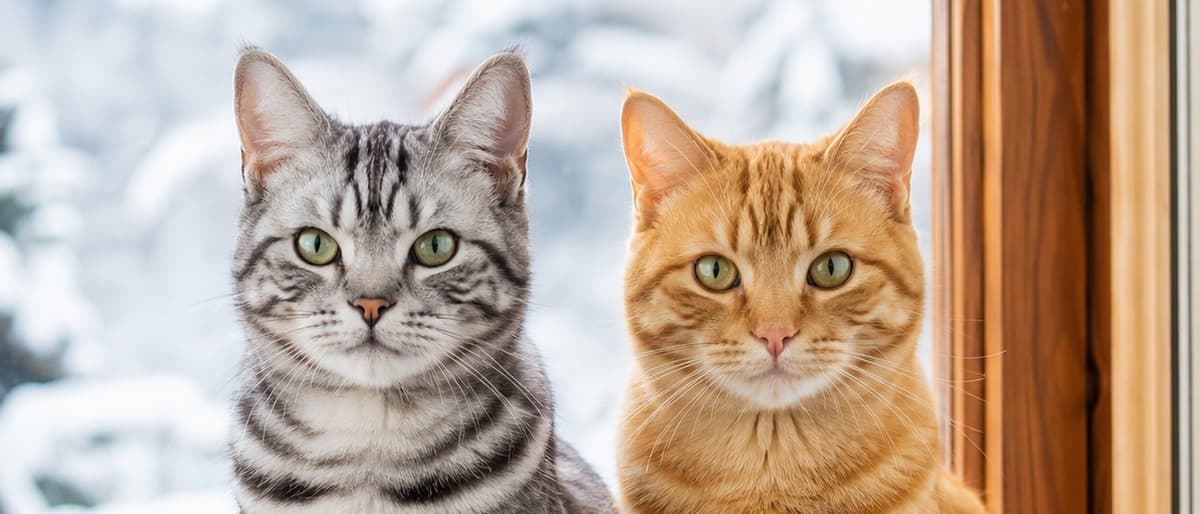
Put two tabby cats side by side. One looks as if it just came down from a frozen mountain — cool, white-silver, with an icy sheen. The other is warm as a sunset: apricot, golden, honeyed. And now the surprise: both extremes are built around exactly the same pigment. The whole difference is one gene that erases it — or another that widens it.
This article expands on the guide to coat colour genetics. There I showed where cat colours come from in general; here we go deeper — into silver, gold and the freshly decoded sunshine. I have gathered what follows from peer-reviewed research, that is, work checked by independent experts before publication — with a few details that will change the way you look at your own cat's coat.
One pigment, two directions
All of a cat's warmth — red, yellow, creams, gold — comes from one pigment: pheomelanin. Its cool counterpart is eumelanin (black and brown). In a tabby cat every single hair is striped lengthwise: it has a dark tip of eumelanin and a lighter, warm band of pheomelanin closer to the root. That warm band is the hero of this whole story.
1
Silver and gold are not “different colours” in any chemical sense. They are two opposite settings of a single slider: how much warm pheomelanin is left in the hair.
Remove the pheomelanin and the cat turns cool and silver. Widen it and the cat turns warm and golden. Everything else is just the names of the genes that push that slider one way or the other.
Silver: the gene that erases warmth
Silver is caused by a dominant gene called the Inhibitor (written as I). The word “inhibitor” simply means a factor that blocks a process — and that is exactly what you see here: the gene almost entirely blocks pheomelanin in the hair shaft, so its base turns white-silver instead of warm. The rest of the hair — the dark eumelanin tips — stays put.
From this one mechanism comes the whole family of “silver” coats:
- silver tabby — a silver background with clear dark stripes on it,
- smoke — a solid cat, without stripes, where colour sits only on the hair tips and the base is white; in motion such a coat looks as if it were smoking,
- chinchilla and shaded silver — pigment barely brushes the very tips of the hair, the rest is ice-white.
Scientific honesty: we have a silver test, but we still do not have the gene
This is one of the most interesting paradoxes in feline genetics. The silver locus was mapped back in 2009 — Menotti-Raymond and colleagues narrowed it down to a stretch of about 3.3 million base pairs on feline chromosome D2, containing some 17 genes. The causative one could not be identified then and has not been identified since. A curiosity: in other mammals silvering is governed by the SILV/PMEL gene — in the cat the locus landed in a completely different part of the genome, so the analogy from other species simply does not apply.
A commercial DNA test for silver already exists (the feline genetics laboratory at the University of Missouri), but the laboratory states plainly that it is not yet known how the detected variant acts or which gene it disrupts. In other words: we can predict the inheritance, we can test for it — and we still do not understand the mechanism. Not every trait we know from the show bench has been decoded in the laboratory.
Gold: when the warm band widens
Gold is the exact inverse of silver. Here pheomelanin is not removed — on the contrary, the warm band at the root of the hair widens, pushing the dark pigment towards the tips. The effect is a deep, apricot-honey base on which the pattern seems to “float” on warmth.
In classical cat genetics this was attributed to an enigmatic factor called wide band. For years it was a description of what you could see at a show rather than a specific, located gene — breeders spoke of a “wide band”, but nobody could point to it in DNA. It was one of the most stubborn puzzles in cat coat genetics.
“Sunshine” — the gold that finally got its gene
And here the hero of the story enters. In Siberian cats, from the early 2000s, a particularly warm, sunlit gold began to appear, which breeders named sunshine. For a long time it was “merely” a show-bench trait. The breakthrough came in 2021: a team from Lyon — VetAgro Sup, the Antagene laboratory and the Institut NeuroMyoGène, with Dr Marie Abitbol as senior author — described the responsible gene in Animal Genetics: CORIN. Two further papers by the same team in 2022 widened the picture with additional variants.
The mechanism is elegant. CORIN belongs to the wide-band family of genes: it suppresses the ASIP pathway (agouti signalling protein — the very switch that controls a cell's shift between producing dark and warm pigment), so the pheomelanin band widens and the dark hair tips shrink. The result is a warm, apricot tone, a pink nose without a black rim and a light, creamy muzzle.
2021
The Siberian variant is CORIN:c.2383C>T, designated wbSIB — an arginine-to-cysteine swap in the protein. It is the first of a series of variants of the same gene described across different breeds.
A few things worth remembering about sunshine:
- It is recessive — a kitten must receive the variant from both parents for the effect to show. Two “hidden” carriers can pass it down for generations without producing gold, until they finally meet.
- It shows only in tabby cats (in genetics: agouti). In a solid cat the mechanism has nothing to widen.
- It is not silver. CORIN is an entirely different gene from the Inhibitor — it acts on the same pigment, but in the opposite direction.
Abitbol's team also described a stronger variety, “extreme sunshine”, and a twin colour in British cats — “copper” / “flaxen gold” (the wbBSH variant, CORIN:c.2425C>T, inherited as an autosomal recessive). Interestingly, once the gene was sequenced it turned out that the Siberian sunshine variant also circulates in some British cats, as well as in Kurilian Bobtails and Toybobs — nature, it seems, does not recognise the breed borders we draw on paper.
Bimetal: gold and silver on one cat
Since silver (Inhibitor) and sunshine (CORIN) are two independent genes acting on the same pigment in opposite directions — what happens when a cat has both at once?
You get a bimetal (sometimes: sunshine silver). Normally silver would smother the warm pigment and “eat” the gold. But the strong widening of the band by CORIN means that some of the warm pheomelanin holds its ground — and zones of cool silver and warm gold coexist on a single coat. It is a rare, spectacular effect and the best possible proof that we are talking about two separate “sliders”, not one colour.
Rufism: why one brown cat is warmer than another
Finally, the concept that ties it all together. Rufism (from the Latin rufus — red) is the general intensification of warm, pheomelanin tones in the background of the coat. It is why one brown tabby looks drab grey and another looks warm and rusty, “brown with red in it”.
For decades rufism was a bag labelled “polygenic”: many small genes were suspected, none could be pointed to, and breeders simply selected cats “towards warmth”. And here is the punchline: sunshine (CORIN) is the first of those “warm” genes that has been named and described. The rest are still waiting to be found.
Gold and silver are selection in opposite directions
Breeding for gold means selecting cats with as much pheomelanin as possible (rufism, a wide band). Breeding for silver is the reverse: you aim for its complete absence, so that only a cool, clean background remains. The same axis — two breeding strategies pulling it in opposite directions.
What this means in practice
For an owner it is above all a beautiful lesson in observation: blow gently into your cat's coat and look at the base of the hair. White-silver? The Inhibitor is probably at work. Warm, apricot? That is pheomelanin that something has widened.
For a breeder it is concrete genetics. Sunshine and copper are recessive, so a cat can be a silent carrier without a trace of gold in its appearance — and DNA tests for CORIN variants are already offered by laboratories. That makes it possible to plan matings deliberately instead of hoping for the best.
And one caveat I repeat with every colour: coat says nothing about character. Silver, golden or sunshine is information about pigment genes, not about a cat's temperament.
In summary
Silver and gold look like two opposite poles, yet they are two settings of a single slider — how much warm pheomelanin is left in the hair. Silver (Inhibitor) erases it, although the gene itself, despite a mapped locus and a ready DNA test, remains unknown. Gold widens its band, and its freshest incarnation, sunshine, has finally been given a name: CORIN. And when both genes meet in one cat, nature performs the trick known as bimetal. Behind every one of these coats stands the same patiently decoded pigment chemistry.
References
- Beauvois, H., Dufaure de Citres, C., Gache, V. & Abitbol, M. (2021). Siberian cats help in solving part of the mystery surrounding golden cats, Animal Genetics, 52(4), 482–491doi:10.1111/age.13076
- Abitbol, M., Dargar, T. & Gache, V. (2022). Golden cats: The story goes on, Animal Genetics, 53(4), 543–545doi:10.1111/age.13215
- Abitbol, M., Dargar, T. & Gache, V. (2022). Golden cats: A never-ending story!, Animal Genetics, 53(5), 715–718doi:10.1111/age.13228
- Menotti-Raymond, M., David, V.A., Eizirik, E., Roelke, M.E., Ghaffari, H. & O'Brien, S.J. (2009). Mapping of the domestic cat SILVER coat color locus identifies a unique genomic location for silver in mammals, Journal of Heredity, 100(suppl. 1), S8–S13doi:10.1093/jhered/esp018
- Kaelin, C.B. & Barsh, G.S. (2013). Genetics of pigmentation in dogs and cats, Annual Review of Animal Biosciences, 1(1), 125–156doi:10.1146/annurev-animal-031412-103659
- Eizirik, E. & Trindade, F.J. (2021). Genetics and evolution of mammalian coat pigmentation, Annual Review of Animal Biosciences, 9(1), 125–148doi:10.1146/annurev-animal-022114-110847
Frequently asked
What is the difference between a silver and a golden cat?
It comes down to one pigment: pheomelanin, the warm yellow-red pigment at the base of the hair. In a silver cat the Inhibitor gene removes almost all of it, so the base of the hair is white-silver (hence silver tabby, smoke, chinchilla). In a golden cat the opposite happens — the warm pheomelanin band at the root stays and widens, giving an apricot-gold base. It is literally the same axis, pushed in two directions.
What is the “sunshine” colour in cats?
Sunshine is a warm, golden coat first described in Siberian cats, caused by the CORIN gene (the wbSIB variant). CORIN widens the band of warm pheomelanin and shortens the dark hair tips, giving an apricot, sunlit tone, a pink nose without a black rim and a light muzzle. It is recessive, so a kitten must inherit the variant from both parents, and it shows only in tabby cats.
Is sunshine the same thing as silver?
No. These are two different, independent genes. Silver is the Inhibitor gene, which removes the warm pigment; sunshine is the CORIN gene, which widens it. They can even occur in one cat at once — the result is what breeders call bimetal, a coat combining silver and golden zones.
Is there a DNA test for silver and for gold?
For both, but at very different stages of knowledge. The CORIN variants behind sunshine and copper are described in peer-reviewed papers and tested commercially. A silver test is available too (the feline genetics laboratory at the University of Missouri), but the laboratory itself notes that it is not yet known how the detected variant works or which gene it disrupts.
Does coat colour say anything about a cat's character?
No. Colour and pattern are pure pigment chemistry and genetics — they have no proven link to temperament. Silver, golden or sunshine is information about pigment genes, not about your cat's personality.