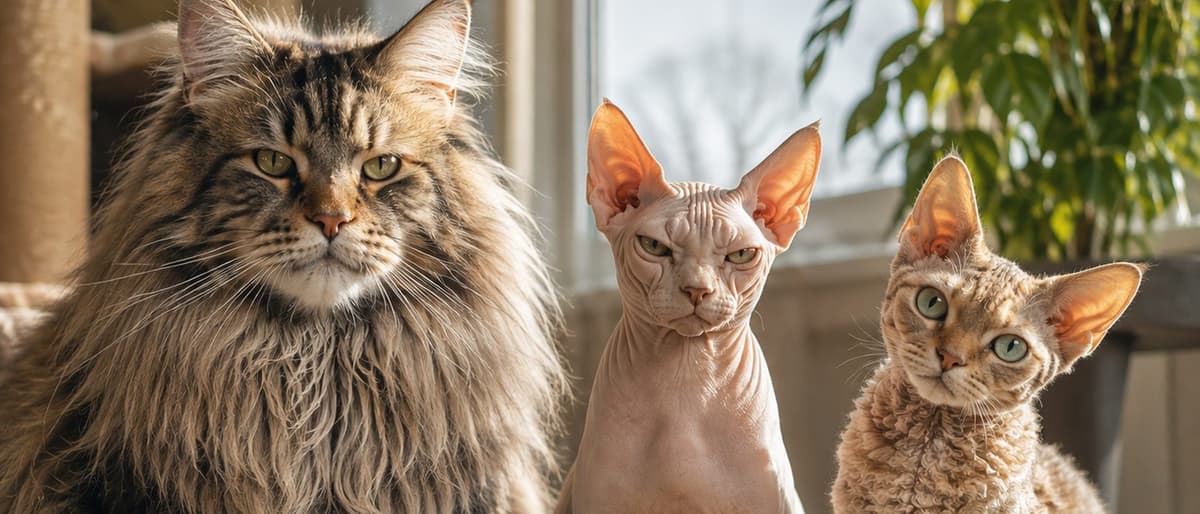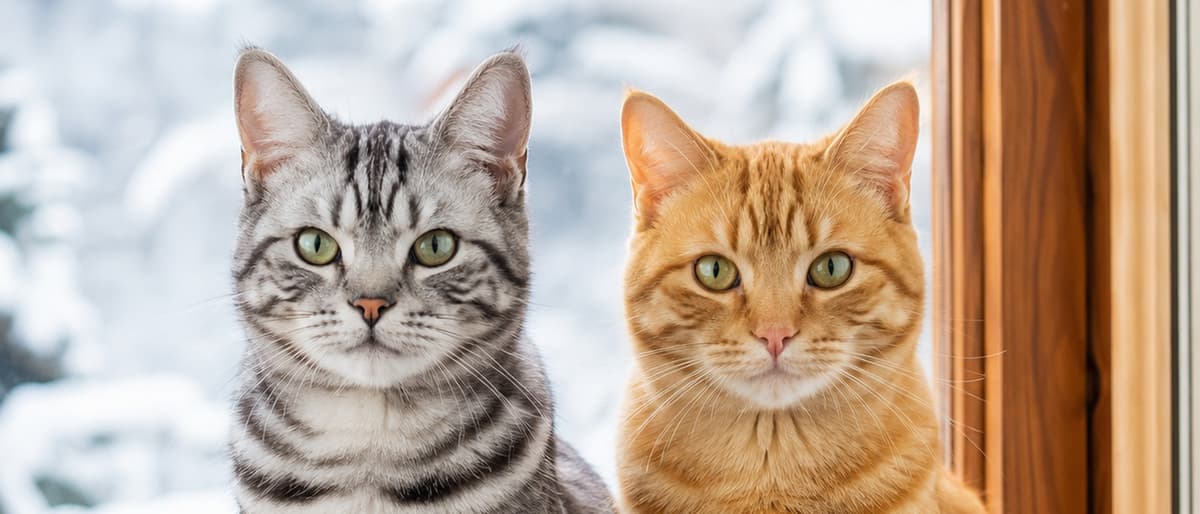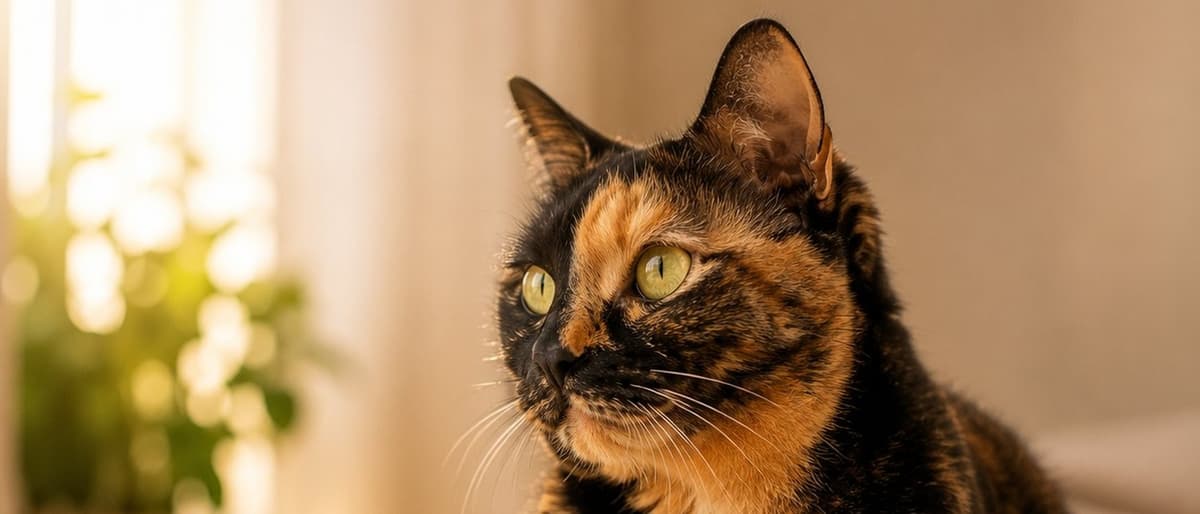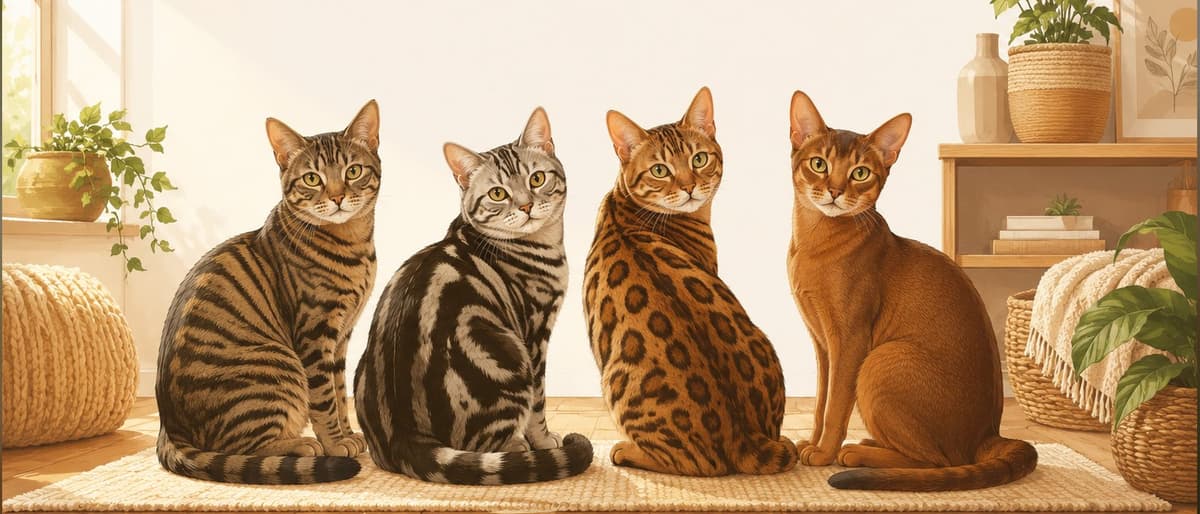
Look at a tabby cat and try to name its pattern. Narrow vertical lines, like a small tiger? Broad, marbled swirls with a “shield” on the flank? Distinct spots? Or a coat with no stripes at all, one that simply “shimmers” evenly (the visual effect of ticking, the banding of individual hairs)? This is neither chance nor a whim of nature — these are four specific patterns, and each of them is drawn by a different, identifiable gene.
This text expands on the guide to coat colour genetics — there we dealt with colours, here we put patterns under the microscope. I have gathered only what follows from peer-reviewed research. I rely mainly on the landmark work of the research group led by Kaelin and Barsh, who took the feline pattern apart into its component pieces.
First the switch: the agouti gene
To talk about stripes at all, the pattern first has to be biologically switched on. That is the job of the gene called agouti (ASIP). In its dominant version (A), every single hair on the cat is banded along its length (agouti banding) — it carries alternating zones of dark and warm pigment. It is out of these multicoloured hairs that the visible tabby pattern on the body is built.
In the recessive version (written genetically as a/a) the cat is non-agouti — that is, solid. A separate mechanism then “paints over” the striped pattern with dark pigment. But here is the fascinating part to remember: that underlying pattern is still physically there.
Ghosts, or the hidden pattern of a solid cat
Look at a solid black cat in strong sunlight. Very often mackerel stripes show through on its body, commonly called ghost markings. This is the best proof that even a black feline “panther” carries a complete tabby pattern underneath, simply covered up. And because that masking mechanism has no effect on red pigment, a solid red cat without the faintest trace of banding does not exist in nature.
Only when the agouti gene is active does the question make sense: which pattern are we dealing with? Nature offers four options here.
Compute your cat's diet — BARF calculatorOpen calculatorThe four patterns a cat can draw
4
All the rest of the complicated names from the show ring are simply variants and modifications of these four.
- Mackerel tabby (the name comes from the fish, because the stripes resemble a mackerel's skeleton): narrow, vertical stripes set densely side by side. This is the familiar picture of the classic brown striped cat.
- Classic / blotched tabby: broad, spiralling swirls on the sides of the body, often forming the characteristic “shield” or “eye” on the animal's shoulder.
- Spotted tabby: what you get when continuous stripes are broken up into separate, distinct spots.
- Ticked tabby (from ticking, meaning fine speckling): a pattern marked by the absence of stripes on the body. All that remains is the fine banding of individual hairs, which makes the whole coat appear to “shimmer” evenly. This is the classic Abyssinian coat.
Now let us look at what does this genetic drawing.
Mackerel versus classic: one gene, Taqpep
This is by far the best-studied piece of the puzzle. Whether an individual is a mackerel or a classic (blotched) cat is decided by one particular gene: Taqpep.
The gene works like a simple two-position switch:
- The dominant version of Taqpep produces the mackerel pattern, generating narrow vertical stripes.
- The recessive version (linked to the loss of the gene's original function) spreads those narrow stripes entirely into the broad, marbled swirls that form the classic pattern.
A classic-patterned cat must inherit the recessive version of Taqpep from both of its parents. That explains why two striped cats can produce classic-patterned offspring — it is enough for both of them to be silent carriers of the recessive gene.
It is worth mentioning that this same gene (Taqpep) is also responsible for the enormous difference in appearance between an ordinary cheetah and the so-called king cheetah. That is remarkable evidence that the shaping of feline patterns rests on the same biological rules across all cats, from the household moggy to the great predators.
The same gene made the “black tigers”
Nine years after the king cheetah paper, the same gene explained another puzzle. In the Similipal reserve in eastern India, around 37% of tigers are pseudomelanistic — with stripes so broad and merged that the animals look almost black. Sagar et al. (2021) showed that this is caused by a mutation in Taqpep present in Similipal and absent in 395 tigers from every other population. As the likely cause the authors point not to selection but to a founder effect and genetic drift in a small, isolated population.
Taqpep or LVRN? It is the same gene
If you ever order a coat-pattern genetic test for your cat, the result may show the abbreviation LVRN (from laeverin) instead of the name Taqpep. That is not a mistake and not a different gene — it is the same sequence under its official symbol. The name “Taqpep” comes from transmembrane aminopeptidase Q and caught on after the 2012 paper; in the genetic databases the same gene is listed as LVRN.
The authors of the 2012 paper also propose a two-step model: Taqpep helps establish a periodic pre-pattern in the developing skin, and only then is it executed by the differential expression of another gene, Edn3. In other words: first the map is made, and only then does someone colour it in.
Spots: when stripes break apart
Put simply, the spotted pattern is stripes that have been interrupted. Instead of forming unbroken bands, they are torn up and fall apart into loose spots. In many cases feline spots are simply a modification of the mackerel or classic pattern, produced by additional factors that effectively cut the continuous line.
For the sake of full scientific honesty it has to be said here that the genetic basis of spots is worked out to a far lesser degree than the workings of Taqpep. On top of that, in different breeds the breaking-up of stripes may rest on entirely different pigmentation-modifying genes. Science is still filling in the details of this process, which is why claims along the lines of “spots are always caused by gene X” deserve due scepticism.
To be precise: this is not “less studied”, it is unknown
It is worth putting this more strongly than it usually is put. The authors of the 2021 paper write plainly that the genetic basis of the difference between the mackerel and the spotted pattern remains unknown. So this is not a matter of missing details, but of a gene that has not been identified.
One thing, however, is settled, and it matters in planning matings: spots are seen only in cats carrying at least one copy of the mackerel version. A classic tabby will not produce spots. That is how it works in breeds such as the Egyptian Mau and the Ocicat.
Ticked: the stripes leave the body
This is the pattern most capable of fooling the eye. In ticked cats (such as the Abyssinian or the Singapura) stripes disappear from the surface of the body altogether. The coat looks “shimmering” and uniform thanks to banding restricted solely to individual hairs. The main agent here is the gene known as DKK4, which encodes a protein that inhibits the Wnt pathway.
When planning litters, there is an important phenomenon to keep in mind: DKK4 is epistatic to Taqpep (that is the biological term for standing above it). In practice, DKK4 masks whatever sits lower in the genetic hierarchy. For that reason, in an adult ticked cat it is very often impossible to see the pattern hidden underneath — it may be genetically classic or mackerel. In most such cases only the birth of kittens reveals what the cat was really carrying in its genes.
Careful with the word “masks”
The natural explanation runs: “DKK4 covers up the existing stripes.” The authors of the study state the opposite. The effect of the ticked variant is not the masking of existing dark stripes, but an influence on how the pattern is laid down at all — on which regions of foetal skin switch DKK4 on in the first place. In the Abyssinian and the Burmese it looks like covering up, but the mechanism is different: the pattern is not painted over, it forms differently from the beginning.
The epistasis itself remains a fact — the difference between the classic and the mackerel pattern is visible only in a cat that is not ticked. The point concerns only how that comes about.
Two teams, the same gene
DKK4 was identified independently by two research groups in the same year. Kaelin's team arrived at it by studying the development of foetal skin, while the 99 Lives consortium led by Lyons searched the genomes of 195 cats to get there (Lyons et al. 2021). Both papers pointed to the same gene and the same two variants. Agreement between two teams travelling by completely different routes is the strongest kind of confirmation genetics has.
The pattern forms before the fur does
The last fact is genuinely surprising. You might think a cat's pattern is “painted” gradually as the coat itself grows. It is not.
The team led by Kaelin showed conclusively that the map setting out the course of a cat's stripes is drawn during the foetal stage, directly in the skin. This happens long before the first pigment-producing cells appear in the skin and before any hair follicle forms there. The research shows that at a very early stage of embryonic development, zones of thicker and thinner skin are visible in the structure of the tissue. It is these that mark out in advance the paths along which dark stripes and pale background will later appear. A cat's body holds a fully planned, laid-out map of its coat pattern at a stage when the animal has no coat at all.
4 days
The 2021 paper shows this even more precisely. At stage 13 the foetal skin is still a uniform, single layer of epithelial cells. Around sixteen days later, at stage 16, the epidermis organises itself into alternating “thick” and “thin” regions — and gene-expression analysis narrows that moment down to four days. In foetuses of the classic genotype those thick regions are widened, exactly as the swirls are widened in an adult classic tabby.
This directly explains why no two cats in the world have identical patterns. Every single animal carries a highly individual scheme of lines, assigned to it back in foetal life.
How to recognise your own cat's pattern
Here is a small crib sheet to make reading a cat's coat easier:
- Mackerel tabby: the lines run vertically and sit densely side by side.
- Classic / blotched tabby: spread-out, fairly broad swirls arranged into shields or rings on the cat's flanks.
- Spotted tabby: distinct dots and separated blotches instead of lines.
- Ticked tabby: stripes may survive only on the face, legs or tail, with uniform, banded (shimmering) hair over the rest of the body.
- A solid cat: look for the pattern in bright light, because the stripes are physically there (ghost markings), merely covered with strong pigment.
The pattern on a coat is the result of how pigments are distributed. It carries no information whatsoever about what character the cat will have. An ordinary backyard mackerel tabby and a show British classic tabby differ in a gene called Taqpep, not in temperament.
References
- Kaelin, C.B., Xu, X., Hong, L.Z., David, V.A., McGowan, K.A., … Barsh, G.S. & Menotti-Raymond, M. (2012). Specifying and sustaining pigmentation patterns in domestic and wild cats, Science, 337(6101), 1536–1541doi:10.1126/science.1220893
- Kaelin, C.B., McGowan, K.A. & Barsh, G.S. (2021). Developmental genetics of color pattern establishment in cats, Nature Communications, 12, 5127doi:10.1038/s41467-021-25348-2
- Lyons, L.A., Buckley, R.M., Harvey, R.J. & the 99 Lives Cat Genome Consortium (2021). Mining the 99 Lives Cat Genome Sequencing Consortium database implicates genes and variants for the Ticked locus in domestic cats (Felis catus), Animal Genetics, 52(3), 321–332doi:10.1111/age.13059
- Sagar, V., Kaelin, C.B., Natesh, M., Reddy, P.A., Mohapatra, R.K. et al. (2021). High frequency of an otherwise rare phenotype in a small and isolated tiger population, Proceedings of the National Academy of Sciences, 118(39), e2025273118doi:10.1073/pnas.2025273118
- Kaelin, C.B. & Barsh, G.S. (2013). Genetics of pigmentation in dogs and cats, Annual Review of Animal Biosciences, 1, 125–156doi:10.1146/annurev-animal-031412-103659
Frequently asked
Is every cat really a tabby underneath?
In a sense, yes. Stripes are a cat's default state — even a solid black cat physically carries a tabby pattern, it is just that a separate mechanism (non-agouti) paints it over with dark pigment. In strong sunlight the mackerel stripes often show through; they are commonly called ghost markings. Because this mechanism has no effect on red pigment, a solid red cat without the faintest trace of striping simply does not exist.
What is the difference between the mackerel and the classic pattern?
It is the same gene (Taqpep) in two versions. The dominant version gives the mackerel pattern — narrow vertical stripes resembling the skeleton of a mackerel. The recessive version, linked to the loss of the gene's original function, spreads them into the broad, marbled swirls of the classic pattern, often with the characteristic “shield” or “eye” on the shoulder. A classic tabby has to inherit that version from both parents — which is why two striped cats can produce classic-patterned kittens.
Why does an Abyssinian have no stripes on its body?
Because the DKK4 gene is at work. It is worth knowing exactly what it does, though: the authors of the study stress that ticking does not consist of painting over existing dark stripes, but changes the way the pattern is laid down in the skin of the foetus in the first place. The result is a coat with no body stripes, carrying only the fine banding of individual hairs. DKK4 is also epistatic to Taqpep — in a ticked cat you usually cannot tell whether it is genetically classic or mackerel underneath.
Where do spots come from?
Science has not established that yet. The authors of the 2021 paper write plainly that the genetic basis of the difference between the mackerel and the spotted pattern remains unknown. What is known is that spots are seen only in cats carrying at least one copy of the mackerel version — a classic tabby will not produce spots. Claims along the lines of “spots are always caused by gene X” are therefore worth treating with due scepticism.
When can you tell what pattern a kitten will have?
The type of pattern is settled genetically at conception, and its map is drawn very early — in the skin of the foetus, before any pigment-producing cells appear and before any hair follicle forms (Kaelin et al. 2021). On a kitten the pattern can be less distinct at first and “matures” over the first weeks and through coat changes, but what it will be was decided much earlier.