Picture the numbers.
Statistically, one in four cats surrendered to a shelter arrives there because of behaviour. And among the behavioural reasons, 43.2 percent are litter box problems — house-soiling, in the English-language literature — meaning the cat either stops using the box altogether or uses it selectively. It is worth noting that these figures come from large-scale studies conducted in the United States, but the problem is universal and affects owners all over the world. It is the single most common reason a cat loses its home.
And among surrendered cats, as many as 72 percent are euthanised in American shelters, according to estimates in the 2014 AAFP/ISFM guidelines. Put plainly: thousands of cats die every year not from a fatal disease, but because of litter box problems.
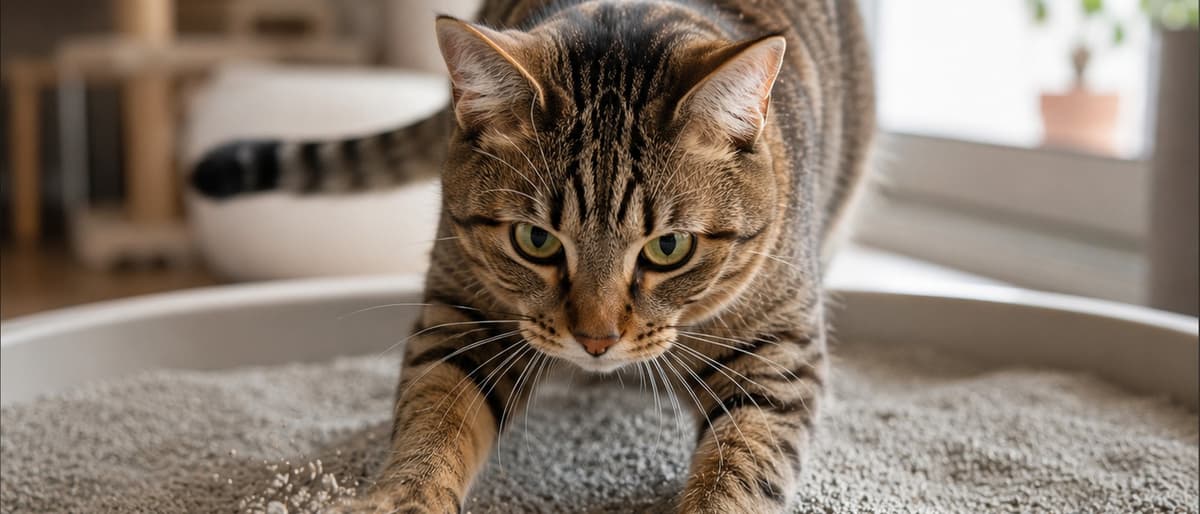
The short answer: a box at least 50 centimetres wide, filled with clay litter. In video observation of 78 cats, the 60 cm and 50 cm boxes were chosen almost equally often (35.9 and 35.5 percent of visits), and the 40 cm box more than twice as rarely (16.9 percent). The reason is anatomical: the thoracolumbar section of an average cat measures 35.3 centimetres, so in a shorter box it cannot adopt its natural posture.
In April 2025 a Japanese team (Iwabuchi-Inoue, Hattori and Kikusui) published a study in the Journal of Veterinary Medical Science that shows, concretely and in numbers, what a cat actually wants: what size, shape and type of litter it prefers. The results are based on data from 78 cats across three controlled experiments.
For every cat owner this should be required reading. Because your cat will not tell you outright that the box does not suit it. It will simply start eliminating next to it. And by then, unfortunately, it is often too late.
The main study: Iwabuchi-Inoue 2025
The methodology covered three experiments. The first examined preferences for box size. Seventy-eight adult cats from three Japanese cat cafés took part. They were offered cardboard litter boxes 40, 50 and 60 centimetres wide, plus their existing box as a control. Video observation ran for three days.
The results were unambiguous. The cats' choices broke down as follows: the 60 cm and 50 cm boxes scored almost identically (35.9 and 35.5 percent of visits respectively), while the 40-centimetre box drew only 16.9 percent. The researchers' conclusion was firm: cats clearly prefer boxes at least 50 centimetres wide.
This is not a mild preference. It is an unambiguous choice: a cat ignores the 40-centimetre box twice as often as the larger ones.
Why 50 centimetres in particular? Anatomy provides the answer. The researchers measured the thoracolumbar vertebrae — the section of the spine covering the chest and loins — in 102 cats. The mean was 35.3 centimetres. So a typical cat has no chance of adopting a full, natural posture in a box shorter than half a metre. It has to contract, hunch and take up a highly uncomfortable position, far from ideal.
35.3 cm
The cat has a further instrument: the vibrissae, extremely sensitive tactile hairs commonly known as whiskers. They act as a spatial sensor, and their span roughly matches the width of the animal's body. A box that is too small means the whiskers brush the walls at every turn. This causes considerable sensory discomfort — exactly the feeling a person would have shut inside an extremely narrow wardrobe.
According to the international feline medicine guidelines (AAFP/ISFM), a litter box should have a minimum length equal to 1.5 times the length of the cat, measured from nose to tail base. For an average cat that means dimensions on the order of 86 by 39 centimetres.
Why 39 cm does not contradict 50 cm
The two numbers describe different sides of the same box. The AAFP/ISFM guidelines give a minimum of 86 by 39 centimetres (34 by 15 inches) — that is, length and width. The Japanese boxes, by contrast, had a fixed depth of 35 cm, and it was the longer side that varied: 40, 50 or 60 cm.
In other words, the „50 cm” in Iwabuchi-Inoue is the longer side, not the shorter one. The shorter side is much the same in both: 35 cm in the study, 39 cm in the guidelines.
Both recommendations therefore say the same thing, and both grow out of the same one-and-a-half rule. The Japanese authors state it explicitly: they adopted 50 cm because it is approximately 1.5 times the mean thoracolumbar length they measured (35.3 × 1.5 ≈ 50).
In the second experiment the researchers examined litter type. The cats were offered three clumping litters: clay (bentonite), wood and paper. Clay won outright and without competition (258 visits). Wood was chosen 152 times, while paper was categorically rejected (a mere 66 times).
In the third and most exciting experiment, a crossover design was used — a scheme in which the subjects are moved back and forth between one environment and another. It covered 20 house cats that already had severe problems with eliminating outside the box. When the cats were given a suitable environment (a wide box of at least 50 cm and clumping clay), the researchers recorded a highly significant increase in elimination inside the box and a drastic fall in elimination outside it. What is more, frustration behaviours such as scratching the plastic rim or scratching the floor right next to the box almost entirely disappeared.
In other words: for a great many cats it was enough to physically change the type of box and litter to solve the very problem for which animals are being put down en masse in shelters.
Compute your cat's diet — BARF calculatorOpen calculatorThe scale of the problem
Salman's team published a paper in 2000 that remains a classic in this field. An analysis of data from 12 American shelters showed that among the behavioural reasons owners gave up cats, litter box problems occupied the inglorious first place, accounting for more than 43 percent of all cases.
The authors identified the main risk factors for losing a home: a daily or weekly frequency of the problem, and a lack of owner education (not reading literature on animal behaviour).
The anatomy of feline elimination
To understand what a cat requires, we need to dip briefly into ethology — the branch of zoology that studies animals' natural behaviour and the instincts shaped by evolution.
The natural sequence of this process, written into the genes, looks like this:
- digging a hollow with the paws in a soft substrate,
- a squatting posture (hind legs abducted, tail held stiffly down),
- passing urine or faeces,
- carefully burying the waste.
This is not a feline whim. Burying waste is a survival mechanism aimed at masking the smell from predators and territorial competitors. The ancestor of our sofa cats, the African wildcat, eliminated on fine-grained desert sand. Clumping clay is a perfect imitation of that substrate, because its fine grains allow the whole digging sequence to be carried out safely for the paw pads.
Digging time in the litter is an excellent indicator of the animal's comfort. In 2006 the research team of Sung and Crowell-Davis demonstrated that cats with litter box problems spent considerably less time digging than healthy cats. If your cat walks in, makes two very quick strokes with a paw and flees the box after a few seconds, that is a loud signal of its aversion to the conditions there. If the cat relaxes, digs for 30 seconds, circles, digs again and buries — everything is perfect.
Litter types — chemistry and preference
Why does clay win? Its mechanism rests on bentonite, a particular rock which swells violently on contact with water, binding the liquid into a compact, safe clump and sealing in the odour.
Silica crystals (silica gel), by contrast, are much larger, hard and have sharp, angular edges. For the highly sensitive pads of a cat's paws, moving across them is simply physically uncomfortable. Cats very often show this aversion by licking their paws excessively right after leaving the box, by sneezing loudly (because of the irritating dust), or by avoiding silica altogether when passing faeces. Wood and paper litters, meanwhile, usually have too coarse a granulation.
And what about scents? Further clinical studies have shown clearly that cats absolutely do not tolerate the artificial fragrances added by manufacturers. What smells to us of a forest meadow or lavender often, in the feline world, masks waste with an unbearably acrid smell of chemical perfume. Your cat simply wants neutrality. International recommendations point categorically to unscented litter.
Number of boxes and where to put them
Litter boxes obey an extremely simple, basic mathematical rule: N+1, where N is the number of cats in the household. That means one cat needs two separate boxes. Two cats mean three boxes, and so on.
What is more, those boxes absolutely must not stand directly next to one another; they should be in separate rooms. Cats perceive litter boxes as critical territorial resources. When two boxes stand shoulder to shoulder, a confident cat can very easily control the entire toilet zone, with the result that the weaker cat is simply afraid to go there and eliminates in another part of the house. Whether a second cat is a good idea at all, and what the research says about it, I have gathered in a separate piece.
A litter box should be in a quiet place that offers peace. Putting it in a noisy utility room, right by the front door, or right next to the food bowls are the biggest strategic errors in managing the home environment.
Should a litter box be covered? A 2013 experiment showed that healthy cats' preferences split evenly on this question (50/50). There is, however, one hard condition: in covered boxes, closed from above, odours cannot disperse naturally. Fumes and dust accumulate inside, discouraging the animal. If you have such a box, it must be cleaned at least twice a day rather than once, to keep the air hygienic enough for the cat.
What to do when your cat eliminates next to the box
This is one of the most important questions.
Step 1 — an absolute must: see a veterinarian
Ruling out a medical basis is the absolute foundation. Inappropriate urination is very often a cry of pain. FLUTD (bladder inflammation, sand, crystals), infections, IBD (inflammatory bowel disease) and early kidney failure all have to be excluded. In older cats — over ten years of age — the main culprit is osteoarthritis. The animal feels tremendous pain trying to climb into a box with a 20-centimetre rim, and so prefers to relieve itself on a smooth carpet.
Step 2 — an audit of the cat's environment
Check how many requirements you meet. Is the box definitely at least 50 cm wide? Are you keeping to the N+1 rule? Do you clean the substrate regularly, every day, using unscented clay in a layer at least 3 centimetres deep?
Step 3 — an analysis of stressors
A new animal? A baby born? Renovation work going on behind the wall, or perhaps very tense relations between individuals? Spikes in stress strongly affect an animal's behaviour at home.
Step 4 — cleaning accidents properly
Stains on carpets or the bed must always be cleaned exclusively with products containing enzymatic neutralisers, which break down organic proteins. Categorically avoid household cleaners based on ammonia, because that compound's odour profile is very close to the odour profile of animal urine. Cleaning a carpet with ammonia gives the animal a very clear, freshly renewed message to come back and finish the job.
What never to do
Under no circumstances punish a cat for eliminating in the wrong place. Shouting and punishment increase the animal's already enormous stress and will only accelerate the problem.
Pushing a cat's nose into urine is an abstraction it cannot possibly understand, and physical harm.
Make any change of litter very slowly and gradually, replacing just 25 percent of the substrate at first and increasing it step by step.
In summary
Your cat will never come up and announce that the litter box you bought is uncomfortable. It will express it in an entirely different language. It will tell you with very shallow, hurried digging, by propping its front paws high on the plastic walls to minimise contact, by vocalising, or finally by doing it right on the bed.
And then it not infrequently ends up in a barred cage in a shelter.
And although this sounds drastic, that fate can most often be prevented by one simple and relatively cheap decision grounded in science. Buy a large box, at least 60 centimetres, fill it with five centimetres of fine, unscented, clumping clay, and find it a convenient and private spot — remembering to scoop it out every single day.
Many cats given up to shelters with the label of spiteful, dirty animals were in truth animals that cared a great deal about hygiene, but were forced to use unsuitable litter boxes.
References
- Iwabuchi-Inoue, Y., Hattori, Y. & Kikusui, T. (2025). Litter box size and litter type preference and their associated behavioral changes in cats, Journal of Veterinary Medical Science, 87(6), 614–620doi:10.1292/jvms.24-0468
- Salman, M.D., Hutchison, J., Ruch-Gallie, R., Kogan, L., New, J.C., Kass, P.H. & Scarlett, J.M. (2000). Behavioral reasons for relinquishment of dogs and cats to 12 shelters, Journal of Applied Animal Welfare Science, 3(2), 93–106doi:10.1207/S15327604JAWS0302_2
- Carney, H.C., Sadek, T.P., Curtis, T.M., Halls, V., Heath, S., Hutchison, P., Mundschenk, K. & Westropp, J.L. (2014). AAFP and ISFM guidelines for diagnosing and solving house-soiling behavior in cats, Journal of Feline Medicine and Surgery, 16(7), 579–598doi:10.1177/1098612X14539092
- Guy, N.C., Hopson, M. & Vanderstichel, R. (2014). Litterbox size preference in domestic cats (Felis catus), Journal of Veterinary Behavior, 9(2), 78–82doi:10.1016/j.jveb.2013.11.001
- Grigg, E.K., Pick, L. & Nibblett, B. (2013). Litter box preference in domestic cats: covered versus uncovered, Journal of Feline Medicine and Surgery, 15(4), 280–284doi:10.1177/1098612X12465606
- Cottam, N. & Dodman, N.H. (2007). Effect of an odor eliminator on feline litter box behavior, Journal of Feline Medicine and Surgery, 9(1), 44–50doi:10.1016/j.jfms.2006.08.004
- Sung, W. & Crowell-Davis, S.L. (2006). Elimination behavior patterns of domestic cats (Felis catus) with and without elimination behavior problems, American Journal of Veterinary Research, 67(9), 1500–1504doi:10.2460/ajvr.67.9.1500
- Villeneuve-Beugnet, V. & Beugnet, F. (2018). Field assessment of cats' litter box substrate preferences, Journal of Veterinary Behavior, 25, 65–70doi:10.1016/j.jveb.2018.03.002
- Heath, S. (2019). Common feline problem behaviours: unacceptable indoor elimination, Journal of Feline Medicine and Surgery, 21(3), 199–208doi:10.1177/1098612X19831202
Frequently asked
What is the best litter box for a cat?
One at least 50 centimetres wide. In the study by Iwabuchi-Inoue and colleagues (2025), cats chose 50 cm and 60 cm boxes almost equally often, and the 40 cm box less than half as often. The reason is anatomical: a cat's thoracolumbar section averages 35.3 centimetres, so in a shorter box the animal has to hunch and contract. The AAFP and ISFM guidelines add a complementary rule: box length should be about 1.5 times the length of the cat, measured from nose to tail base.
Which litter do cats prefer?
Fine, clumping bentonite clay, unscented. In the same study clay drew 258 visits, wood 152 and paper only 66. Clay best imitates the fine-grained sand on which the domestic cat's desert ancestor eliminated, and it lets the cat perform the whole digging sequence without hurting its paw pads. Many cats avoid silica crystals because of their hard, angular edges. Cats do not tolerate artificial fragrances — international guidance points to unscented litter.
How many litter boxes does a cat need?
The N+1 rule applies, where N is the number of cats in the home. One cat needs two boxes, two cats need three, and so on. The boxes must not stand side by side — they belong in separate rooms. Cats treat a litter box as a territorial resource, so when two stand shoulder to shoulder a confident cat can control the whole zone and a weaker one will go elsewhere in the house.
What should I do if my cat eliminates next to the litter box?
See a veterinarian first — inappropriate urination is very often a signal of pain, and FLUTD, infections, inflammatory bowel disease and early kidney failure have to be ruled out, as does osteoarthritis in cats over ten. Only then audit the environment: box width, the N+1 rule, unscented clay and daily scooping. Never punish the cat — punishment raises stress and accelerates the problem. Clean accidents only with enzymatic neutralisers, never with ammonia.