The box of toys stands in the corner. Inside it there is a toy mouse that once drove the cat wild, a ball with a bell, something furry on a spring, and a wand toy that on the first day was the best thing in the world. Today the cat walks past all of it with the expression of someone who has seen too much in life. And a moment later it is hunting a bottle cap with total commitment.
This is not a whim and not spoiling. It is a mechanism researchers have taken apart piece by piece — and one that explains why rotating toys works better than buying more of them.
A cat does not get bored with play. It gets bored with the stimulus
The key study was published in 2002 by Sarah Hall, John Bradshaw and Ian Robinson. They proposed a hypothesis that sounds banal but has concrete consequences: a cat's play ends not because the cat loses the appetite for it, but because it habituates to one particular object.
They tested it simply. Cats were given the same toy across three consecutive short sessions. The intensity of play fell from session to session, until it had almost entirely faded. Then, in a fourth session, some of the cats received a contrasting toy — different in colour, and therefore also in smell.
The effect was immediate: play came back at full strength.
3 sessions
If the cause had been fatigue or a drop in motivation, swapping the object would have changed nothing. But it did change things, and at once. The motivation to play was there the whole time; what was blocked was only the response to that one, already familiar object.
More interesting still is the effect of the gap between sessions. When the interval was 25–45 minutes, play after the swap was weaker than at the very beginning. When the interval was shortened to five minutes, it was more intense than the first time round. Researchers call this rebound from inhibition.
Two terms worth telling apart
Disinhibition is the phenomenon in which an extinguished response returns after a change of stimulus. Rebound from inhibition is its stronger version: the response returns stronger than it originally was.
From this the authors drew a conclusion about two independent mechanisms governing a cat's play:
- A prey detector — responds to features resembling prey: small size, movement, complex texture.
- A change detector — watches whether the object is changing. If it is not, it shuts the whole response down.
A cat's default behaviour towards any object therefore looks like this: initial interest, if the object has the right features — and then rapid habituation, unless those features change.
What a toy that actually works looks like
Before we start rotating, it is worth knowing what is even worth rotating. The answer came from an earlier study by the same team, in which cats were presented with objects differing in size, texture and movement.
| Feature | What works hardest |
|---|---|
| Size | Small, about 7 × 5 × 1 cm — that is, the size of a mouse |
| Movement | Essential; a motionless object produces a far weaker response |
| Texture | Real fur, feathers or artificial fur beat other materials |
This is fairly brutal news for the toy industry: a cat does not need electronics or eight functions. It needs something small, fluffy and moving in a way that looks like fleeing.
Hunger comes into it too. In a 1998 study cats were tested in two states: right after a meal, and after 16 hours without food. Hungry cats played with a small toy more contactfully — with more behaviours resembling the killing of prey. Towards a larger toy they reacted more cautiously, more investigatively. Exactly the same pattern had been described earlier for real hunting: the probability of an attack depends on the size of the prey and the degree of hunger.
The practical conclusion
Play works best before a meal, not after it. The order „hunt, then eat” is, after all, the one a cat knows from nature.
Why a disintegrating toy is often the best one
In the discussion of their paper, Hall and colleagues draw attention to a property they call the changeability of the object. Real prey changes during a hunt: it weakens, stops fleeing, comes apart, gets soaked with saliva. For the cat this is a signal of progress — information that the hunt is going the right way.
An ordinary toy does not change at all. After two minutes it looks exactly as it did at the start, so the change-detecting mechanism reports: nothing is happening, we are done.
Hence the phenomenon every owner knows: a wand toy that has lost its feathers can become toy number one. Not despite falling apart — because of it. Pieces coming loose, material wet with saliva, an ever more frayed tip: to a cat this is information that the prey is giving way.
A toy that does not change is, to a cat, prey that cannot be caught. And such a hunt makes no sense. It is also the most dangerous moment of the whole business — but more on that shortly.
How much play a day? There is a number
It is rare for a piece of behavioural advice to have a controlled trial on several hundred cats behind it. This one does.
A team from the University of Exeter ran a twelve-week experiment across 219 households with 355 outdoor cats that hunted regularly. Owners first spent several weeks scrupulously counting the prey brought home, and were then randomly assigned one of the interventions.
| Intervention | Change in the number of prey brought home |
|---|---|
| High meat content, grain-free food | −36% |
| 5–10 minutes of object play a day | −25% (and −35% for mammals alone) |
| Birdsbesafe collar cover | −42% for birds, no effect on mammals |
| Bell on the collar | no discernible effect |
| Food puzzle | +33% |
Three numbers that stayed in the full text
The table shows the effect on all prey combined. The results section, however, gives separate figures for mammals and birds — and the differences can be larger than in the overall summary.
Food puzzles raised the number of mammals by 49%, considerably more than the 33% visible in the combined row.
High meat content food cut the number of birds by 44% — working on birds even better than the Birdsbesafe collar cover, which was designed for exactly that purpose.
And after the trial ended, 76% of owners said they would carry on with daily play. In practice that is the most important of these numbers: an intervention that works but that people do not want to use is useless. This one they wanted to keep.
The play consisted of letting the cat stalk, chase and pounce on a feathered wand toy, and at the end receive a toy mouse it could catch and bite. That is, the full hunting sequence together with its ending.
That last part matters. Play cut off halfway — the feather disappears into a drawer before the cat has caught anything — leaves the cat with an unfinished hunt. Closing the sequence with something that can be caught, bitten and „killed” is part of the mechanism, not a decoration.
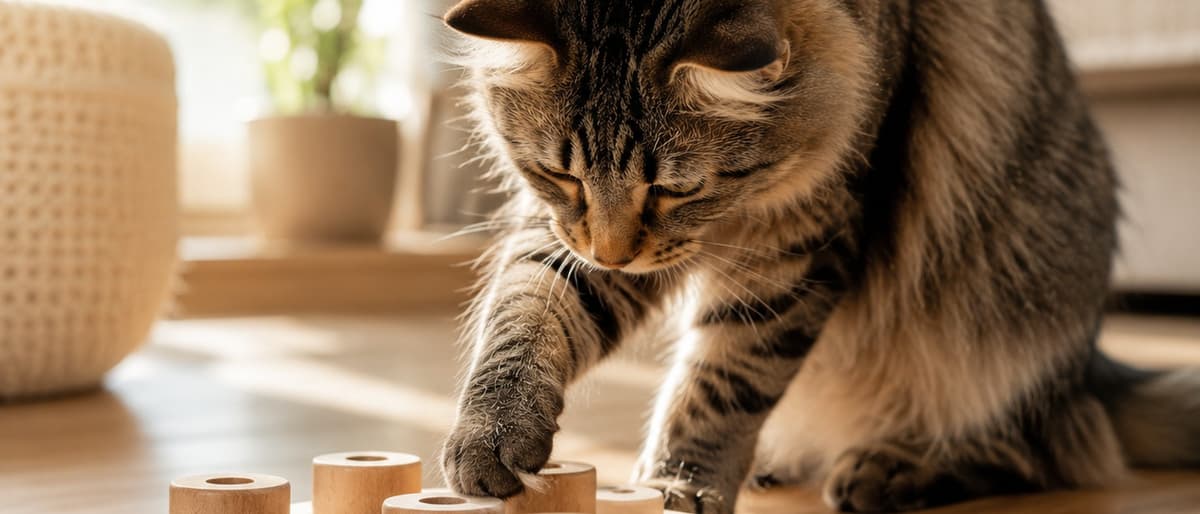
Food puzzles: excellent, but not instead
That same row in the table above, the one that says „+33%”, is one of the most interesting results of the whole study — and it needs an honest comment, because food puzzles also have strong evidence in their favour.
On the plus side: a paper published in JFMS by the team of Dantas, Delgado, Johnson and Buffington gathered a series of cases from behavioural practices in which, after food puzzles were introduced, cats lost weight (from a few to more than 30 percent of body mass over a year to eighteen months), aggression towards people and other cats decreased, anxiety and attention-seeking behaviours eased, and in a cat with cognitive dysfunction the daily rhythm improved. In a shelter study, 23 of 27 cats used a puzzle with no rise in aggression within the group. The authors themselves note the limitations: these are case descriptions, often combined with other interventions.
On the side of caveats there are two results. The first is precisely that rise in the number of prey — one possible explanation being that a cat which has to work for food at home is more motivated to hunt outside. The second comes from research into a phenomenon called contrafreeloading, that is, animals' tendency to choose food that requires effort over food offered outright. It has been demonstrated in birds, rodents, wolves, primates and even giraffes. Cats placed before a choice between a puzzle and a tray with the same food ate significantly more from the tray. Of 17 cats, as many as eight showed no such tendency at all.
How to reconcile the two
A food puzzle is a good tool for a cat that is bored, eats too greedily or is overweight — but it is not a substitute for play with a person, and not every cat will take to it. Introduce it alongside a full bowl, at an easy level of difficulty, and watch whether the cat actually uses it.
How to rotate toys so that it means something
A few simple rules follow from the research. Let me be honest about one thing: the rotation schedule itself has not been tested under home conditions — what was tested is how fast play fades and how strongly it returns after a change of stimulus. The rest is a reasonable inference from that data.
- Keep three or four toys out, not all of them. A toy permanently within the cat's reach stops being a stimulus — it becomes furniture.
- Swap the set every few days. You do not have to buy anything new: an old toy mouse put away for two weeks comes back as a different stimulus.
- Hide them properly. A toy „hidden” on a visible shelf is still in the cat's field of view and still goes stale.
- Vary the features, not just the items. Since contrast is what restores play, the next set should differ in texture and manner of movement, not merely in the colour of the plastic.
- Leave structures permanently in place. Tunnels, hiding spots, a rug to stalk beneath — these are not objects of play in the sense in which toys were studied, but the scenery that makes the first phase of the hunt possible. There is no reason to rotate them.
- Play with your cat daily, briefly, before a meal and with the sequence closed.
Safety: what tempts most can be the most dangerous
Back to the disintegrating wand toy. Everything that makes it attractive — loose strings, feathers coming away, small parts — makes it risky at the same time.
The biggest problem here is not small plastic parts but string, thread and ribbon. In cats, so-called linear foreign bodies are a well-documented reason for gastrointestinal surgery. In a retrospective analysis of 56 cats operated on for foreign bodies, 18 had a linear foreign body, and their procedures lasted longer and more often ended in surgical site infection than with ordinary swallowed objects.
Worth remembering
The practical rule is single and simple: wand toys, string and anything that frays come out only for supervised play, and then go back in the drawer. For solo play we leave objects that are all of a piece, with nothing to bite off.
In summary
A cat that walks indifferently past a box of toys is not a bored, glum creature without passion. It is a predator whose nervous system has made a very sensible decision: not to invest energy in prey that has looked identical for three weeks and does not run away.
The whole art lies, then, not in buying but in managing the stimulus: a few toys out, the rest put away, a swap every few days, five minutes of shared hunting a day before dinner, and something that can be caught at the end. That is far cheaper than another electric mouse — and, more importantly, it has been tested.
References
- Hall, S.L., Bradshaw, J.W.S. & Robinson, I.H. (2002). Object play in adult domestic cats: the roles of habituation and disinhibition, Applied Animal Behaviour Science, 79(3), 263–271doi:10.1016/S0168-1591(02)00153-3
- Hall, S.L. & Bradshaw, J.W.S. (1998). The influence of hunger on object play by adult domestic cats, Applied Animal Behaviour Science, 58(1–2), 143–150doi:10.1016/S0168-1591(97)00136-6
- Cecchetti, M., Crowley, S.L., Goodwin, C.E.D. & McDonald, R.A. (2021). Provision of high meat content food and object play reduce predation of wild animals by domestic cats Felis catus, Current Biology, 31(5), 1107–1111doi:10.1016/j.cub.2020.12.044
- Delgado, M.M., Han, B.S.G. & Bain, M.J. (2022). Domestic cats (Felis catus) prefer freely available food over food that requires effort, Animal Cognition, 25(1), 95–102doi:10.1007/s10071-021-01530-3
- Dantas, L.M.S., Delgado, M.M., Johnson, I. & Buffington, C.A.T. (2016). Food puzzles for cats: feeding for physical and emotional wellbeing, Journal of Feline Medicine and Surgery, 18(9), 723–732doi:10.1177/1098612X16643753
- Gollnick, H.R., Schmiedt, C.W., Wallace, M.L., Sutherland, B.J. & Grimes, J.A. (2023). Retrospective evaluation of surgical treatment of linear and discrete gastrointestinal foreign bodies in cats: 2009–2021, Journal of Feline Medicine and Surgery, 25(6), 1098612X231178140doi:10.1177/1098612X231178140
- Ellis, S.L.H., Rodan, I., Carney, H.C., Heath, S., Rochlitz, I., Shearburn, L.D., Sundahl, E. & Westropp, J.L. (2013). AAFP and ISFM feline environmental needs guidelines, Journal of Feline Medicine and Surgery, 15(3), 219–230doi:10.1177/1098612X13477537
Frequently asked
Why does my cat get bored with a toy?
Because it habituates to one particular object rather than losing its appetite for play. Hall, Bradshaw and Robinson (2002) gave cats the same toy across three consecutive short sessions and the intensity of play faded almost completely. When some of the cats received a contrasting toy in a fourth session, play returned at once and at full strength. If fatigue were the cause, a swap would change nothing. The authors described this as two mechanisms at work: a prey detector responding to prey-like features, and a change detector that shuts the response down when the object stays the same.
How often should I rotate my cat's toys?
Keep three or four toys out and swap the set every few days. You do not need to buy anything new — an old toy mouse put away for two weeks comes back as a different stimulus. Hide them properly, because a toy left on a visible shelf still goes stale, and vary texture and movement rather than just colour. An honest caveat: the rotation schedule itself has not been tested in home conditions. What was tested is how fast play fades and how strongly it returns after a change of stimulus — the rest is a reasonable inference from that data.
How many minutes a day should I play with my cat?
Five to ten minutes a day has a controlled trial behind it. A team from the University of Exeter ran a twelve-week experiment across 219 households with 355 outdoor cats. Daily object play cut the number of prey animals brought home by 25 percent. Closing the sequence matters: the cat should stalk, chase and pounce on a wand toy, and at the end get something it can catch and bite. Play cut off halfway leaves the cat with an unfinished hunt. It works best before a meal, not after.
Are food puzzles good for cats?
They are a good tool but not a substitute for play with a person. In their favour: the case series by Dantas and colleagues (2016) describes weight loss, reduced aggression, and the easing of anxiety and attention-seeking behaviour. Against: in Cecchetti and colleagues (2021) food puzzles raised the number of prey brought home by 33 percent, and Delgado and colleagues (2022) showed that cats offered a choice between a puzzle and a tray ate significantly more from the tray. Introduce one alongside a full bowl, at an easy difficulty, and check whether the cat actually uses it.