You buy a new food. The best on the market, vet-recommended, the perfect protein-to-fat ratio. You put it in the bowl. Your cat sniffs it, gives you a pitying look, and walks away. You try the next day. And the next. The cat eats its old food, and the new one sits untouched.
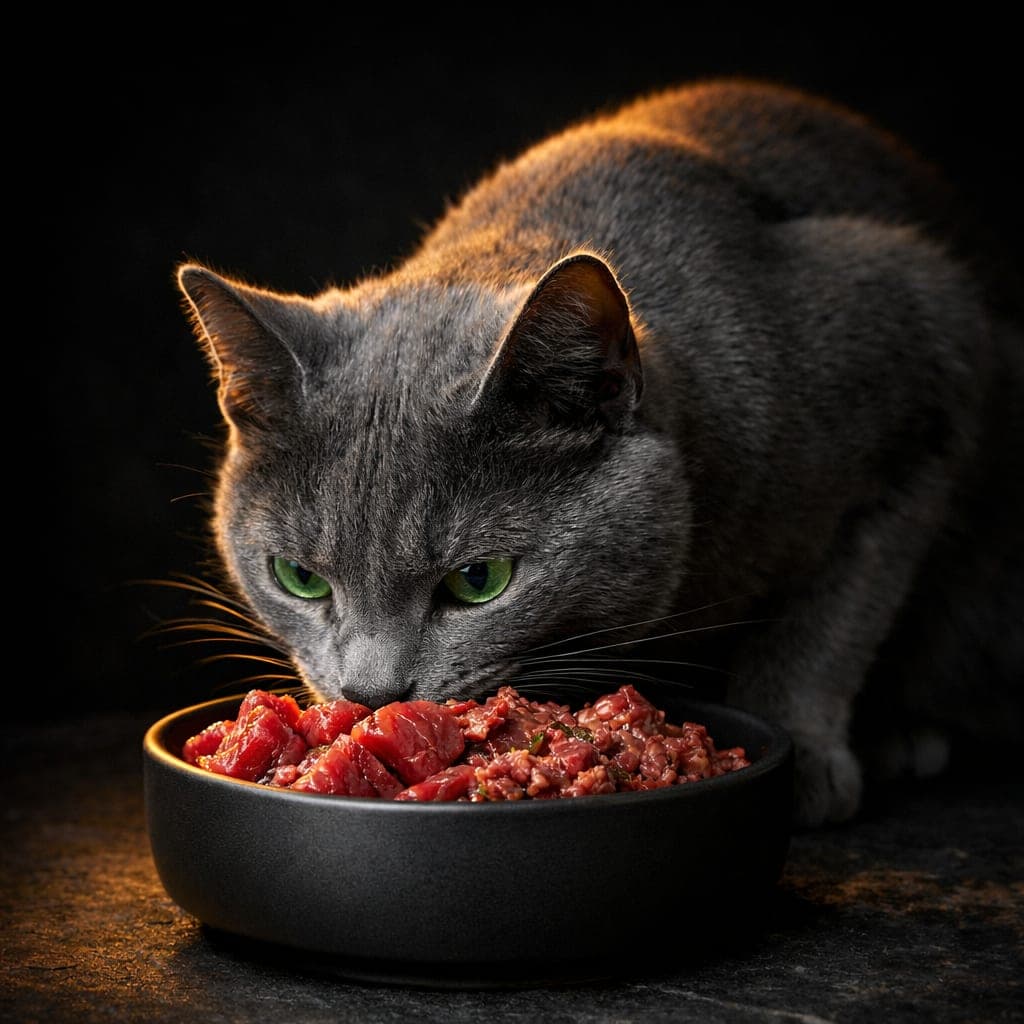
You try to switch to BARF. Raw chicken heart — a perfect source of taurine. You put it in the bowl. The cat looks personally offended. Didn't even lick it. As if it were poison.
Spoiled? Stubborn? No. Your cat has switched on an evolutionary defense system that has protected it for millions of years. It's called food neophobia.
What is food neophobia?
Food neophobia — from the Greek neo (new) + phobos (fear) — is an instinctive distrust of unfamiliar food. A cat that has never eaten raw meat treats it the same way you'd treat a suspicious fish at a market in a foreign country: cautiously, at a distance, and probably without tasting it.
This is not fussiness. It's a survival mechanism.
John Bradshaw — professor at the University of Bristol and a world-renowned expert on feline behavior — explains this in his review "Normal feline behaviour" (2018, Journal of Feline Medicine and Surgery): food neophobia in cats is an evolutionary adaptation. A cat in the wild is an obligate carnivore (one that must eat meat to survive, for anatomical and metabolic reasons) — eating an unknown plant, insect or fungus could mean death. So evolution "built in" a default setting:
Unfamiliar food = potentially poisonous = don't eat.
— Neophobia in one sentence
The problem? The very mechanism that protected wild cats from poisoning now makes your housecat refuse a new food it desperately needs. Evolution didn't anticipate pet shops.
The window that changes everything: weeks 3-8 of life
The most important discovery in research on feline neophobia concerns when it takes shape. And the answer is surprisingly precise.
Prenatal imprinting — before the cat is even born
It begins even earlier than you'd think. Becques and colleagues (2010, Chemical Senses) ran the first experiment proving that a kitten's food preferences begin forming while still in the womb of the pregnant queen. We call this phenomenon prenatal imprinting (a lasting memory laid down before birth).
The experiment was very simple: mother cats were fed a cheese-flavored diet for 25 days before giving birth. When the kittens were born and just 2 days old, they were tested in a two-choice test (where the animal had two options to choose from) — the smell of cheese vs. the smell of ordinary food.
The result? The kittens of the "cheese" mothers oriented toward the cheese smell significantly more often. The control kittens chose at random. Aromas from the mother's diet pass through the amniotic fluid and later through the milk — programming a kitten's senses of taste and smell before its first independent meal.
In a second experiment, Becques extended exposure across the pre- and postnatal period. Mothers were fed a cheese-flavored diet from day 25 before birth to day 23 after birth. The kittens absorbed the new smell and taste first in the amniotic fluid, then through the mother's milk.
Then, once those same kittens were 45 days old (long past milk-drinking and eating solid food), they were tested. The result? Kittens previously exposed to the cheese aroma ate significantly more cheese-flavored chicken than plain-flavored chicken. The control group showed no preference whatsoever.
Takeaway
The diet of a pregnant and nursing mother literally programs the food preferences of her kittens. If the mother cat eats BARF — her kittens will be predisposed to raw meat. If she eats only dry food — the kittens will be "programmed" for kibble.
Weeks 3-8: the critical window
Between weeks 3 and 8 of life, kittens pass through a period scientists call the critical window for dietary imprinting. This is the time when exposure to different flavors, textures and smells has a disproportionately large effect on lifelong food preferences.
Kuo (1967) demonstrated this in a landmark experiment: kittens fed a varied diet in the post-weaning period accepted a wide range of foods at 6 months of age. Kittens fed a single ingredient — rejected most new foods.
3-8 wk
A monotonous diet in kittenhood = neophobia in adulthood. A varied diet in kittenhood = openness in adulthood. It's decided once, in the first two months of a kitten's life.
Weeks 5-8: the mother as teacher
Here enters one of the most beautiful studies in the history of animal behavior. Wanda Wyrwicka (1978) trained mother cats to eat… bananas and potatoes. Yes — obligate carnivores ate bananas, ignoring meat, because they received hypothalamic stimulation (a neural reward) for doing so.
And then she watched what the kittens did.
The result: 18 of 22 kittens (82%) copied their mother and ate bananas or potatoes — ignoring the meat sitting right beside them. The kittens didn't begin copying the mother before day 35 of life, and the peak of imitation fell on days 49-56 (weeks 7-8).
And most importantly: the kittens kept eating bananas/potatoes after weaning — even when tested on their own, at 9-27 weeks of age. The mother cat had "programmed" them for food that is biologically absurd for an obligate carnivore.
The control group? 8 of 9 kittens (89%) that had never seen their mother eat a banana — refused the banana through three 24-hour tests.
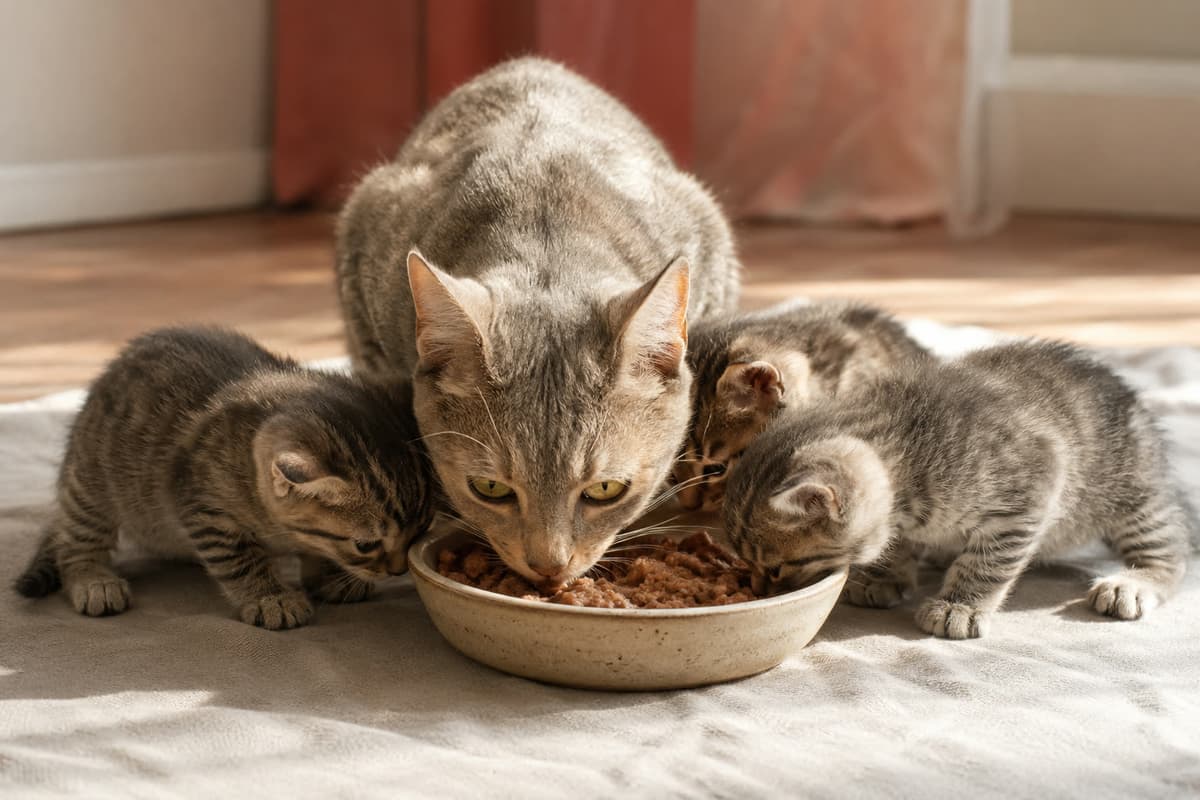
Kittens eat what their mother eats. Not what's "natural." Not what's "healthy." What they see in their mother's mouth between weeks 5 and 8 of life.
— Takeaway from Wyrwicka 1978
After week 8: the window closes
After week 8 of life the critical window begins to close — gradually, not suddenly. Bradshaw (2018) notes that the socialization period in cats runs from 2 to 9 weeks, with declining sensitivity in the following weeks.
- Up to around week 12 new flavors can still be accepted, but they require more effort.
- After week 12 neophobia begins to dominate.
- After 6 months food preferences are largely set.
This doesn't mean an adult cat can't learn to eat new food. It can. But it takes systematic work — not a one-off bowl on the floor.
Compute your cat's diet — BARF calculatorOpen calculatorA timeline of the feline palate
| Period | What happens | Source |
|---|---|---|
| Prenatal | Aromas from the mother's diet pass through the amniotic fluid → prenatal taste imprinting | Becques 2010 |
| Weeks 0-2 | Mother's milk only. Aromas from the mother's diet pass into the milk | Becques 2010 |
| Weeks 2-3 | First interest in solid food. The mother begins bringing prey | Bradshaw 2018 |
| Weeks 3-8 | Critical window. Exposure to flavors, textures, smells shapes adult preferences | Kuo 1967, Bradshaw 2018 |
| Weeks 5-8 | Peak of copying the mother — kittens actively do what their mother does (peak: days 49-56) | Wyrwicka 1978 |
| Weeks 8-12 | The window closes. New flavors still possible, but acceptance grows harder | Bradshaw 2018 |
| >12 weeks | Neophobia dominates. New food = "suspect" | Bradshaw 1986 |
| 6+ months | Preferences largely set. The primacy effect is strong | Stasiak 2001, Kuo 1967 |
Two opposing mechanisms: primacy vs. novelty
Maciej Stasiak (2002, Nutritional Neuroscience) isolated two mechanisms that shape the food preferences of adult cats — and both stem from early experiences:
The primacy effect
Adult cats prefer the diet they were raised on. It's the "safe base" — food the brain associates with safety (because the mother provided it, because it caused no illness, because it's familiar).
Stasiak demonstrated this in an experiment: 4 cats fed exclusively beef for 6 months and 4 cats fed exclusively tuna. The "beef cats" had a strong preference for beef, the "tuna cats" for tuna — even into adulthood.
The primacy effect is strongest in situations of stress, illness or a change of surroundings. A sick cat, a cat after a move, a cat at the vet clinic — all will reach for "their" diet, the one from kittenhood.
The novelty effect
By contrast — cats that feel safe and relaxed may show a preference for new food (neophilia). It's an exploratory mechanism: "I'm safe, I can try something new."
Stasiak discovered something interesting: both groups (beef and tuna), when given a choice, preferred tuna — regardless of what they'd been raised on. The novelty effect + the exceptional palatability of tuna (histidine + IMP — see Why cats can't taste sweetness) overrode the primacy effect.
Where is your cat on the spectrum?
| ← Neophobia | → Neophilia |
|---|---|
| Monotonous diet as a kitten | Varied diet as a kitten |
| Stress, illness, new place | Safety, relaxation |
| Adult / senior | Young / curious |
| No exposure to new flavors | Regular rotation |
Neophobia and neophilia are two ends of the same spectrum. Your cat's position on this spectrum was largely programmed in the first 8 weeks of life — but it can be shifted. Slowly. Patiently.
Why does this matter for a cat's health?
Neophobia is not just an "inconvenient habit." It has real health consequences:
1. Changing the diet during illness. A cat with chronic kidney disease (CKD) needs a low-phosphorus diet. A cat with diabetes — a low-carbohydrate one. A cat with urolithiasis — one with modified pH. If your cat is neophobic and has eaten a single dry food its whole life — changing the diet during illness becomes a medical nightmare. The cat refuses the new therapeutic food, loses weight, and the disease progresses.
2. Switching to BARF. A cat raised on dry food has never seen raw meat. The smell, the texture, the temperature — it's all foreign. The neophobic system says: "this is not food." The owner tries once, twice, and gives up. "My cat won't eat BARF." No. Your cat doesn't yet know that this is food. It needs time to learn.
3. Emergencies. The favorite food is out of stock. A move. A flood. A pandemic and supply shortages. A cat that eats only one specific brand is doomed to a hunger strike if that brand disappears from the shelf.
How to break neophobia in an adult cat?
An adult cat can learn to accept new food. But it requires understanding the mechanisms — not fighting the cat.
1. The mere-exposure effect
Bradshaw (1986) proved that mere exposure to unfamiliar food alone — the sight and smell, without any pressure to eat — reduces neophobia. The cat doesn't have to eat the new food. It has to see and smell it repeatedly.
In practice: place the new food beside the old. Don't remove the old. Don't force. Let the cat see the new bowl, smell it, get used to its presence. Over several days. A week. Two.
2. Gradation — small steps
Instead of an abrupt change (old → new): add the new to the old at a ratio of 10:90, then 20:80, then 30:70. A change so slow the cat doesn't register the moment of transition.
When switching to BARF: start with freeze-dried meat sprinkled over the old food. Then add a microscopic piece of raw meat beside the bowl. Then a bigger one. Then mix it with wet food. Weeks, not days.
3. Temperature and aroma
Warming the new food to 37°C (body temperature — see Why cats prefer warm food, Eyre 2022) releases more volatile aromatic compounds. A stronger smell = more information for the feline nose = less uncertainty = less neophobia.
4. The presence of a "trusted person"
Wyrwicka (1978) showed that kittens eat what they see in their mother's mouth. With an adult cat, you are the "mother." Eat beside the cat (literally — sit by the bowl). Show that you yourself are reaching for food from a plate nearby. Social facilitation (the psychological phenomenon of social imitation) — observing "someone trusted eating" — greatly reduces neophobia.
5. Patience — not a hunger strike
WARNING: never starve a cat
NEVER starve a cat to "force" a diet change. Cats that don't eat for 24-48 hours are at risk of hepatic lipidosis (fatty liver disease) — a serious, potentially fatal condition. Obese cats especially. You break neophobia through exposure, gradation and patience. Never through starvation.
What does this mean for breeders and kitten owners?
If you have influence over a kitten's first weeks of life — you hold the key to its future palate.
For breeders
- The pregnant mother's diet matters — aromas from her diet program the kittens prenatally (Becques 2010). If the mother eats BARF — the kittens will be predisposed to raw meat.
- Weeks 3-8: variety! Offer kittens different textures (raw, cooked, paté, chunks), different meat species (chicken, turkey, beef, rabbit), different temperatures. The more experiences in this window — the more flexible the palate in adulthood.
- Let the kittens see the mother eat — social facilitation (Wyrwicka 1978). A mother eating raw meat = kittens learning that raw meat is food.
For new kitten owners
- Ask the breeder what they fed — that's your base (the primacy effect, Stasiak 2002). You start from it, but you don't end there.
- First weeks at home: introduce the new — an 8-12-week-old kitten is still in the tail end of the window. Use it. Offer samples of different foods, textures, temperatures.
- Don't feed a single food for years — monotony = neophobia. Regular rotation of flavors and textures keeps the palate flexible.
For owners of adult cats
- It's never too late — but it takes work. Pure exposure + gradation + warmth + patience.
- Plan ahead — if you know your cat may one day need a therapeutic diet (CKD, diabetes) — start introducing variety NOW, before it's too late.
- The BARF Pro calculator will help you balance the diet no matter what stage of transition you're at — whether your cat still eats 90% old food with 10% raw meat, or already 100% BARF.
Summary: your cat isn't picky — it's programmed
Food neophobia in cats is not a character flaw. It's an evolutionary safety system, shaped over millions of years of predation, programmed in the first weeks of life by the mother's diet and early experiences.
A cat that refuses new food isn't telling you "I don't want it." It's saying "I don't know if it's safe." And that's a fundamental difference — because you can't do anything about "I don't want it," but about "I don't know" — you absolutely can.
All you have to do is give it time to find out.
References
- Bradshaw J.W.S. (1986). Mere exposure reduces cats' neophobia to unfamiliar food, Animal Behaviour 34:613-614
- Bradshaw J.W.S. (2018). Normal feline behaviour: …and why problem behaviours develop, Journal of Feline Medicine and Surgery 20(5):411-421↗
- Wyrwicka W. (1978). Imitation of mother's inappropriate food preference in weanling kittens, Pavlovian Journal of Biological Science 13(2):55-72↗
- Kuo Z.Y. (1967). The Dynamics of Behavior Development, Random House, New York
- Becques A., Larose C., Gouat P., Serra J. (2010). Effects of pre- and postnatal olfactogustatory experience on early preferences at birth and dietary selection at weaning in kittens, Chemical Senses 35(1):41-45↗
- Stasiak M. (2002). The development of food preferences in cats: the new direction, Nutritional Neuroscience 5(4):221-228↗
- Stasiak M. (2001). The effect of early specific feeding on food conditioning in cats, Developmental Psychobiology 39(3):207-215↗
- Alegría-Morán R.A., Guzmán-Pino S.A., Egaña J.I., Sotomayor V., Figueroa J. (2019). Food Preferences in Cats: Effect of Dietary Composition and Intrinsic Variables on Diet Selection, Animals 9(6):372↗
- Eyre R., Trehiou M., Marshall E. et al. (2022). Aging cats prefer warm food, Journal of Veterinary Behavior 47:86-92
Frequently asked
Why won't my cat even sniff the new food?
It's not fussiness — it's a built-in mechanism guarding against poisoning. If your cat is an adult raised on a single food, it has a strong primacy effect (Stasiak 2002): the brain treats the familiar food as a "safe base." The new one — as suspect. Mere exposure over several days to a couple of weeks (place the new bowl alongside, don't remove the old one) reduces this wariness (Bradshaw 1986).
Can I starve him so he starts eating the new food?
NO. Cats that don't eat for 24-48 hours are at risk of hepatic lipidosis (fatty liver disease) — a potentially fatal condition. Obese cats especially. You break neophobia with patience and gradation, never with starvation.
When is the best time to introduce a varied diet in a kitten?
The critical window is weeks 3-8 of life, peaking at copying the mother during weeks 5-8 (Wyrwicka 1978). After weaning, up to around week 12, the kitten is still in the tail end of the window — it's worth introducing samples of different meats, textures and temperatures. After 6 months, preferences are largely set.
Can an adult cat learn to eat BARF?
It can, but it takes systematic work — not a one-off bowl on the floor. The keys: pure exposure (sight and smell with no pressure), gradation 90:10 → 80:20 → 70:30 over weeks, warming to body temperature (Eyre 2022 — cats prefer food at 37°C because it releases more aromas), and your presence at the meal.
Can a breeder program kittens for a specific diet?
Yes, and literally so. Becques (2010) showed that aromas from a pregnant mother's diet pass through the amniotic fluid and program a kitten's senses before birth. If the mother eats BARF — the kittens will be predisposed to accept raw meat. Wyrwicka (1978) showed that kittens copy their mother even with biologically absurd foods (bananas, potatoes).