Imagine an athlete who has no control over his metabolism. Whether he eats a lot of protein or nothing at all, his liver keeps running at full throttle — breaking down amino acids, producing glucose, burning energy. Sounds absurd? That is exactly how your cat lives. Its enzymes have no "protein brake," the kind that humans and dogs have. And that has serious consequences for what you put in its bowl.
This is not the opinion of a single researcher. Fifty years of feline nutrition research show a consistent picture: the cat is an extreme carnivore with a metabolism so specialized that nutritional standards for dogs or omnivores simply don't apply to it.
The study that changed how we understand cats
In 1977, three scientists from the University of California, Davis — Quinton Rogers, James Morris, and Robert Freedland — published a study that to this day is one of the most frequently cited in the field of feline nutrition. The result shook the consensus of the time.
The experimental design
Adult cats were fed diets with drastically different protein levels: low (17.5%), high (70%), and a standard commercial diet. Some of the cats were additionally fasted for 5 days. Then the activity of the key liver enzymes was measured — those responsible for amino acid breakdown, the urea cycle, and gluconeogenesis.
In a human or a dog, the scenario is predictable: low protein → enzymes slow down (conserving resources); high protein → enzymes speed up (coping with the excess). Classic metabolic adaptation.
What they discovered in cats
The liver enzymes responsible for breaking down protein worked at the same, maximum intensity — regardless of whether the bowl held 17.5% protein, 70%, or none at all.
0
A cat cannot "slow down" protein digestion. The amino-acid catabolism enzymes are permanently at max — whether the bowl holds 70% protein or the cat has fasted for 5 days. Evolution removed this regulator, because in a cat's natural diet amino acids are never in short supply.
This was not a matter of a delay or weak regulation. It was a complete absence of an adaptive mechanism. For the first time it was documented that a mammalian species could simply NOT HAVE a regulation that all other mammals possess.
Compute your cat's diet — BARF calculatorOpen calculatorWhy can't a cat "slow down"? The evolutionary explanation
James G. Morris — the same researcher from the 1977 experiment — returned to the subject 25 years later with a foundational paper, "Idiosyncratic nutrient requirements of cats appear to be diet-induced evolutionary adaptations" (Nutrition Research Reviews, 2002).
His thesis is elegant: over millions of years of evolution, cats ate exclusively animal tissue. In a cat's natural diet, protein makes up 50-60% of the dry matter. There is no day "without protein." There is no fruit season. There are no plant-based alternatives. Evolution removed the regulatory mechanisms that were superfluous.
The same explains the whole list of feline nutritional "quirks":
| Metabolic function | Human / Dog | Cat |
|---|---|---|
| Regulation of protein-breakdown enzymes | Yes — they slow down with low protein | No — permanently at max |
| Synthesis of taurine from other amino acids | Yes — sufficient | No — blocked enzyme |
| Conversion of beta-carotene into vitamin A | Yes — efficient | No — missing the essential enzyme |
| Synthesis of niacin (B3) from tryptophan | Yes — efficient | No — the precursor is burned off too fast |
| Active sweet-taste receptor | Yes | No — the Tas1r2 gene is broken |
Each of these "gaps" in metabolism has the same origin: in nature they were unnecessary, because the cat got everything ready-made from meat. Evolution does not maintain tools that aren't used.
An engine that never stops: obligatory gluconeogenesis
The Eisert study (2011)
Regina Eisert of Lincoln University in New Zealand published a key analysis in the Journal of Comparative Physiology B. She framed the problem differently from everyone before her:
A cat does not have a high requirement for protein per se. It has a powerful requirement for glucose, which it satisfies through obligatory gluconeogenesis from amino acids.
A cat's brain — like every mammalian brain — needs a constant supply of glucose. But wild cats eat exclusively meat (1-2% carbohydrate). So where does the glucose come from? The liver produces it directly from amino acids and — crucially — cannot switch this process off.
What happens when protein runs short?
In a fasted cat, about 30% of the glucose produced goes to the brain's needs alone. But gluconeogenesis does not slow down when there is no meat in the bowl. The enzymes keep working.
The liver needs raw material. If it isn't getting it from the diet — it takes it from its own tissue:
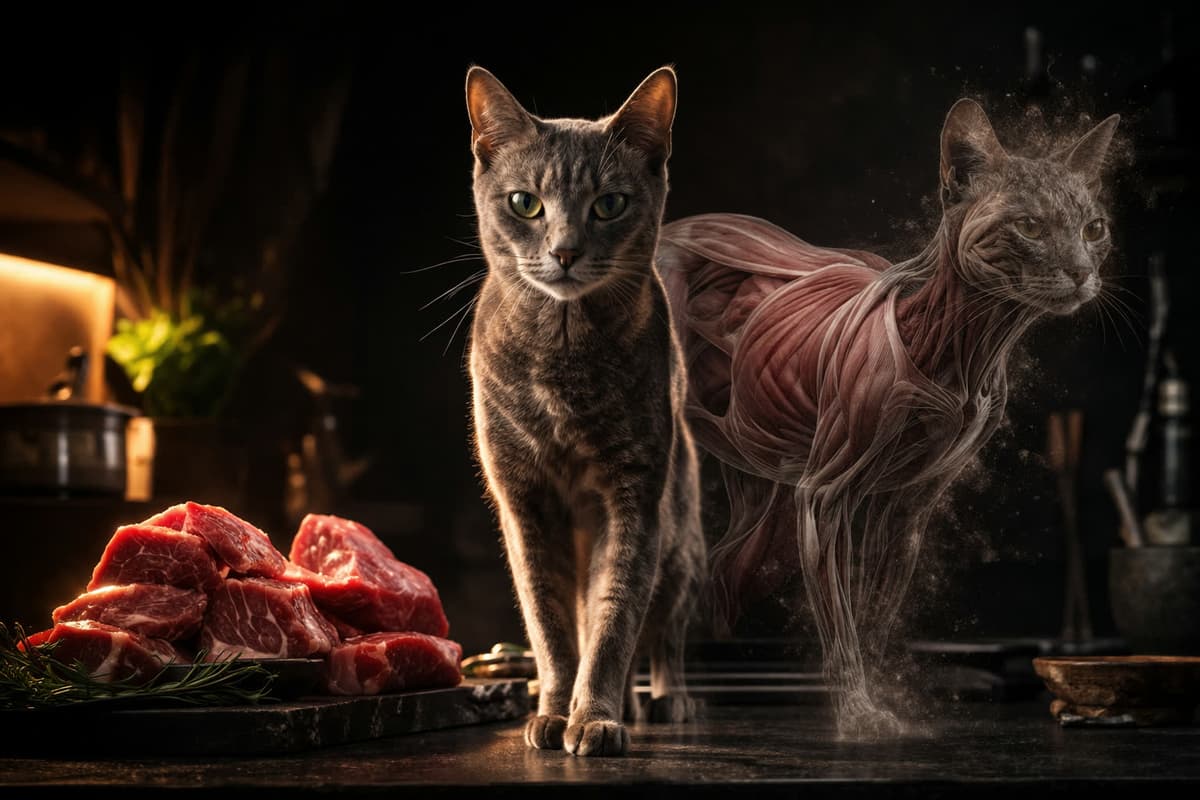
The body begins to literally break down its own muscle tissue in order to extract the amino acids from which the liver will make glucose, so the brain can keep working.
This is not a metaphor. It is a biochemical necessity. A lack of protein in the diet does not mean the cat "eats less." It means it eats itself.
A 3.5-fold chasm: why good blood work lies
The Laflamme and Hannah study (2013)
This study changed how we understand protein minimums for cats. It was published in the Journal of Feline Medicine and Surgery. Cats were fed for two months on diets with different amounts of protein (20%, 26%, 34%). Then two parameters were measured:
- Nitrogen balance — the classic marker in blood work; it tells you whether the body is "keeping up" with supplying amino acids for current needs.
- Muscle mass (DEXA, a body-imaging technique) — hard data: how much muscle there really is.
A fundamental discrepancy was discovered:
| Goal | Protein required | What happens at a lower level |
|---|---|---|
| Maintaining nitrogen balance | ~1.5 g/kg of body weight | "Good blood work" |
| Maintaining muscle mass | ~5.2 g/kg of body weight | The body burns muscle |
3.5×
Nitrogen balance is satisfied at 1.5 g protein/kg per day, but actual protection of muscle tissue requires 5.2 g/kg. A cat with "normal" blood work can systematically lose muscle for months before anything shows up clinically.
This explains why so many cats on commercial senior diets "lose weight naturally with age." Most of them are not losing weight because of aging — they're losing weight because the diet is too poor in protein to maintain their muscles.
What does this mean for foods with a "minimum protein" label?
Let's connect three findings:
- Rogers et al. (1977): A cat's protein-digesting enzymes always run at maximum revs.
- Eisert (2011): A cat has to produce glucose from amino acids and cannot switch this process off.
- Laflamme & Hannah (2013): To protect its muscles, a cat needs 3.5× more protein than the standard minimums.
Let's compare real food types:
| Food | Protein | Carbohydrate | Fat |
|---|---|---|---|
| Cheap dry food | 25-28% | 40-50% (grains) | 10-15% |
| Mid-range | 30-35% | 25-35% | 15-20% |
| Premium / BARF | 50-60% | 1-5% | 25-30% |
| Natural diet (mouse, % of dry matter) | 55-60% | 1-2% | 25-30% |
A food with 25% protein may be enough to maintain nice blood work (threshold ~1.5 g/kg). But it will never be enough to maintain muscle tissue (threshold ~5.2 g/kg). This is not marketing babble — it is a direct consequence of the data from 1977, 2002, 2011, and 2013.
Practical tips for owners
How much protein does your cat really need?
| Diet goal | Minimum protein | Effect |
|---|---|---|
| Survival (laboratory minimum) | ~1.5 g/kg of body weight | Maintains blood work, but destroys muscle |
| Muscle protection (health) | ~5.2 g/kg of body weight | The actual, safe health minimum |
| Optimum (natural profile) | ~8-10 g/kg of body weight | The ideal evolutionary level (BARF) |
For an average cat weighing 4 kg:
- Survival: about 6 g of protein per day
- Health: about 21 g of protein per day
- Optimum: about 32-40 g of protein per day
When does muscle wasting become visible?
Feel your cat and pay attention to:
- The spine — are the spinal knobs sharper and more palpable than before?
- The shoulder blades — are the shoulder-blade bones "protruding" unnaturally?
- The thighs — have the hind-leg muscles become slack and less firm?
- The temples — have the hollows on the head (at the temples) become more pronounced?
The sooner you notice, the easier it is to reverse the process. Sarcopenia (muscle wasting) progresses over months, but with the right protein in the diet, muscle tissue rebuilds just as systematically.
Summary: a cat is not a little human with whiskers
When a human or a dog switches to a protein-poor diet, the body adapts and switches on conservation systems. Both species possess an evolutionary safety brake that lets them survive far longer on a protein-poor diet while minimizing the losses to their own muscle tissue.
A cat does not have this brake.
This is not a "more demanding cat" that would be better off given good food. It is a biological necessity grounded in fifty years of research. In a properly composed feline diet there are no compromises on the amount of good meat. Because feline biology simply never gave us that option.
References
- Rogers, Q.R., Morris, J.G. & Freedland, R.A. (1977). Lack of hepatic enzymatic adaptation to low and high levels of dietary protein in the adult cat, Enzyme, 22(5), 348-356doi:10.1159/000458816
- Morris, J.G. (2002). Idiosyncratic nutrient requirements of cats appear to be diet-induced evolutionary adaptations, Nutrition Research Reviews, 15(1), 153-168doi:10.1079/NRR200238
- Eisert, R. (2011). Hypercarnivory and the brain: protein requirements of cats reconsidered, Journal of Comparative Physiology B, 181(1), 1-17doi:10.1007/s00360-010-0528-0
- Laflamme, D.P. & Hannah, S.S. (2013). Discrepancy between use of lean body mass or nitrogen balance to determine protein requirements for adult cats, Journal of Feline Medicine and Surgery, 15(8), 691-697doi:10.1177/1098612X12474448
- Verbrugghe, A. & Hesta, M. (2017). Cats and Carbohydrates: The Carnivore Fantasy?, Veterinary Sciences, 4(4), 55doi:10.3390/vetsci4040055
Frequently asked
Will blood tests show that a cat is short on protein?
Not necessarily. Laflamme & Hannah (2013) documented a discrepancy: a cat can have a completely normal nitrogen balance (i.e. "good blood work") and simultaneously be actively losing muscle mass. Nitrogen balance is satisfied at as little as ~1.5 g protein/kg, but muscle protection requires ~5.2 g/kg. A threefold difference.
How much protein per day does a 4 kg cat need?
To maintain blood work alone: about 6 g. To protect the muscles: about 21 g. The evolutionary profile (BARF): 32-40 g. Less than 21 g/day is slow nibbling away at its own muscle.
How do I recognize that a cat is losing muscle?
Feel your cat. Sharp, clearly palpable spinal knobs, protruding shoulder blades, slack thigh muscles, hollows at the temples — these are the classic signs of muscle wasting (sarcopenia). They appear gradually, so they are easy to miss.
Does this only concern old cats?
No. Muscle wasting from protein deficiency strikes at any age. In older cats, the natural processes of aging are added on top — which is why seniors need MORE protein, not less, contrary to the popular myths about a "senior diet."
My cat eats a commercial AAFCO-approved diet. Is that enough?
AAFCO sets minimums for survival, not for optimal health. The AAFCO standard for an adult cat is 26% protein on a dry-matter basis — a value consistent with the nitrogen-balance minimum, not with muscle protection. Foods that meet AAFCO may be too low in protein to maintain muscle mass over the long term.