On Facebook, Instagram and in cat groups, colourful infographics keep appearing: “10 fruits that are safe for cats!”, “Which vegetables can a cat eat?”, “Superfoods for your kitty!”.
It sounds caring. The problem is that the question “which fruits can a cat eat?” completely skips a more fundamental one: does a cat need fruit at all?
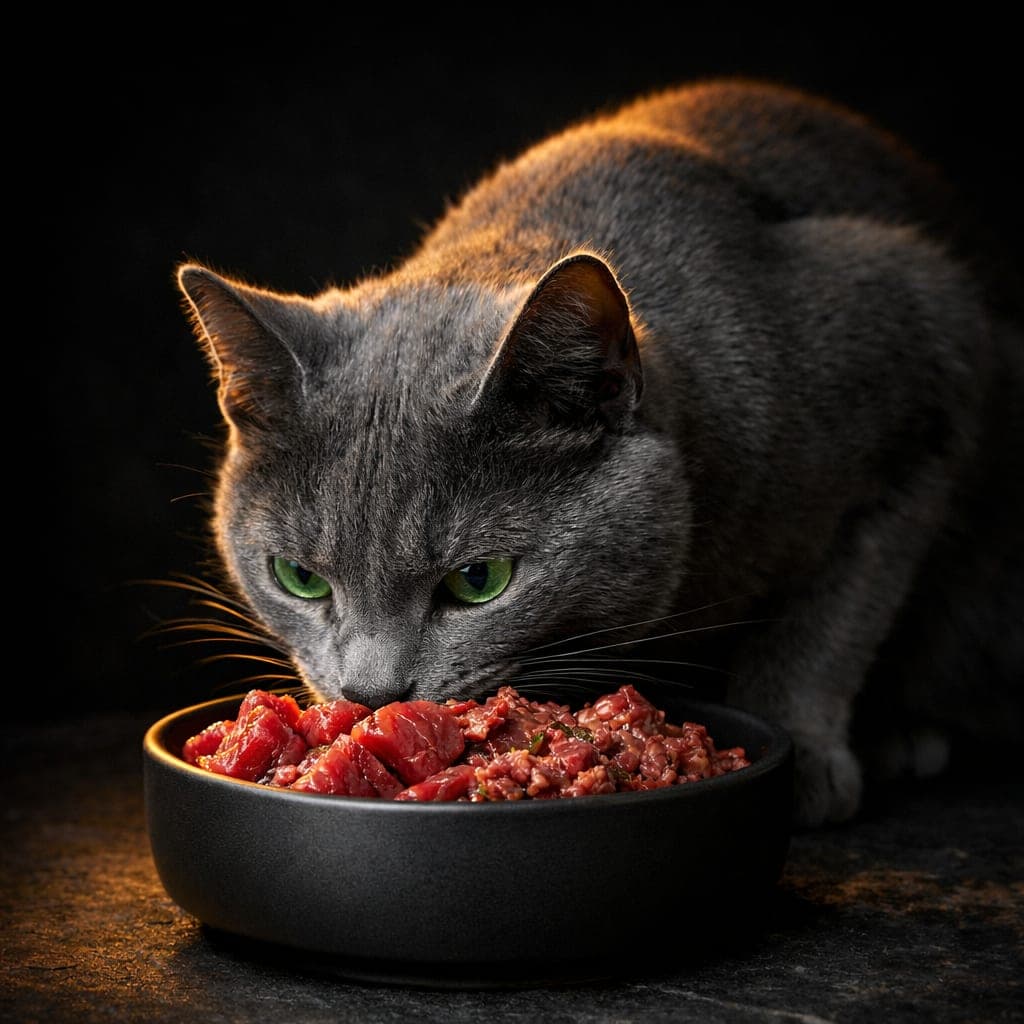
The answer is no. Neither fruit nor vegetables. The cat is an obligate carnivore — one of the few domestic mammals whose entire anatomy and physiology, from its set of digestive enzymes to its taste receptors, is built from the ground up for meat alone. In a cat's diet, fruit and vegetables are at best unnecessary ballast and at worst a deadly poison.
And this brings me to the main point of this article. While a slice of apple or banana probably won't hurt a cat, onion, garlic, chocolate or lilies can seriously harm it and even kill it. And a frightening number of owners still don't know this.
Why doesn't a cat need fruit or vegetables?
Obligate carnivore — what it really means in numbers
Plantinga and colleagues (2011) analysed the diet of free-living cats (feral domestic cats) on the basis of as many as 27 different studies. The result leaves no room for doubt.
52 / 46 / 2
The energy profile of a free-living cat is on average 52% of energy from protein, 46% from fat and only a tiny fraction from carbohydrates. That is the total share of sugars and starch in its natural menu — about 2%. And it eats them mainly as the remains of its prey's stomach contents (that is, what the caught mouse or bird had eaten and partly digested beforehand).
Never in its evolutionary history has the cat eaten fruit or vegetables by choice. Its body simply isn't adapted to it.
Metabolic pathways and enzymes the cat lacks
Digesting carbohydrates from plants requires the right metabolic pathway and specific enzymes — which the cat has largely been deprived of.
Salivary amylase — practically absent. In humans, starch digestion begins in the mouth, because saliva contains amylase that breaks down complex sugars. The cat — like the dog, in fact — has practically none of this enzyme in its mouth. Plant food is swallowed chemically intact.
Pancreatic amylase — low. The cat's pancreas does produce amylase, but its activity in the pancreas and in intestinal contents is low compared with most species, and when the diet contains more starch, the cat increases it only slightly (Kienzle 1993). How much starch the cat digests depends on its form: in Kienzle's studies, cats digested cooked corn starch almost completely, raw corn starch at 78% and raw potato starch at only 36%. Whatever the cat doesn't digest in the small intestine moves on to the large intestine, where it is fermented by bacteria and can cause diarrhoea, bloating and gas.
Liver glucokinase — practically inactive. Glucokinase is an enzyme that in humans and dogs acts like a fast switch for sugar metabolism — it lets the liver quickly capture glucose from the blood after a meal and then turn it into usable energy or store it for later. Tanaka et al. (2005) detected no activity of this enzyme in the cat's liver. That doesn't mean, however, that a cat's blood sugar shoots up after a carbohydrate meal. Kienzle (1994) fed cats a diet containing 29–37% starch in dry matter and found no significant difference in post-meal glucose compared with a carbohydrate-free diet — not after one hour, three or six. The cat's liver, on the other hand, has higher activity than the dog's of other glucose-metabolising enzymes, including hexokinase.
Glucose transport — twice as slow. As Verbrugghe and Hesta (2017) showed, active glucose absorption in the gut (handled by the SGLT1 transporter) runs roughly twice as slowly in cats as in dogs.
And what about fructose, the sugar in fruit?
The history of research on this topic is a great example of how science corrects its own mistakes.
In the 1990s, researcher Ellen Kienzle showed that when cats were fed a diet high in sugar (36% sucrose), fructose appeared in their urine (fructosuria). The author herself drew a cautious conclusion — that the cat's capacity to metabolise sugars is rather limited — but over the following years the claim took hold that cats have no fructokinase at all and that fruit sugar passes through them unmetabolised.
In 2009, Schermerhorn's team (Springer, Lindbloom-Hawley and Schermerhorn) detected the genetic material (mRNA) of fructokinase in the cat's liver, pancreas, spleen and muscle, and confirmed the presence of the enzyme itself in the liver. So cats do have it! The catch is that the presence of an enzyme says nothing about its capacity — and Kienzle's measurements show that the cat can't cope with a larger sugar load and the excess ends up in the urine.
What does this mean in practice? The cat's liver will cope without trouble if your cat lands its face in your banana and licks a little of the fruit. But if it eats more, the excess fructose will end up in the urine, and in the gut it will start to bind water osmotically, which encourages diarrhoea. A cat isn't built for fruit salad.
What is safe (in case of theft)
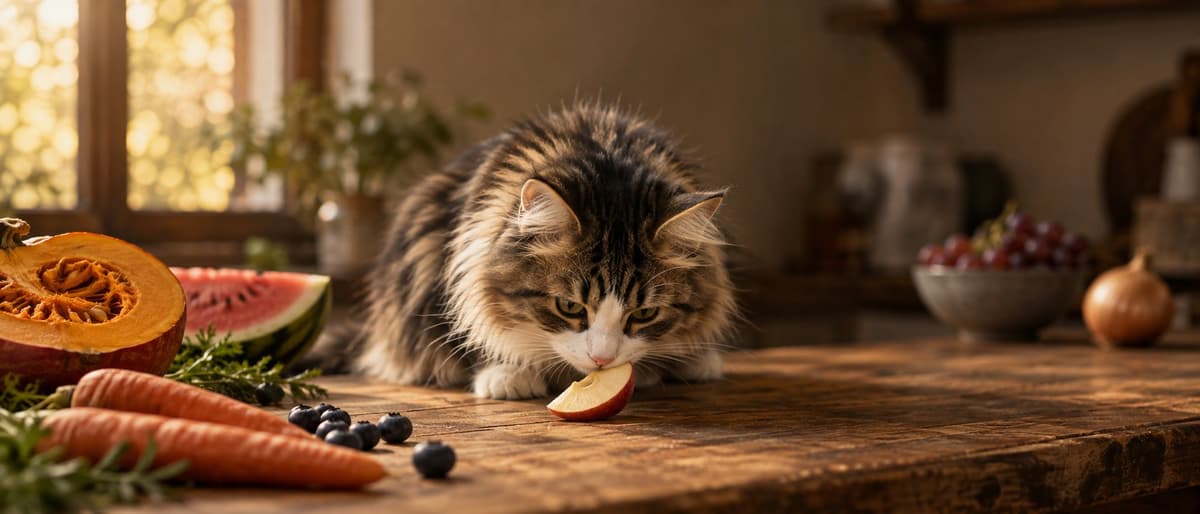
Before I get to the poisons, I've put together a short list of plant foods that, in absolutely minimal amounts, shouldn't cause a disaster in a cat. Let me stress, though: this does not mean you should give them on purpose to vary the diet. It's about situations where a cat simply steals a piece from your plate or counter out of curiosity — if it eats a tiny amount of the foods below, nothing bad will happen.
Tolerated fruit: watermelon (without seeds and rind, it's mostly water), a small piece of banana or apple (absolutely without seeds!). Blueberries and strawberries — they'll do, though they bring more sugar than benefit.
Tolerated vegetables: pumpkin, carrot, courgette and a little broccoli (always cooked). Be careful with cooked beetroot — although cats tolerate it, it contains a lot of oxalates, which matters for a cat prone to urinary stones, and it also strongly colours the urine, making it harder to spot possible blood in the litter tray.
Why must plants for a cat be cooked?
The cat's intestine is the short and relatively simple digestive tract of a true predator. It is built for fast digestion of protein and fat, not for hours of laborious fermentation of plant fibre. The cow has a multi-chambered stomach for this, the rabbit a huge caecum, and both species a powerful gut flora. The cat has none of that.
A raw vegetable reaches the predator's stomach locked in intact, thick cell walls of packed cellulose and pectin. The cat's digestive tract has neither the time nor the tools to break this down physically. As a result, a raw, hard carrot passes through the gut like rubble, often completely undigested, irritating the mucosa. Cooking softens the plant tissue, and blending cooked vegetables additionally breaks the cell walls mechanically, making them more accessible to the cat's digestive system.
The role of vegetables in a BARF diet (as a substitute for fur and feathers)
In nature, a cat eats its prey whole. It also swallows fur, feathers, claws and hard cartilage. These physically indigestible parts provide no calories, but they play a vital role in the gut: they act like natural fibre. They scrub the digestive tract, drive strong peristalsis and help form healthy, firm faeces.
A balanced home-prepared diet (BARF) is clean, ground meat, bones and supplements — there's no mouse fur or bird feathers in it. That's why some protocols and owners add a small amount of cooked, blended pumpkin or carrot to the mix. Not as a vitamin superfood, but as a functional, mechanical substitute for what the cat's gut deals with in nature. A popular and often much better alternative to vegetables (one that doesn't add an unnecessary glycaemic load of carbohydrates) is psyllium husk.
What is dangerous — the cat's list of poisons
This is where the jokes end. Some of the foods below destroy a cat's organs and can kill even in small doses. With others, you'll see that the internet scares people without good reason — and it's worth knowing which are which.
Onion, garlic, leek, chives (the Allium family)
Toxicity: extremely high. Cats are the most sensitive species of all domestic animals to these plants!
Why it poisons: sulphur compounds (including n-propyl disulphide) in these vegetables cause oxidative stress in red blood cells. Haemoglobin is damaged and precipitates as so-called Heinz bodies, and the damaged cells are destroyed. Acute, dangerous haemolytic anaemia sets in. The cat is especially defenceless here, because its spleen is poor at removing red cells with Heinz bodies from the blood (Christopher et al. 1990).
Toxic dose: poisoning has been reported in cats after eating less than a teaspoon of cooked onion or 5 g of raw onion per kilogram of body weight (in dogs, signs appear at 15–30 g/kg). For a standard four-kilogram cat, that's just 20 grams (less than an average onion weighs). Garlic is 3 to 5 times more toxic to cats than onion!
Worst of all, the signs can lull us into a false sense of security, because the poisoning builds up slowly and shows itself late. If a cat regularly licks leftovers of a human dinner seasoned with garlic and onion, we're quietly pushing it into chronic anaemia. Robertson et al. (1998) fed cats baby food with added onion powder for five weeks — the proportion of red cells with Heinz bodies reached 33–53%, and in the two-month part of the study a diet with 2.5% onion powder lowered the haematocrit.
Grapes and raisins
Toxicity: high in dogs — they can cause acute kidney failure. In cats there is no confirmed case: in the Dutch poisons registry (Dijkman et al. 2022), none of the 13 cats that ate grapes or raisins developed kidney failure, and signs — mainly vomiting — occurred in two.
For many years researchers couldn't pinpoint the exact culprit. The best-supported hypothesis points to tartaric acid (and potassium bitartrate), but it's still a hypothesis, based on cases in dogs (Wegenast et al. 2022). Its concentration in the fruit ranges from 0.35% to as much as 2%, which may explain why in dogs some grapes cause harm while others produce no signs at all.
The rule: we keep grapes and raisins out of reach, because the toxic dose isn't known even for dogs. If a cat eats a raisin, we call the vet and ask — without waiting for symptoms, but also without panic.
Chocolate and coffee (methylxanthines)
The human liver handles caffeine and theobromine (found in cocoa beans) without trouble. The dog eliminates theobromine more slowly than a human (its half-life in dogs is 17.5 hours), and there is little good data for cats. We know the toxic thresholds from dog data, so for a cat let's treat them as an order of magnitude: in a 4 kg cat, about 15 g of dark chocolate (70% cocoa) may already cause heart rhythm disturbances, about 22 g may cause seizures, and the potentially lethal range starts at around 37 g.
And note: pure cocoa powder (for example spilled while baking at home) contains the most theobromine — one heaped spoonful can give a cat a dose that causes heart rhythm disturbances and seizures. That's a reason to call the emergency vet immediately.
Lilies — a deadly threat in a vase
This is an ornamental plant, not food, but it absolutely deserves a place here, because it is behind many cat poisonings. The toxins in lilies cause rapid necrosis of the kidney tubules in cats. The dangerous ones are true lilies (Lilium) and daylilies (Hemerocallis) — not peace lilies or calla lilies, which are also commonly called lilies.
Very little is enough to cause poisoning: a piece of a leaf, or pollen that falls on the cat's coat and is licked off during routine grooming. Even drinking water from a vase of cut lilies is a reason for an immediate visit to the vet.
The good news: cats treated quickly have a good prognosis — in a study of 112 cats exposed to lilies (Lam et al. 2025), all those treated in hospital survived.
Xylitol
So-called birch sugar, now widely used in chewing gum, toothpaste and “healthy” biscuits. In dogs, eating xylitol forces the pancreas into a massive release of insulin, which leads to hypoglycaemia (a drastic, life-threatening drop in blood sugar) and liver damage. In cats, the only study carried out (Jerzsele et al. 2018) did not confirm this — doses dangerous for dogs caused no significant changes in six cats. That's too little to call xylitol safe, but for a cat it is not an emergency the way it is for a dog.
Why does a cat steal onions or vegetables from the counter at all?
One owner wrote under one of my posts: “If it came down to anatomy, my cat wouldn't steal raw onions from the kitchen.”
Well, a cat doesn't steal onions because it instinctively likes the taste (cats most likely can't taste sweetness at all, because of a genetic mutation in the sweet-taste receptor described by Li et al. in 2005). It steals them for several other reasons:
- It's fascinated by the hard texture that crunches between its teeth (pure sensory stimulation).
- An onion is great prey — round, slippery and rolling away across a smooth floor.
- Stealing gets your attention. A cat learns very quickly that knocking an onion off the counter guarantees an emotional reaction and a chase around the house — a fantastic reward for a bored animal.
- It may be a sign of pica — a behavioural disorder involving compulsive eating and chewing of non-food items (such as cables, wool, foil or soil). Such behaviour needs veterinary diagnosis.
The exception is grass. A study from the University of California, Davis (Hart et al. 2021), based on two surveys with one to two thousand responses from owners, showed that only very few cats seemed ill before eating plants, and short-haired cats ate plants as often as long-haired ones — which contradicts the popular explanations about settling the stomach and getting rid of hairballs. The authors see it as an innate tendency inherited from wild ancestors. Cat grass sown in a pot at home (oats, barley) is a safe and good form of greenery for a cat.
Pumpkin — a vegetable with an overrated reputation
Finally, a curiosity. Plain cooked pumpkin (without any seasoning) has a reputation online as a home remedy for cats' guts — both for constipation and for diarrhoea. The data don't support it.
In its article “The Problem with Pumpkin”, the nutrition team at Tufts University calculated that to give a cat as much fibre as one popular high-fibre therapeutic diet contains, you would need to feed more than two and a half cups of pumpkin a day — and even then it might not be the right type of fibre. Psyllium is better documented: in the study by Keller et al. (2024), a diet with 6% psyllium gave cats more bowel movements and moister, bulkier faeces than a diet with cellulose. With chronic diarrhoea or constipation, however, we don't add anything on our own — choosing the fibre and the dose is up to the vet.
What to do if you suspect your cat has been poisoned
If you have even the slightest suspicion that your cat has licked lily pollen, grabbed a raisin from a cake on the table or got into spilled cocoa:
- Never try to make your cat vomit with home remedies! Most internet tricks, such as giving hydrogen peroxide by mouth, can seriously damage the oesophagus and stomach.
- Call a 24-hour clinic immediately. When the kidneys are being damaged fast (lilies), every minute counts for starting the IV fluids that flush toxins out of the body.
- Write down exactly what the cat ate, at what time and roughly how much. It seems trivial, but it greatly speeds up the vets' work in calculating toxic doses and prognosis and in giving specific antidotes.
Your cat absolutely doesn't need human vitamins from fruit or fashionable superfoods. If you want to treat your home predator, skip the berry purées. Give it a raw, well-frozen chicken heart or a little freeze-dried meat. It will thank you with the purr every carnivore deserves.
References
- Plantinga, E.A., Bosch, G. & Hendriks, W.H. (2011). Estimation of the dietary nutrient profile of free-roaming feral cats: possible implications for nutrition of domestic cats, British Journal of Nutrition, 106(S1), S35–S48doi:10.1017/S0007114511002285
- Verbrugghe, A. & Hesta, M. (2017). Cats and carbohydrates: The carnivore fantasy?, Veterinary Sciences, 4(4), 55doi:10.3390/vetsci4040055
- Kienzle, E. (1993). Carbohydrate metabolism of the cat 1. Activity of amylase in the gastrointestinal tract of the cat, Journal of Animal Physiology and Animal Nutrition, 69(1–5), 92–101doi:10.1111/j.1439-0396.1993.tb00793.x
- Kienzle, E. (1993). Carbohydrate metabolism of the cat 2. Digestion of starch, Journal of Animal Physiology and Animal Nutrition, 69(1–5), 102–114doi:10.1111/j.1439-0396.1993.tb00794.x
- Kienzle, E. (1994). Blood sugar levels and renal sugar excretion after the intake of high carbohydrate diets in cats, The Journal of Nutrition, 124(12 Suppl), 2563S–2567Sdoi:10.1093/jn/124.suppl_12.2563S
- Tanaka, A., Inoue, A., Takeguchi, A., Washizu, T., Bonkobara, M. & Arai, T. (2005). Comparison of expression of glucokinase gene and activities of enzymes related to glucose metabolism in livers between dog and cat, Veterinary Research Communications, 29(6), 477–485doi:10.1007/s11259-005-1868-1
- Springer, N., Lindbloom-Hawley, S. & Schermerhorn, T. (2009). Tissue expression of ketohexokinase in cats, Research in Veterinary Science, 87(1), 115–117doi:10.1016/j.rvsc.2008.11.004
- Li, X., Li, W., Wang, H., Cao, J., Maehashi, K., Huang, L., Bachmanov, A.A., Reed, D.R., Legrand-Defretin, V., Beauchamp, G.K. & Brand, J.G. (2005). Pseudogenization of a sweet-receptor gene accounts for cats' indifference toward sugar, PLoS Genetics, 1(1), e3doi:10.1371/journal.pgen.0010003
- Christopher, M.M., White, J.G. & Eaton, J.W. (1990). Erythrocyte pathology and mechanisms of Heinz body-mediated hemolysis in cats, Veterinary Pathology, 27(5), 299–310doi:10.1177/030098589002700501
- Robertson, J.E., Christopher, M.M. & Rogers, Q.R. (1998). Heinz body formation in cats fed baby food containing onion powder, Journal of the American Veterinary Medical Association, 212(8), 1260–1266doi:10.2460/javma.1998.212.08.1260
- Salgado, B.S., Monteiro, L.N. & Rocha, N.S. (2011). Allium species poisoning in dogs and cats, Journal of Venomous Animals and Toxins including Tropical Diseases, 17(1), 4–11doi:10.1590/S1678-91992011000100002
- Dijkman, M.A., van Roemburg, R.G., De Lange, D.W., Hugen, S. & Robben, J.H. (2022). Incidence of Vitis fruit-induced clinical signs and acute kidney injury in dogs and cats, Journal of Small Animal Practice, 63(6), 447–453doi:10.1111/jsap.13483
- Wegenast, C.A., Meadows, I.D., Anderson, R.E., Southard, T., González Barrientos, C.R. & Wismer, T.A. (2022). Acute kidney injury in dogs following ingestion of cream of tartar and tamarinds and the connection to tartaric acid as the proposed toxic principle in grapes and raisins, Journal of Veterinary Emergency and Critical Care, 32(6), 812–816doi:10.1111/vec.13234
- Lam, J., Hess, R.S. & Reineke, E.L. (2025). Prevalence of acute kidney injury and outcome in cats treated as inpatients versus outpatients following lily exposure, Journal of the American Veterinary Medical Association, 263(1), 41–46doi:10.2460/javma.24.05.0355
- Jerzsele, Á., Karancsi, Z., Pászti-Gere, E., Sterczer, Á., Bersényi, A., Fodor, K., Szabó, D. & Vajdovich, P. (2018). Effects of p.o. administered xylitol in cats, Journal of Veterinary Pharmacology and Therapeutics, 41(3), 409–414doi:10.1111/jvp.12479
- Hart, B.L., Hart, L.A., Thigpen, A.P. & Willits, N.H. (2021). Characteristics of plant eating in domestic cats, Animals, 11(7), 1853doi:10.3390/ani11071853
- Keller, E., Laxalde, J., Tranier, N., Belmar von Kretschmann, P., Jackson, A. & van Hoek, I. (2024). Psyllium husk powder increases defecation frequency and faecal score, bulk and moisture in healthy cats, Journal of Feline Medicine and Surgery, 26(4), 1098612X241234151doi:10.1177/1098612X241234151
- Heinze, C. (2017). The problem with pumpkin, Petfoodology, Cummings School of Veterinary Medicine, Tufts University↗
- Merck Veterinary Manual (2024). Chocolate toxicosis in animals, Merck Veterinary Manual, Toxicology↗
- Merck Veterinary Manual (2024). Garlic and onion (Allium spp) toxicosis in animals, Merck Veterinary Manual, Toxicology↗
- ASPCA Animal Poison Control Center (2026). People foods to avoid feeding your pets, ASPCA↗
- ASPCA Animal Poison Control Center (2026). Toxic and non-toxic plant list — cats, ASPCA↗
- Cornell Feline Health Center (2026). Easter peril: look out for lilies and other items, Cornell University College of Veterinary Medicine↗
Frequently asked
Can cats eat fruit and vegetables?
A piece of watermelon, apple without seeds or cooked carrot won't harm a cat, but the cat doesn't need them. Plantinga and colleagues (2011) calculated from 27 studies that a free-living cat gets 52% of its energy from protein, 46% from fat and only about 2% from carbohydrates — mostly from the gut contents of its prey. In a cat's diet, fruit and vegetables are at best unnecessary ballast.
How much onion does it take to poison a cat?
Less than most people assume. According to the Merck Veterinary Manual, cats are the species most sensitive to Allium plants, and poisoning has been reported after less than a teaspoon of cooked onion or 5 g of raw onion per kilogram of body weight — in dogs, signs appear at 15–30 g/kg. Garlic is 3–5 times more toxic than onion. Regular feeding of leftovers is dangerous too: in the study by Robertson et al. (1998), cats fed baby food with onion powder for five weeks had 33–53% of red blood cells with Heinz bodies.
Are grapes as dangerous for cats as they are for dogs?
There is no evidence of that. In the Dutch poisons registry (Dijkman et al. 2022), none of the 13 cats that ate grapes or raisins developed kidney failure, and signs — mainly vomiting — occurred in two. Because the toxic dose isn't known even for dogs, I keep grapes and raisins out of a cat's reach. If a cat eats a raisin, I call the vet and ask — without waiting for symptoms, but also without panic.
Is xylitol poisonous to cats?
To dogs, yes. In cats, the only study carried out (Jerzsele et al. 2018) showed no toxic effect: doses of 100, 500 and 1000 mg/kg, dangerous for dogs, caused no significant changes in six cats. That's too little to call xylitol safe, but for a cat, eating a crumb of a xylitol-sweetened biscuit is not the emergency it is for a dog.
Does pumpkin help cats with diarrhoea and constipation?
Much less than the internet says. The nutrition team at Tufts University calculated that to give a cat as much fibre as one popular high-fibre therapeutic diet contains, you would have to feed more than two and a half cups of pumpkin a day. Psyllium is better documented: in the study by Keller et al. (2024), a diet with 6% psyllium gave cats more bowel movements and moister, bulkier faeces than a diet with cellulose. Chronic diarrhoea or constipation, however, needs diagnosis by a vet, not something sprinkled into the bowl.