Under one of my posts about cats' paw pads, a reader asked a question that turned out to be better than the post itself: what are the feline equivalents of human nerve fibres, how fast do they conduct, and can you programme a cat with touch?
The answer is amusing, because the question stands on its head. It is not the cat that has equivalents of human fibres. It is we who have equivalents of feline ones — because a large part of what neurophysiology knows today about the mammalian sense of touch was measured in cats first. That is how the review in “Neuron” puts it: what we have learned about the structure and physiology of the sensory afferents of hairy skin comes in large measure from recordings made in the cat and the rabbit (Abraira and Ginty 2013).
And out of those technical measurements come surprisingly practical things: where to stroke a cat, how fast to do it, and why one and the same stroke ends in purring on one occasion and in teeth sinking into your hand on another.
What nerve fibres are, and what the cat needs the whole system for
Before we get to speeds and centimetres, it is worth being clear about what we are talking about. Nerve fibres are, at their simplest, a biological network of communication cables. They wrap the whole feline body and act as tireless informants. They register everything happening where the cat meets the outside world — whether a surface is cold, whether pressure is too strong, whether something causes pain, or whether touch is safe and friendly. It is thanks to this network that a cat can pull its paw back from a hot stove in a fraction of a second, move safely in the dark, and build a relationship with us through affectionate touch.
Four kinds of cable under the skin
A cat's skin communicates with the spinal cord and brain through several different kinds of nerve fibre. They differ in thickness, in whether they carry natural insulation (the so-called myelin sheath) and — as a direct consequence of that insulation — in the speed at which they pass signals on. The division taught in every medical or biological degree runs as follows:
- A-alpha: the thickest fibres, from muscles and tendons; they tell the brain about tension and the position of a limb in space.
- A-beta: thick, solidly wrapped in insulation; responsible for the sensation of touch, pressure and vibration.
- A-delta: thin and very lightly insulated; they carry cold sensation and that first, sharp signal of damage (a prick, for instance).
- C: the thinnest, with no insulating sheath at all; responsible for slow, diffuse pain, itch, warmth — and, which is the very heart of this text, for the sensation of slow, gentle touch.
Fibre thickness and that insulation translate directly into the speed of data transmission. The myelin sheath works as an enormous accelerator: thanks to it the electrical signal leaps along the fibre instead of laboriously creeping along its whole length.
Boyd and Kalu (1979) described in the cat a simple relationship still in use today: conduction velocity in metres per second is the fibre diameter in micrometres multiplied by a certain factor. It is not one factor for all sizes — for myelinated fibres thinner than about twelve micrometres it comes to around 4.5–4.6.
0.2–2 m/s
Fast touch fibres cover the same distance between fifteen and a hundred times more quickly: in the table compiled by Abraira and Ginty (2013) the Aβ subtypes fall between 16 and 100 metres per second. Along them, a signal from a cat's paw reaches the spinal cord in a few thousandths of a second.
What does that mean for us as owners? That a cat's skin handles different kinds of our touch quite differently — but not because slow stroking “gives time” to the slow fibres. Conduction velocity and what a given fibre responds to at all are two independent things.
Beware a convenient shortcut
It is tempting to explain that slow stroking works because the slow signal has time to arrive. That is not true: a C fibre conducts just as slowly no matter how fast our hand moves across the skin.
The point is the tuning of the endings, not the speed of the cable. These fibres are maximally activated by a stimulus that moves slowly across their receptive field — in the literature they are called caress detectors outright (Abraira and Ginty 2013). Brief patting or brisk rubbing excites mainly the fast touch fibres. Slow, calm stroking additionally reaches that second system.
Why rubbing a bruised knee brings relief
The difference in speed is not merely a dry fact from a physiology textbook. It explains why one kind of touch can change how another is felt.
Picture what happens in the spinal cord when two different signals from the same spot on the skin arrive at different times. The lightning-fast touch signal races along a thick fibre, arrives first, and finds the slower pain signal still on its way.
Melzack and Wall proposed in 1965 that this is not chance but a mechanism. The spinal cord runs a system known as gating (the gate control theory): whether a pain signal is passed on depends on the balance between excitation of the thick touch fibres and the thin pain fibres. Strong excitation of the thick ones muffles the message.
Hence the human and animal reflexes: we rub the place where we banged ourselves, and we scratch the place that itches persistently. In both cases we reflexively excite the fast touch fibres in order to damp down traffic in the thin pain or itch fibres. Through that simple mechanism we bring ourselves immediate relief.
Honestly about the status of this theory
The 1965 paper was a theory, formulated to resolve a contradiction that the physiology of the 1960s could not handle — not a closed proof. The core of the idea, that pain transmission depends on the balance between thick and thin fibres, took hold for good. The details of the proposed circuit, however, were sharply criticised, with Nathan's classic 1976 review at the head of the queue, and some of them did not survive (Mendell 2014). That is an important distinction: the mechanism works, but the story of “they proved it once and for all” is too smooth.
The fibres found in cats half a century before humans
Here begins the most interesting part, and the real answer to the question of how to programme a cat with touch.
In 1939 Yngve Zotterman published a paper on the sense of touch in which he described something in the cat that nobody expected: fibres with conduction velocities typical of the thinnest, unmyelinated cables, responding not to pain but to gentle touch. That demolished the comfortable assumption that these thin cables deal exclusively in suffering. Zotterman himself supposed they were responsible for tickling — and in that he was wrong.
Iggo confirmed the existence of these fibres in 1960, and in 1977, together with Kornhuber, described them quantitatively. The recordings came from the saphenous nerve, and the receptive fields — averaging about four by three millimetres — lay in the hairy skin of the leg and foot (the hairless pads were studied separately). The most important thing, however, is a property described for this whole class of fibres: they respond most strongly to a stimulus that moves slowly across their receptive field. The review in “Neuron” calls them caress detectors outright (Abraira and Ginty 2013).
Not to firm pressure. Not to brisk rubbing. Only to very slow movement.
A New Zealander from Edinburgh
Ainsley Iggo (1924–2012) is often taken for a Scot, and not by accident — he died in Edinburgh as emeritus professor of veterinary physiology at the Royal (Dick) School of Veterinary Studies. He was born in New Zealand, though, and came to Scotland later: he took his PhD in Aberdeen in 1954. As The Physiological Society writes in his obituary, it was he who produced the first system for classifying C fibres and mechanoreceptors.
And what about humans? For decades it was held that we simply do not have such a slow touch system — and the abstract of Vallbo's 1993 paper says exactly that: it was generally accepted that touch in human skin is served solely by fast myelinated fibres, unlike in other mammals. In 1990 Nordin described such units in the human supraorbital nerve, recording them with fine electrodes inserted directly into the nerve. He found eleven unmyelinated fibres, eight of which had very low thresholds and responded to gentle touch — and slow stroking proved a particularly effective stimulus. Three years later Vallbo and colleagues showed that such fibres are common and widespread throughout human hairy skin.
The gap between describing these fibres in the cat and finding them in humans is therefore about half a century. The human system of affective touch — the one written about so much today in the context of hugging, closeness and bonding — is a younger discovery in science than the feline one.
The cat is not, then, a patient onto whom we force conclusions from human medicine. It is the species on which that knowledge was built.
In 2009 Löken and colleagues added the missing piece of the puzzle. They stroked human subjects with a soft brush at various speeds. Those slow fibres fired hardest at 1–10 centimetres per second. What is more, subjects rated exactly that pace of stroking as the most pleasant.
What we still do not know about cats
What was measured in cats is that these fibres exist and how they behave (Iggo and Kornhuber 1977). That this whole class of fibres responds most strongly to slow movement is described in the review literature. But that such activation translates into a sensation of pleasure, and that the optimum for stroking falls at 1–10 cm/s — those were measured in humans, not in cats.
I know of no study testing which stroking speed goes with relaxation in a cat, and none linking the activity of these feline fibres to purring, relaxation or a falling heart rate. The golden numbers quoted online for stroking cats are a human result copied across. This remains an open field.
So we know that the cat has a working system for receiving slow, gentle touch. From human studies we carry over the reasonable — but still only an — assumption that this system goes with a feeling of relaxation and pleasure in cats too.
That something was measured in humans does not mean it was measured in cats. It only means we have good reason to suppose so.
Where a cat really likes to be touched
Fortunately, the question of where and how to stroke has a solid answer from an entirely different direction — from researchers who did not probe feline nerves but scrupulously counted and recorded behaviour.
Ellis and colleagues (2015) did something simple: they stroked cats in various body regions and scored the negative responses. They also checked whether it matters who does the stroking, and in what order. The results:
- The tail and the base of the tail came off worst, with clearly the highest negative scores — and that regardless of whether the cat was stroked by its owner or by a stranger.
- The other regions — including the temporal area, under the chin, the flanks and the neck — produced low and similar scores. The Ellis study therefore yields no ranking of the “most pleasant” places; it yields where the cat protests most often. In my experience the flanks, belly and neck are strongly individual: some cats accept them, some cannot stand them — but that is a breeder's observation, not a result from a table.
- The order of regions touched made no difference. Put briefly: you cannot warm a cat up by stroking its cheeks so that it will accept having its belly stroked a moment later.
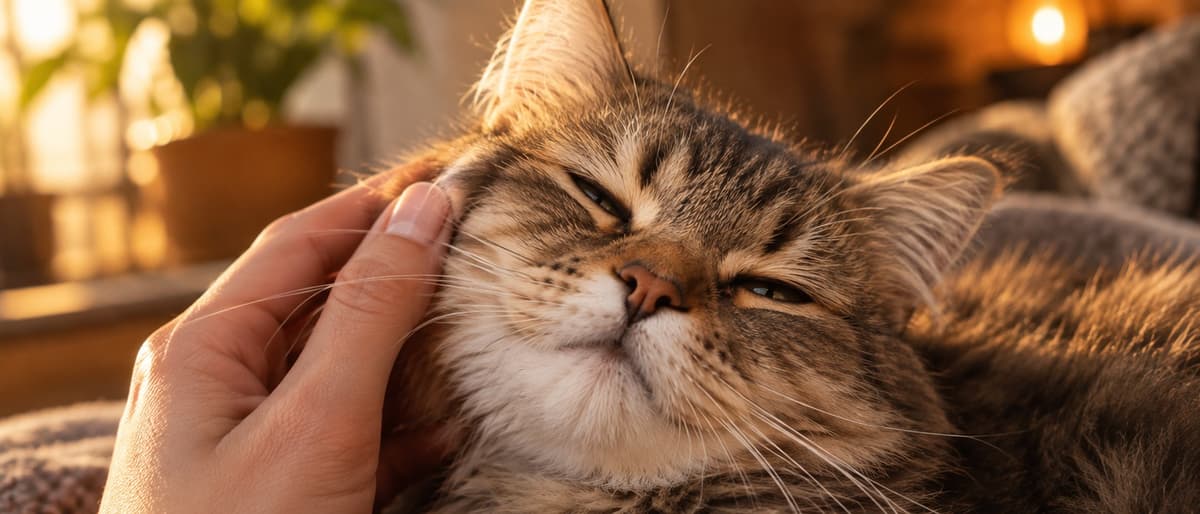
Where, then, does the common advice to stick to cheeks and chin come from? From a different study. Soennichsen and Chamove (2002) also recorded positive responses. They compared four areas — temporal, perioral, caudal and a non-gland site — with the stroking done by the cats' own owners. The temporal region, the band between the eye and the ear, produced the most positive and the fewest negative responses, the tail region exactly the reverse, and the other two fell in between. It only needs to be known that this was a study of nine cats, tens of times smaller than the Ellis one. The 2022 AAFP and ISFM guidelines point to similar places: the head and neck are preferred, especially around the scent glands, while negative responses appear on touching the region just in front of the tail base and the belly.
A curiosity from the Ellis study, and a painful one for some: cats responded more negatively to stroking by their own owner than by an unfamiliar person. The authors do not settle why and themselves flag the owner-cat relationship as needing further study. The likely explanation is that around a stranger a cat inhibits itself more, while at home it communicates its limits more freely — by pushing the hand away with its teeth, for instance.
A newer result from the same line of research adds an uncomfortable detail. Finka and colleagues (2022) examined the stroking styles of 119 people and looked at what predicts them. The outcome was paradoxical: the longer someone's experience with cats and the higher they rated their own knowledge of cat behaviour, the more often their style departed from what cats prefer — greater age and high neuroticism worked the same way. Being used to cats is therefore no guarantee that we stroke them the way a cat would wish.
The conclusion: the fact that a cat lives with us and trusts us is not an automatic pass to touching it anywhere without warning.
So why does a cat suddenly bite during stroking?
Most often because the stroking — even stroking that was pleasant at first — stopped being comfortable, and the hand reached places that are off limits for this particular individual (along the whole back down to the tail, for instance).
There are, of course, charming exceptions to the rule. Many of us know the sight of a cat that adores a particular kind of patting right at the base of the tail, lifts it high and treads comically on the spot. But those are highly individual preferences, and with cats you do not know it is better not to assume they will enjoy it.
Usually, when a cat has had enough, the warning signals appear well before the bite, but to an untrained eye they are simply too quiet. Before teeth or claws arrive, a cat will usually:
- Suddenly freeze.
- Cut the purring short.
- Flatten or turn its ears slightly to the sides.
- Start twitching the skin along its back, as if shooing a fly.
- Start tapping the tip of its tail against the floor.
When you see those signals — simply take your hand away at once, without sudden movements, and let the cat leave.
An important medical caveat
A sudden, new intolerance of touch in a cat that used to love it may be one of the first signs of developing disease. Very often it is connected with pain or joint degeneration, particularly around the spine and hindquarters. If such a change in behaviour persists, the first step should always be a visit to the vet. Before we start looking for causes in the psyche, physical suffering has to be ruled out — and any sensible behaviourist will send us for tests first anyway.
Simple rules that worked on a hundred cats
In 2021 Haywood and her team tested whether people themselves can be taught to stroke properly. They took a hundred cats from the Battersea shelter in London and a hundred and twenty people unfamiliar to them.
The design was simple, and one detail of it is what gives the result its force: the same people met the cats twice — before the training and after it. The interactions were filmed (535 observations in total, sessions of five minutes), and both the cat's behaviour and how closely the human followed best practice were then scored.
The instructions fitted into three points:
- Choice and control: hold out your hand and wait. Let the cat come over, sniff and rub against your hand by itself. Do not impose. Leave it an open escape route.
- Attention: focus on the cat, watch its body language, ears and tail.
- Touch: restrict it primarily to the temporal region.
The effect after training was clear: cats more often behaved in a friendly way — rubbing, purring, exploring with their tails up — and less often responded with aggression towards the human or with behaviours indicating conflict and tension.
What to do about cats' paws
Since the subject began with a question about paw pads, let it end on them.
Ferrington (1985) studied the fibres innervating the skin of the cat's paw pad. He showed that the slowly adapting receptors in the pad respond not so much to pressure itself as to distortion of the nerve endings, and that among vibrations they are most sensitive to those at 5–10 Hz.
What that number does not say
This is a result for one class of receptors — the slowly adapting ones, and they were all that paper dealt with. “The pad feels 5–10 Hz best” would therefore be a step too far: that is how this particular, well-described group of fibres responds, not the whole pad.
The pad is therefore a sensitive detector of deformation and of vibration in the ground, not merely a gauge of how hard the cat is standing on it. A cat's reluctance to have a stranger hold its paws is not a sulk, then: the paw is at once a measuring instrument and the thing the cat escapes or defends itself with. Nobody has tested that experimentally — it is a conclusion from physiology, not a study result. Cats whose claws have to be trimmed regularly for medical reasons are accustomed to having their paws touched over weeks: patiently, with a reward (a paste on a lick mat, for instance) and always with the cat's consent, never by force in passing.
In summary
Feline neurophysiology of touch, though beautifully measured, rests mostly on research from 1939 to 1985. We have no hard feline data on the stroking speed that gives cats pleasure — but we do know what to do with our own hands.
Stroke reasonably slowly, close to the cat's head: cheeks, around the ears, under the chin. Approach the tail and the belly with great caution. And most importantly — always leave the animal free choice, the initiative and a way out. It is a simple set of operating instructions that can work wonders even with cats considered aggressive.
References
- Zotterman, Y. (1939). Touch, pain and tickling: an electro-physiological investigation on cutaneous sensory nerves, The Journal of Physiology, 95(1), 1–28doi:10.1113/jphysiol.1939.sp003707
- Iggo, A. (1960). Cutaneous mechanoreceptors with afferent C fibres, The Journal of Physiology, 152(2), 337–353doi:10.1113/jphysiol.1960.sp006491
- Iggo, A. & Kornhuber, H.H. (1977). A quantitative study of C-mechanoreceptors in hairy skin of the cat, The Journal of Physiology, 271(2), 549–565doi:10.1113/jphysiol.1977.sp012014
- Boyd, I.A. & Kalu, K.U. (1979). Scaling factor relating conduction velocity and diameter for myelinated afferent nerve fibres in the cat hind limb, The Journal of Physiology, 289, 277–297doi:10.1113/jphysiol.1979.sp012737
- Melzack, R. & Wall, P.D. (1965). Pain mechanisms: a new theory, Science, 150(3699), 971–979doi:10.1126/science.150.3699.971
- Mendell, L.M. (2014). Constructing and deconstructing the gate theory of pain, Pain, 155(2), 210–216doi:10.1016/j.pain.2013.12.010
- Nordin, M. (1990). Low-threshold mechanoreceptive and nociceptive units with unmyelinated (C) fibres in the human supraorbital nerve, The Journal of Physiology, 426, 229–240doi:10.1113/jphysiol.1990.sp018135
- Vallbo, Å.B., Olausson, H., Wessberg, J. & Norrsell, U. (1993). A system of unmyelinated afferents for innocuous mechanoreception in the human skin, Brain Research, 628(1–2), 301–304doi:10.1016/0006-8993(93)90968-S
- Löken, L.S., Wessberg, J., Morrison, I., McGlone, F. & Olausson, H. (2009). Coding of pleasant touch by unmyelinated afferents in humans, Nature Neuroscience, 12(5), 547–548doi:10.1038/nn.2312
- Abraira, V.E. & Ginty, D.D. (2013). The sensory neurons of touch, Neuron, 79, 618–639doi:10.1016/j.neuron.2013.07.051
- Soennichsen, S. & Chamove, A.S. (2002). Responses of cats to petting by humans, Anthrozoös, 15(3), 258–265doi:10.2752/089279302786992577
- Ellis, S.L.H., Thompson, H., Guijarro, C. & Zulch, H.E. (2015). The influence of body region, handler familiarity and order of region handled on the domestic cat's response to being stroked, Applied Animal Behaviour Science, 173, 60–67doi:10.1016/j.applanim.2014.11.002
- Haywood, C., Ripari, L., Puzzo, J., Foreman-Worsley, R. & Finka, L.R. (2021). Providing humans with practical, best practice handling guidelines during human-cat interactions increases cats' affiliative behaviour and reduces aggression and signs of conflict, Frontiers in Veterinary Science, 8, 714143doi:10.3389/fvets.2021.714143
- Finka, L.R., Ripari, L., Quinlan, L., Haywood, C., Puzzo, J., Jordan, A., Tsui, J., Foreman-Worsley, R., Dixon, L. & Brennan, M.L. (2022). Investigation of humans individual differences as predictors of their animal interaction styles, focused on the domestic cat, Scientific Reports, 12(1), 12128doi:10.1038/s41598-022-15194-7
- Rodan, I., Dowgray, N., Carney, H.C., Carozza, E. et al. (2022). 2022 AAFP/ISFM Cat Friendly Veterinary Interaction Guidelines: approach and handling techniques, Journal of Feline Medicine and Surgery, 24(11), 1093–1132doi:10.1177/1098612X221128760
- Ferrington, D.G. (1985). Functional properties of slowly adapting mechanoreceptors in cat footpad skin, Somatosensory Research, 2(3), 249–261doi:10.3109/07367228509144567
Frequently asked
Where do cats most like to be stroked?
The safest area is the temporal region — the band running from the corner of the eye across the cheek to the base of the ear — along with the area under the chin. Two things have to be kept apart, though. The large study by Ellis and colleagues (2015) measured negative responses and showed that the tail and its base produce by far the most; the other regions all scored similarly low. That the temporal region produces more positive responses was shown in an older and much smaller study of nine cats (Soennichsen and Chamove 2002). The 2022 AAFP and ISFM guidelines point to the head and neck as preferred areas, and to the region just in front of the tail base and the belly as ones where cats respond negatively.
Why does a cat suddenly bite during stroking?
Usually because touch that began as pleasant stopped being so, and the hand reached areas that this particular cat does not accept. The warning signals normally come earlier and are simply too quiet: the cat freezes, stops purring, turns its ears to the sides, twitches the skin along its back, or starts tapping the tip of its tail against the floor. It helps to keep sessions short, to stay in the temporal region and to leave the cat a way out. A separate matter: a sudden intolerance of touch in a cat that used to enjoy it can be a sign of pain — and then the first step is a veterinary visit, not a behaviourist.
Does a cat experience stroking as pleasure?
Everything points that way, but what was measured in cats has to be kept apart from what was measured in humans. In cats, what was measured is that these fibres exist and how they behave (Iggo and Kornhuber 1977); that this class of fibres responds most strongly to a stimulus moving slowly across the skin is described in the review literature (Abraira and Ginty 2013). That activating such fibres goes with a sensation of pleasure was shown in humans: subjects rated stroking as most pleasant at 1–10 cm/s, and that is exactly when these fibres fired hardest (Löken et al. 2009). I know of no feline equivalent of that measurement. So we have solid anatomy and physiology, and the conclusion about pleasure is a reasonable transfer from humans.
How fast does a cat feel touch?
It depends which touch. Fast, thickly myelinated touch fibres conduct at tens of metres per second — in the table compiled by Abraira and Ginty (2013) the individual subtypes fall between sixteen and a hundred metres per second. The thinnest unmyelinated fibres conduct at 0.2–2 metres per second, which is between about fifteen and a hundred times slower. Speed depends directly on fibre diameter: for myelinated fibres thinner than about twelve micrometres it is multiplied by a factor of around 4.5–4.6 — a relationship described in cats by Boyd and Kalu in 1979.
Do cats prefer being stroked by their owner or by a stranger?
The result runs against intuition: in the study by Ellis and colleagues (2015) cats responded more negatively to stroking by their own owner than by an unfamiliar person. The authors do not settle why and flag the owner-cat relationship as needing further study. The likely explanation is that a cat inhibits itself more around a stranger, while at home it communicates its limits more freely. Worth adding is a newer result from the same line of work: the longer someone's experience with cats and the higher they rate their own knowledge of cat behaviour, the more often their stroking style departs from what cats prefer (Finka et al. 2022).