Imagine you had a secret sense — a second nose that picks up scent messages invisible to ordinary smell. Sounds like science fiction? For your cat it is everyday life. Every day its body runs a full chemical analysis of its surroundings using structures we humans do not have at all.
Your cat sees the world differently. Hears it differently. But above all — it smells differently. And this is not only about the sensitivity of the nose itself. It is that a cat has a second, independent olfactory apparatus, built for reading the chemical social signals we cannot detect at all. That apparatus is Jacobson's organ — the vomeronasal organ, VNO for short. Everything a cat says to other cats in the language of chemistry travels this way.
The main nose and the second nose: two systems in one head
A cat has two separate systems for detecting scent molecules.
The main nose — the olfactory epithelium. This is the classic system for everyday odours: food, surroundings, warnings.
The second nose — Jacobson's organ. It lies at the base of the nasal septum, above the hard palate: a pair of thin, fluid-filled structures surrounded by cartilage. Two tiny channels connect it to the mouth — the nasopalatine ducts (Lat. ductus nasopalatinus) — which open through the incisive papilla (Lat. papilla incisiva), a small anatomical bump just behind the upper teeth.
That difference in position matters in practice. The main nose receives volatile molecules straight from the air. Jacobson's organ receives larger, heavier molecules — pheromones — which will not travel anywhere on their own. They have to be pumped in mechanically.
The flehmen response: the cat is not smelling, it is tasting
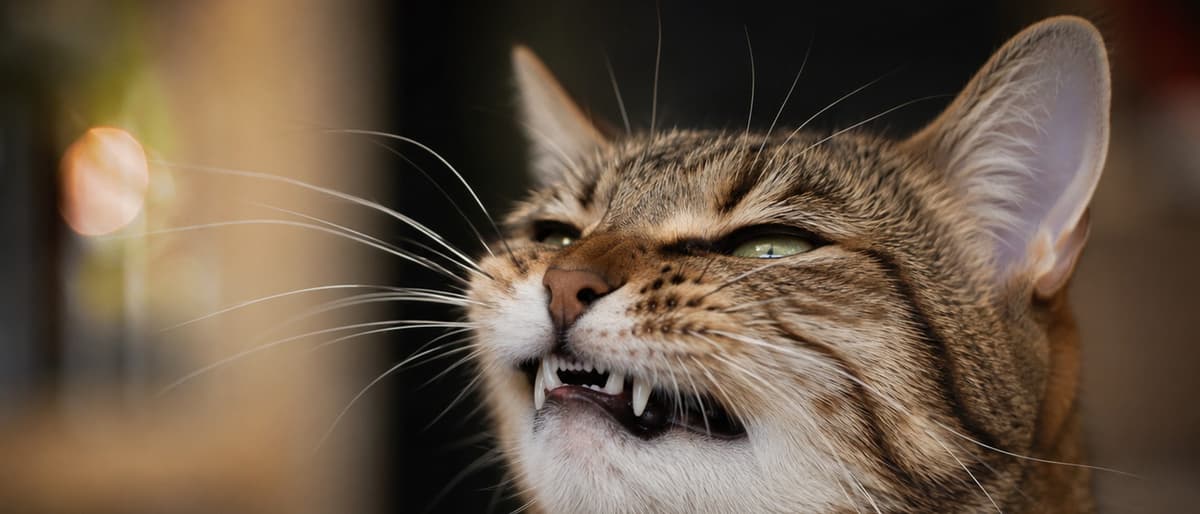
Have you ever seen your cat open its mouth, wrinkle its nose and freeze with a strange expression? That is the flehmen response — from the German word for baring the teeth and curling the lip. It looks like surprise or a grimace of disgust, and it is an analytical procedure.
When a cat encounters an interesting pheromone, it opens its mouth, presses its tongue against the palate, and by that movement forces the molecules from the mouth into the incisive papilla, and from there through the nasopalatine ducts straight into Jacobson's organ. It is deliberate, chemical tasting of a smell.
The neural pathway that follows is just as interesting, because it bypasses conscious processing:
- The pheromone molecule binds to receptors in the epithelium of Jacobson's organ.
- The signal goes to the accessory olfactory bulb.
- From there it travels to the amygdala, and onward to the hypothalamus.
So the cat delivers chemical data directly to the emotional centres of the brain. Receiving a pheromone does not involve reflection; it triggers an immediate, biologically determined response of the body.
The organ itself is formed and organised by the time of birth — the morphological studies covered fetal, newborn and adult cats. The feline version is also uniform in terms of receptors: staining revealed only one of the two receptor pathways found in mammals. So a cat does not have a richer set than other animals — it has a simpler one, used very intensively.
We also know that kittens recognise their mother by scent and remember it for a long time. In a study of kittens from fifteen litters, the memory of the mother's odour persisted more than a year after weaning — and the direction of interest reversed with age. Freshly weaned kittens sniffed the odour of an unfamiliar female for longer; those same cats as adults chose the scent of their own mother.
What we do not know at this point
It is tempting to attribute that recognition to the second nose specifically — but the studies on kittens' scent memory measured olfaction as a whole and did not establish which of the two systems does the work. The anatomy is ready from birth, the ability is documented, and assigning it to a particular structure remains open. I say so plainly, because in popular accounts this sentence tends to be closed off faster than the data allow.
Compute your cat's diet — BARF calculatorOpen calculatorA pheromone is not a message for a cat to think over. It is a state to undergo.
Pageat and the five fractions: the anatomy of a feline message
In 1996 Patrick Pageat described five pheromone fractions secreted by the sebaceous glands on a domestic cat's cheeks and labelled them F1–F5. The functions attributed to them look like this:
| Fraction | Attributed function |
|---|---|
| F2 | sexual pheromone produced by a tomcat during courtship |
| F3 | territorial signal left by rubbing the head against objects |
| F4 | allomarking pheromone — marking familiar people and animals as members of the group |
| F1, F5 | functions far less well understood |
This division has entered circulation so thoroughly that it gets cited like textbook anatomy. Which is why it is worth knowing where it comes from.
Where our knowledge of the F1–F5 fractions really comes from
The 1996 source is a patent application, not a peer-reviewed paper. The exact chemical composition of the individual fractions remains proprietary information, and independent laboratories have never confirmed their characterisation. That does not mean the division is invented — it means it rests on a single source of a commercial nature. I write this as a chemist: "a fraction was described" and "a compound was characterised" are two different things.
The practical conclusion still holds, though: the message depends on the carrier. What a cat leaves on the furniture is a signal about the environment. What it leaves on your leg when it rubs against you concerns social belonging.
Feliway Classic or Friends: this is not the same pheromone
Pheromone products differ in purpose and active substance, and the brand names do a fine job of obscuring that.
Feliway Classic is described by the manufacturer as a synthetic equivalent of the territorial F3 fraction. It is used when a cat marks with urine, scratches furniture, or is under territorial stress.
Feliway Friends (sold in some countries as Feliway MultiCat) rests on something else — a synthetic analogue of the appeasing pheromone secreted by the sebaceous glands of the queen's mammary region in the first days after birth, and released during nursing. This product is intended for tension between cats in one household.
Buying one instead of the other is the most common mistake with these products — and the most common reason behind the sentence "pheromones didn't work for me".
Note the phrase "described by the manufacturer". I used it deliberately, because both substances come from the same proprietary source as the F1–F5 fractions: from the work of Pageat's team, patented and never independently characterised. The appeasing pheromone has a patent of its own, exactly like the facial pheromones. This is not an accusation against the products — it is information about what this entire market rests on.
How much is actually known about efficacy
The study most often invoked here is DePorter et al. (2019). It is worth knowing its real shape, because it gets cited more forcefully than it deserves.
It was a pilot study covering 45 multi-cat households in which aggression had persisted for at least two weeks: 20 homes received the product, 25 a placebo, and the diffusers ran for 28 days.
The result: aggression scores fell in both groups — including the placebo group. The difference in favour of the product came to p = 0.06, which does not reach the conventional 0.05 threshold; the authors adopted a threshold of 0.10. That is a promising signal, but not proof. All participants also received behavioural training, which by itself could have improved matters in both groups.
Felinine and MMB: sulphur chemistry in cat urine
Have you ever wondered why an intact tomcat's urine smells so unbearably intense? Tomcats excrete around 95 mg of felinine a day, while for females the figure is around 19 mg.
Felinine itself, paradoxically, has no smell. It is an amino acid — and it is what happens to it next that hits the human nose.
The key player in its formation is cauxin, a cat-specific protein with enzymatic activity, belonging to the carboxylesterases. Cauxin does not break felinine down — it makes it: it hydrolyses felinine's precursor, cutting it into felinine and glycine. Only then does the finished felinine break down further, and four sulphur compounds have been identified in the headspace gas above cat urine as candidate derivatives.
The most important of them is MMB (3-mercapto-3-methyl-1-butanol), known in the literature as the tomcat compound — the scent signature of a male cat. It is responsible for that sharp, striking smell.
Because felinine production depends heavily on testosterone, neutering drastically reduces its concentration. Less felinine means less MMB being formed — and relief for the human nose.
Anal sacs: a chemical proof of identity
The famous greetings involving a sniff around the tail conceal specific chemistry. The main volatile components of a cat's anal sac secretions are short-chain free fatty acids, and their proportions differ between individuals.
Three things from that study matter here. First, the profile turned out to be stable over time — repeated after two months in the same cats, it was almost unchanged. Second, no differences were found between the sexes. Third, in behavioural tests cats were able to tell individuals apart by that scent alone.
The authors draw a more precise conclusion than the one usually repeated: this scent serves recognition of a particular individual, not of species or sex. It is literally a chemical proof of identity.
And this is where a situation familiar to many people in multi-cat homes comes from. A cat stressed by a visit to the vet can empty its glands out of fear. It comes home without its own chemical signature, coated instead in the smell of the clinic — and its housemate is entitled not to recognise it. This is not spite. It is reading data that are no longer there.
Catnip and silver vine: mayhem on the opioid receptors
Finally, the most enjoyable part of feline chemistry — and the only one in which the second nose plays no part at all.
In a study of one hundred cats, four plants were tested. One in three cats does not respond to catnip. Close to 80% of animals respond to silver vine, and around 50% to valerian and Tatarian honeysuckle. The most interesting finding is that among cats that do not respond to catnip, almost 75% do respond to silver vine — so "my cat doesn't like catnip" is by no means the end of the subject.
The mechanism was worked out only recently and is surprisingly elegant:
- The plant compounds — nepetalactone in catnip, nepetalactol in silver vine — are picked up by the main olfactory system, not by Jacobson's organ.
- The signal activates the μ-opioid system.
- Blood β-endorphin levels rise, producing the state of euphoria visible as rolling and rubbing the face against the plant.
Administering a μ-opioid receptor antagonist blocks the response — the strongest evidence that this is indeed the pathway involved.
And now the best part. The phenomenon serves a defensive function: rubbing with the head and body transfers the active plant compounds straight onto the cat's fur, where they repel mosquitoes of the species Aedes albopictus. The feline "high" is therefore an evolutionarily programmed application of a natural repellent. I developed this thread in a separate article on catnip.
A year later the same group added an element that looks like a detail and is not. During this whole ceremony cats lick and chew the leaves — and for a long time nobody knew why. It turns out that damage to the leaf by the cat substantially increases iridoid emission from both plants, and in silver vine it also diversifies their composition. In other words: the cat is not only applying the repellent, it is activating it along the way.
Is it safe, and is it addictive
This question always comes up, so let me answer it plainly. A 2023 study examined prolonged exposure of cats to silver vine: no hallmarks of addictive behaviour were found, and blood indicators of stress and of liver or kidney injury did not rise.
One caveat I have to add: that study concerned silver vine, not every plant and not every product on the shelf. Nor does it excuse switching off common sense — if your cat reacts to anything in an unusual way, that is a conversation with a vet, not with an article.
The second nose as a key to feline psychology
Behind every freeze over an invisible pheromone and every catnip hit lies the same principle: in a cat, chemistry goes straight to the oldest parts of the brain, the ones handling emotion and survival.
A pheromone is not a message requiring deliberation. It carries an immediate emotional state locked into the structure of a molecule. Feline psychology rests to a large degree on precisely this invisible but very loud stream — the one a cat uses every day to tell itself the reality around it.
References
- Pageat, P. (1996). Properties of cats' facial pheromones (patent), WO1996023414A1 / US5709863A
- Pageat, P. (2019). Cat appeasing pheromone (patent), US Patent 10,258,594↗
- Pageat, P. & Gaultier, E. (2003). Current research in canine and feline pheromones, Veterinary Clinics of North America: Small Animal Practice, 33(2), 187–211doi:10.1016/s0195-5616(02)00128-6
- Vitale, K.R. (2018). Tools for Managing Feline Problem Behaviors: Pheromone therapy, Journal of Feline Medicine and Surgery, 20(11), 1024–1032doi:10.1177/1098612X18806759
- DePorter, T.L., Bledsoe, D.L., Beck, A. & Ollivier, E. (2019). Evaluation of the efficacy of an appeasing pheromone diffuser product vs placebo for management of feline aggression in multi-cat households: a pilot study, Journal of Feline Medicine and Surgery, 21(4), 293–305doi:10.1177/1098612X18774437
- Salazar, I., Quinteiro, P.S., Cifuentes, J.M. & Caballero, T.G. (1996). The vomeronasal organ of the cat, Journal of Anatomy, 188(Pt 2), 445–454↗
- Salazar, I. & Sánchez-Quinteiro, P. (2011). A detailed morphological study of the vomeronasal organ and the accessory olfactory bulb of cats, Microscopy Research and Technique, 74(12), 1109–1120doi:10.1002/jemt.21002
- Szenczi, P., Urrutia, A., Hudson, R. & Bánszegi, O. (2022). Are you my mummy? Long-term olfactory memory of mother's body odour by offspring in the domestic cat, Animal Cognition, 25(1), 21–26doi:10.1007/s10071-021-01537-w
- Apps, P., Mmualefe, L., Jordan, N.R., Golabek, K.A. & McNutt, J.W. (2014). The “tomcat compound” 3-mercapto-3-methylbutanol occurs in the urine of free-ranging leopards but not in African lions or cheetahs, Biochemical Systematics and Ecology, 53, 17–19doi:10.1016/j.bse.2013.12.013
- Hendriks, W.H., Moughan, P.J., Tarttelin, M.F. & Woolhouse, A.D. (1995). Felinine: a urinary amino acid of Felidae, Comparative Biochemistry and Physiology Part B, 112(4), 581–588doi:10.1016/0305-0491(95)00130-1
- Miyazaki, M., Yamashita, T., Suzuki, Y. et al. (2006). A major urinary protein of the domestic cat regulates the production of felinine, a putative pheromone precursor, Chemistry & Biology, 13(10), 1071–1079doi:10.1016/j.chembiol.2006.08.013
- Miyazaki, T., Nishimura, T., Yamashita, T. & Miyazaki, M. (2018). Olfactory discrimination of anal sac secretions in the domestic cat and the chemical profiles of the volatile compounds, Journal of Ethology, 36(1), 99–105doi:10.1007/s10164-017-0532-x
- Bol, S., Caspers, J., Buckingham, L. et al. (2017). Responsiveness of cats (Felidae) to silver vine, Tatarian honeysuckle, valerian and catnip, BMC Veterinary Research, 13(1), 70doi:10.1186/s12917-017-0987-6
- Uenoyama, R., Miyazaki, T., Hurst, J.L. et al. (2021). The characteristic response of domestic cats to plant iridoids allows them to gain chemical defense against mosquitoes, Science Advances, 7(4), eabd9135doi:10.1126/sciadv.abd9135
- Uenoyama, R., Miyazaki, T., Adachi, M., Nishikawa, T., Hurst, J.L. & Miyazaki, M. (2022). Domestic cat damage to plant leaves containing iridoids enhances chemical repellency to pests, iScience, 25(7), 104455doi:10.1016/j.isci.2022.104455
- Uenoyama, R., Ooka, S., Miyazaki, T. et al. (2023). Assessing the safety and suitability of using silver vine as an olfactory enrichment for cats, iScience, 26(10), 107848doi:10.1016/j.isci.2023.107848
Frequently asked
What is the flehmen response in cats?
It is that characteristic freeze with the mouth open and the upper lip curled back, which looks like a grimace of disgust but is in fact an analytical procedure. The cat presses its tongue against the palate and forces scent molecules from the mouth through the incisive papilla into Jacobson's organ. Put simply: the cat is not smelling the odour, it is tasting it.
Where is Jacobson's organ located in a cat?
At the base of the nasal septum, above the hard palate. It is a pair of thin, fluid-filled structures surrounded by cartilage. It connects to the mouth through the nasopalatine ducts, which open at the incisive papilla — a small bump just behind the upper incisors. The organ itself therefore does not sit in the oral cavity; it merely communicates with it.
What is the difference between Feliway Classic and Feliway Friends?
They are two different pheromones. Classic is described by the manufacturer as a synthetic equivalent of the F3 fraction, the territorial signal a cat leaves by rubbing its head against objects — it is used for urine marking, furniture scratching and territorial stress. Friends is based on the appeasing pheromone secreted by the sebaceous glands of the queen's mammary region after birth, and is intended for tension between cats in the home. Buying one instead of the other is the most common mistake with these products. It is worth knowing that the composition of both substances remains proprietary and has not been confirmed by independent laboratories.
Why does an intact tomcat's urine smell so intense?
The culprit is felinine — an amino acid excreted in urine, of which a tomcat produces around 95 mg a day and a female around 19. Felinine itself is odourless. The sharp smell comes only from its sulphur derivatives, including the compound abbreviated MMB, known in the literature as the tomcat signature. Felinine production depends on testosterone, which is why the smell weakens after neutering.
Why is a cat returning from the vet sometimes attacked by its housemate?
Anal sac secretions form an individual scent profile in every cat, stable over time — something like a chemical proof of identity. A stressed cat can empty these glands out of fear and comes home without its own signature, coated instead in the smell of the clinic. The other cat reads that as a stranger. It is not spite; it is reading data that are no longer there.