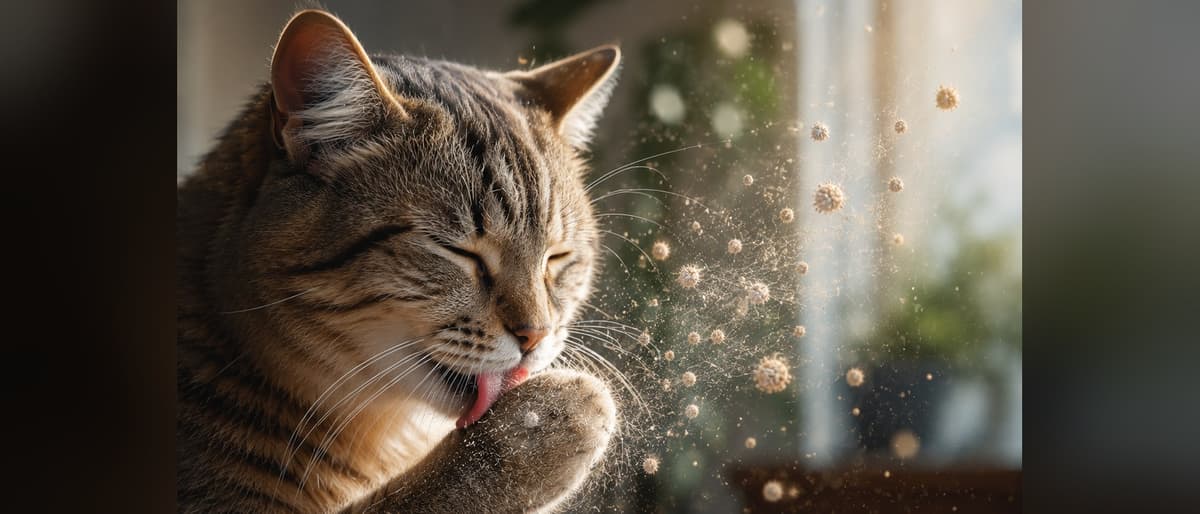
In part one we answered the question of which cat produces less of the allergenic protein Fel d 1. The conclusion was inconvenient for the entire cat-marketing industry: breed tells you almost nothing. But there is a second, equally important question, discussed far less often, which in everyday life frequently decides the most: how much of that protein actually reaches you, how long the contact lasts, and at what point in life you met your first cat.
This text focuses on the exposure rather than the cat. It gathers what peer-reviewed research shows about dose, contact time and the „childhood window” — the factors that barely feature in conversations about cat allergy, yet have incomparably better support in hard data than anything that can be said about a pedigree.
Sensitisation is not the same as allergy
We have to start here, because without a strict distinction between these two terms the rest of the argument falls apart.
Sensitisation, in the immunological sense, means the body has produced IgE antibodies against a given protein. That is purely a laboratory measurement. Allergy means that contact with that protein produces real symptoms in us. That is a clinical event. As it turns out, one without the other is far more common than is generally assumed.
The scale of this is shown by a 2024 study by Zahradnik and colleagues, conducted on 313 first-year veterinary students. About 11% had antibodies against cats, that is, sensitisation. Yet only 41% of that group reported actual allergic symptoms. In other words, the remaining nearly sixty percent of people with a positive blood marker experienced no complaints at all.
In practice this means one thing: a positive cat test is not a verdict, and on its own it is not a diagnosis of allergic disease. It is simply information that an allergist must weigh against what genuinely happens during our contact with the animal.
Interestingly, the same study showed that of the forty students who grew up on a farm with animals, not one was sensitised to any of the animals tested.
Why „a farm”, not „the countryside”
This figure is often quoted imprecisely, and the difference matters. The authors write specifically about growing up on a farm with animals (in the table: „childhood on farm with animals”, 40 people out of 313, or 12.8%), not about living in the countryside.
This is not an editorial quibble. Allergology recognises a separate, well-documented phenomenon known as the farm effect: what protects is contact with livestock and with the farm environment itself, not an address outside the city. A house in a small town, with no livestock, does not produce that effect.
The reaction has a threshold, not a switch
The everyday picture of allergy tends to be binary: either this cat sets me off or it does not. Science shows something quite different — the body's reaction appears only once a certain threshold is crossed, and the dose we take in accumulates over time.
This is best illustrated by so-called chamber studies, in which sensitised people stay in a closed room with a tightly controlled concentration of cat allergen. Yang and colleagues (2022) ran such a test on thirty people with cat allergy. Subjects spent two sessions of 180 minutes each in the chamber. The duration of those sessions is itself an excellent answer to the question in the title — if the reaction appeared immediately in everyone, nobody would design a three-hour exposure.
The key results from this experiment teach us two things:
- Time to reaction was significantly associated with the Fel d 1 concentration in the chamber — the higher the airborne allergen concentration, the sooner the patient reacted.
- In as many as 33% of subjects the reaction appeared with a clear delay — after leaving the chamber, within the following 24 hours.
It is worth noting honestly that this work was sponsored by a pharmaceutical company (Regeneron Pharmaceuticals) to assess the usefulness of chambers for drug testing, and that what it measured above all was lung function in people with mild asthma. Even so, the conclusion about the relationship between allergen concentration and time to reaction remains credible — the authors report it directly as a result.
Compute your cat's diet — BARF calculatorOpen calculatorWhy running cats change everything
Since the key is the protein concentration in the air, it is worth knowing what that actually depends on.
Custovic and colleagues (1998) measured this precisely in British homes, analysing the particle sizes on which cat Fel d 1 travels. The results were fascinating:
- About 49% of the allergen in household air was carried on large particles (above 9 µm).
- Around 23% of the allergen was bound to fine particles (smaller than 4.7 µm).
Why does this matter? Because the two fractions behave completely differently. Large particles settle onto floors and furniture very quickly — but return to the air with any vigorous movement. Fine particles, by contrast, stay suspended for hours — and, as we are about to see, for days.
The next stage of the experiment proved it: after the cats were removed from the living room, the total airborne Fel d 1 level fell by 61.7% within two days. The drop, however, concerned almost exclusively the coarser fraction, which fell to 13% of its baseline value. The fine fraction simply stayed in the air — in the measurements taken on days one, two and four it barely changed at all, and only after two weeks did it come down to 33% of baseline.
This study explains a classic observation made by many allergy sufferers. Walking into a home where a cat is asleep, you mainly breathe in that fine, permanently suspended portion of the allergen. But the moment the cats start chasing and playing, that large, previously settled half lifts off the floor, carpets and upholstery. For the immune system this is not „slightly more allergen” — it is a step change in dose.
What this study did not measure
Custovic measured air under undisturbed conditions and after the cats were removed from the room. He did not run an experiment in which cats run on command while someone counts how far the concentration jumps and over what time.
The statement about settled allergen being thrown back up is therefore an inference from the particle physics this paper described: if half the allergen sits on settling particles, and if it was precisely that fraction which disappeared from the air once the cats were removed, then movement must be lifting it back up. The direction is certain. A specific number — how many times higher, and within how many minutes — is not in this paper, and I did not find it in another, which is why I do not quote one here.
How many cats is too many?
This is one of the few relationships in feline allergology that behaves entirely intuitively. In household dust analyses by Nicholas and colleagues (2008), Fel d 1 concentration rose steadily with the number of cats in the home. Homes with cats showed a geometric mean allergen level of 32.88 compared with 0.43 in homes where no cats lived — a gulf of roughly two orders of magnitude.
This means that from an allergy sufferer's perspective, visiting one „average” cat is a completely different burden on the body than visiting a home where four cats are playing.
The moment in a person's life matters
Here we come to the best-documented part, and the one most persistently mangled in public discussion.
Ownby and colleagues (2002) analysed a birth cohort in the Detroit area, following children to a mean age of about 6.7 years. They examined the proportion of positive skin tests at ages 6–7 according to animal contact in the first year of life:
- No dog or cat: positive tests in 33.6% of subjects.
- One dog or cat in the home: positive tests in 34.3% of subjects.
- Two or more animals in the home: positive tests in only 15.4% of subjects.
Note the middle value. This study indicates that having one animal offered virtually no statistical protection — a clinically meaningful difference appeared only with two animals or more.
Swedish researchers reached the same conclusion. Hesselmar and colleagues (1999) showed that contact with a cat in the first year of life was associated with less frequent sensitisation to cats at ages 12–13. Crucially for the strength of this evidence, the researchers repeated their analyses excluding families who had deliberately avoided pets because of existing allergies in the family (to rule out selection bias) — and the result still held.
Before you take this as a rule — the literature is not unanimous
I called this the best-documented part and I stand by that in terms of the number of studies. But „best documented” does not mean „settled”.
A systematic review of longitudinal studies in urban populations (Lodge et al. 2012) covered nine papers and 6,498 participants. It opens by stating that the literature on this question is contradictory. Six papers found less allergic disease with early animal contact, one found no association, and two found increased risk — but only in high-risk groups.
Two conclusions follow. First, the protective effect is best supported in children without a family history of allergy. Second, in families that already carry an allergic burden the picture blurs or even reverses — which is why the line below about consulting an allergist is not mere courtesy.
The authors add something relevant to this particular text: the protective signal is clearer for dogs than for cats.
Tolerance that leaves a measurable trace
What actually happens in the body of a child growing up with cats? Platts-Mills and colleagues (2001) studied 226 children aged 12–14 and uncovered a remarkably interesting mechanism of immunological tolerance.
- The highest cat exposure in the home was associated with less frequent sensitisation.
- Moreover, such high exposure went hand in hand with a higher prevalence of IgG and IgG4 antibodies directed against cat Fel d 1.
- Of the 76 children living in homes with high Fel d 1 concentrations who were not sensitised to cats, as many as 31 also had high levels of IgG against that protein.
The authors called this a modified Th2 response and regarded it as a form of immunological tolerance. The child's immune system does not ignore Fel d 1 at all. It sees it perfectly well and responds to it, simply using a different class of antibody from the ones that cause troublesome symptoms. Fascinatingly, house dust mites in the same study behaved in exactly the opposite way — there, the higher the exposure, the more frequent the diagnosed sensitisation.
What none of this means
Popular culture often draws extreme and unwarranted conclusions from these studies. Let us set clear limits.
It does not mean an allergic adult will miraculously desensitise by bringing home a kitten. The entire literature here concerns mechanisms of building tolerance and preventing sensitisation in children only. There is no confirmed evidence that the same mechanism rescues an adult in whom allergy is already active. Occupational medicine in fact describes the reverse process: under intense, years-long contact with animals, adults can develop an occupational allergy. I should say honestly that this observation comes from a different field than the studies discussed above and I am not resting it on a specific paper here — separating what arose on the job from what existed beforehand is difficult in any case. Treat it as a reason for caution rather than a measured effect.
It does not mean that adopting „a second cat to toughen up the baby” is a universal medical recommendation. The studies cited above show cohort-level phenomena; they do not provide individual preventive advice. Introducing an animal into a family that already carries a heavy allergic burden always requires an allergist's opinion.
Honest caveats about these studies
To analyse honestly, one has to see the gaps even in the finest research.
The Platts-Mills study (2001) is cross-sectional — it shows phenomena occurring together, not an unambiguous causal chain. In Ownby (2002), only 57% of the selected children completed the full study (474 of the original 835). Yang (2022) is commercial research paid for by a pharmaceutical company. Custovic (1998) measured dust and air statistics, not the direct wellbeing of the people inside.
A caveat about the Zahradnik study — but in the other direction
The instinctive suspicion here is that people with severe allergies simply do not choose veterinary studies, so the group must be „healthier” than average. The authors report the opposite.
First, they state plainly that the prevalence of sensitisation among first-year veterinary students roughly corresponds to that in the general population. Second, they point to a selection bias running the other way: students with asthma appeared particularly motivated to take part because of their health situation, and a pre-existing allergy may have increased interest in participating.
The real limitations of this work are different, and the authors list them: symptoms were based on participants' self-assessment, no challenge tests were performed, and the data were not adjusted for confounders such as family history of allergy, number of siblings or socio-economic status.
What follows in practice?
Working strictly from the data, without stretching the facts, three firm rules follow for the average person.
A short visit is no test of tolerance. Half an hour over coffee in a living room with a cat asleep in an armchair tests only your initial threshold of provocation, not that particular animal. A genuine, reliable challenge has to last long enough (remember the delayed reactions) and take place under conditions of real air movement.
The setting determines the outcome. The same person and the same cat can produce entirely different clinical symptoms depending on how many animals are currently in the home and whether they are chasing each other across the room, lifting settled allergen out of the carpets.
A person's age outweighs a cat's pedigree. This is the most inconvenient conclusion for cat marketing. The moment in a person's life and the early childhood window matter incomparably more for future immune protection than whether we buy a cat reputed to be „hypoallergenic” or take in an ordinary moggie.
In summary
In part one of our material we established that a fully hypoallergenic cat simply does not exist, because physiologically there is no cat in the world that does not produce Fel d 1. In part two we can see that serious science offers no naive answer along the lines of „this cat will set you off and that one will not”.
Allergic reactions depend on a cumulative dose that builds over time. Half the allergen in household air sits on particles that settle and rise again with every movement — so whether the cats happen to be asleep or chasing a toy changes the dose more than the pedigree of any of them. Rather than hunting for the perfect, safe breed in a classified advert, it is far wiser to understand your own tolerance threshold and the physics of the environment you spend time in.
A note from the author
I am a doctor of chemistry by training. In the text above I analyse protein concentrations, the sizes of airborne particles and the results of immunological tests. I am not a medical doctor.
Interpreting test results, deciding on any treatment (immunotherapy), and guidance on whether a family with allergies can live with a particular animal — these always and unconditionally belong to an allergist.
References
- Zahradnik, E., Nöllenheidt, C., Sander, I., Beine, A., Lehnert, M., Hoffmeyer, F. & Raulf, M. (2024). Animal exposure, sensitization, and allergic symptoms in first-year veterinary medicine students, Allergologie Select, 8, 51–63doi:10.5414/ALX02449E
- Yang, W.H., Kelly, S., Haya, L., Mehri, R., Ramesh, D., DeVeaux, M., Wang, C.Q., Meier, P., Narula, S., Shawki, F., Pennington, R., Perlee, L. & O'Brien, M.P. (2022). Cat allergen exposure in a naturalistic exposure chamber: A prospective observational study in cat-allergic subjects, Clinical & Experimental Allergy, 52(2), 265–275doi:10.1111/cea.14087
- Custovic, A., Simpson, A., Pahdi, H., Green, R.M., Chapman, M.D. & Woodcock, A. (1998). Distribution, aerodynamic characteristics, and removal of the major cat allergen Fel d 1 in British homes, Thorax, 53(1), 33–38doi:10.1136/thx.53.1.33
- Nicholas, C., Wegienka, G., Havstad, S., Ownby, D. & Johnson, C.C. (2008). Influence of cat characteristics on Fel d 1 levels in the home, Annals of Allergy, Asthma & Immunology, 101(1), 47–50doi:10.1016/S1081-1206(10)60834-4
- Ownby, D.R., Johnson, C.C. & Peterson, E.L. (2002). Exposure to dogs and cats in the first year of life and risk of allergic sensitization at 6 to 7 years of age, JAMA, 288(8), 963–972doi:10.1001/jama.288.8.963
- Hesselmar, B., Åberg, N., Åberg, B., Eriksson, B. & Björkstén, B. (1999). Does early exposure to cat or dog protect against later allergy development?, Clinical & Experimental Allergy, 29(5), 611–617doi:10.1046/j.1365-2222.1999.00534.x
- Platts-Mills, T., Vaughan, J., Squillace, S., Woodfolk, J. & Sporik, R. (2001). Sensitisation, asthma, and a modified Th2 response in children exposed to cat allergen: a population-based cross-sectional study, The Lancet, 357(9258), 752–756doi:10.1016/S0140-6736(00)04168-4
- Lodge, C.J., Allen, K.J., Lowe, A.J., Hill, D.J., Hosking, C.S., Abramson, M.J. & Dharmage, S.C. (2012). Perinatal cat and dog exposure and the risk of asthma and allergy in the urban environment: a systematic review of longitudinal studies, Clinical and Developmental Immunology, 2012, 176484doi:10.1155/2012/176484
Frequently asked
Does a positive cat allergy test mean I am allergic?
Not necessarily. Sensitisation means only that IgE antibodies against the cat protein are present in the blood — a laboratory measurement. Allergy means that contact with that protein produces real symptoms, a clinical event. In a study of 313 first-year veterinary students, about 11% had antibodies against cats, but only 41% of that group reported symptoms. The remaining nearly sixty percent felt nothing at all. A positive result is information an allergist must weigh against what actually happens on real contact with the animal — it is not a diagnosis.
Why do I react to one cat and not another?
Usually the deciding factor is not the cat but the allergen dose reaching you. Roughly half of the airborne Fel d 1 in a home sits on large particles that settle quickly onto floors and furniture but return to the air with any vigorous movement. So a home where a cat sleeps in an armchair and a home where two cats chase each other across a carpet are two different exposures for the immune system, even when the cat is nominally „the same”. The number of animals matters too: allergen concentration rises with the number of cats in the home.
Is a short visit to someone with a cat a good allergy test?
No. In a chamber study, sensitised people spent 180 minutes in controlled exposure, and in 33% of them the reaction appeared only after leaving, within the following 24 hours. Half an hour over coffee in a living room where the cat is asleep therefore tests mainly your initial threshold, not your tolerance of that particular animal. A meaningful trial has to last long enough, account for delayed reactions, and take place under real movement — because only then does the allergen lift off the floor.
Does a cat in the home protect a child from allergy?
The direction is reproducible, but it concerns children only, and only the early period of life. In a birth cohort near Detroit, positive skin tests at ages 6–7 were found in 33.6% of children with no dog or cat, 34.3% with one animal, and 15.4% with two or more. One animal offered virtually no protection. A Swedish study confirmed the direction for sensitisation at ages 12–13, including after excluding families who deliberately avoided pets because of allergy. It must be added, however, that a systematic review of nine longitudinal studies calls the literature on this question contradictory: the protective effect is best supported in children without a family history of allergy, while in high-risk groups two papers found increased risk. Nor does any of this mean an allergic adult will desensitise by taking in a cat — no such evidence exists.