A cat's paw is one of those body parts we look at every day and know almost nothing about. It looks soft, it ends in pads, and at first glance it seems a simple affair: four limbs and some claws. In fact the paw, and the pads in particular, is a complicated structure doing several jobs at once. The pads alone are a sophisticated shock absorber, an extremely sensitive vibration detector, and the only place on the body where a cat sweats. The paw as a whole also serves scent communication and defence.
In this article I have gathered what has been demonstrated in solid research, separating it from the myths that circulate in popular guides. I also mark — and this matters to me just as much — the places where the data run out and reasonable inference begins. Some of the most frequently repeated claims about feline anatomy have no support in any documented experiment, even though they sound like established fact.
Eighteen toes, and a thumb the cat never stands on
Let us start with the structure of the paw itself, which is relatively easy to check for yourself.
A cat has eighteen toes: five on each front paw and four on each hind paw. The asymmetry can be surprising at first, but it is a constant rule across the cat family. There are exceptions, such as polydactyl cats — those born with extra digits.
The difference in toe count comes from the presence of the so-called first digit, the feline equivalent of a human thumb, on the forelimbs only. On the hind paws this digit is absent altogether.
On the front paw the first digit sits high, on the inner side of the limb and well above the other toes. Because of that position it makes no contact with the ground during normal walking, carries none of the body weight, and leaves no print.
It is tempting to write this digit off as a useless evolutionary leftover, but it does real work. A cat uses it to grip and hold prey or toys, to steady itself when climbing, and in any movement where the paw functions like a hand.
The claw that is easiest to forget
Claws wear down mainly through scratching surfaces and walking. The claw on the first digit never touches the ground, so it does not blunt the way the others do — and in veterinary practice it is the one that most often overgrows and can grow painfully into the pad. Older and less active cats are particularly affected.
This is an observation from the clinic, not a study with numbers attached. But the consequence is simple: this one claw is worth checking more often than the rest, because a cat instinctively hides pain and will not tell you.
It is worth adding that the cat is a digitigrade animal. It does not rest the whole foot on the ground the way we do. The entire body weight sits on the toes and on the large metacarpal pad. The joint that looks, from our perspective, like a knee bent backwards on a standing cat is anatomically the heel, held high above the ground. This arrangement lengthens the stride and allows a cat to move very fast and completely silently.
Twenty-four pads: a map of the paw
The pads have specific names, and they do not all do the same job.
The front paw has seven: one under each of the five toes (the digital pads), one large pad under the metacarpus (the metacarpal pad), and one more set higher up at the back of the leg — the carpal pad.
The hind paw has five: four digital pads and one large metatarsal pad. There is no carpal pad on the hind limbs at all.
24
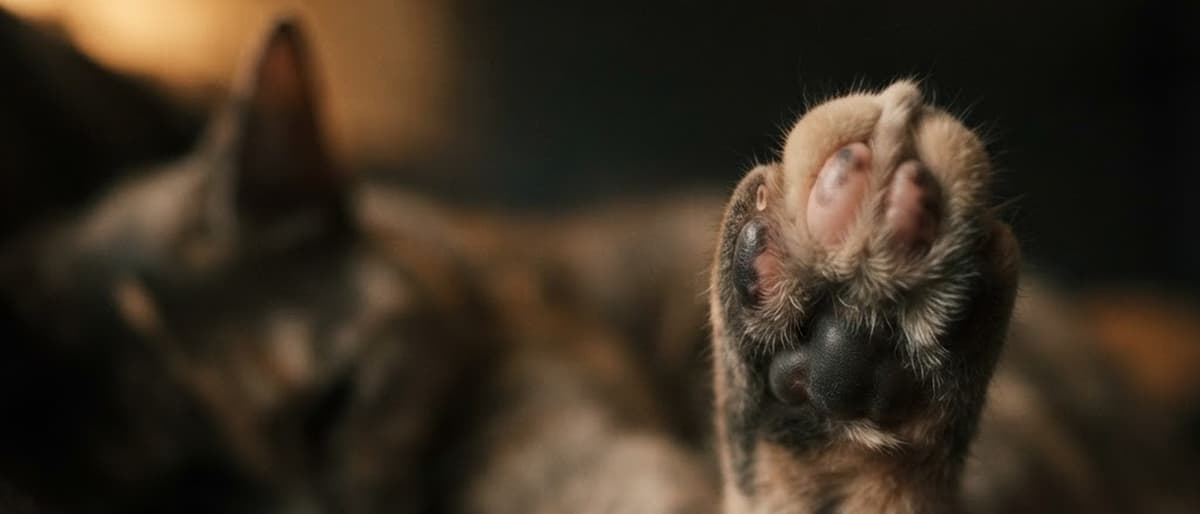
If you try to count these on your own cat, you will probably come up short. The pad under the first digit can be genuinely tiny, and the digit sits high enough on the leg that it simply does not appear when you look at the paw from below. What you see is four digital pads and one large one — which is exactly what the front paw in the photograph at the top of this article looks like.
The carpal pad does not touch the ground during ordinary walking, because it sits too high. It occurs only on the forelimbs — the ones that land first and lead the movement.
Where description outruns evidence
Veterinary sources agree in assigning the carpal pad a role as a brake and an anchoring point during a sudden stop, when landing from a height, and when descending head first. The description is coherent and makes sense.
It has to be said honestly, though, that this is a functional description derived from comparative anatomy, not a conclusion from direct biomechanical measurements on cats. I know of no study that has measured this function.
What a pad is actually made of
Although a pad feels like firm rubber from the outside, its internal structure and mechanics are something else entirely.
Miao and colleagues (2017) examined the layers of a dog's pad histologically — that is, tissue structure under a microscope — and built a physical computational model from it to test how the pad responds on ground impact. The experiment was carried out on dogs, but carrying the conclusions across to cats is not a stretch here: the authors state explicitly that very similar fat and collagen structures occur in the footpads of humans, elephants, domestic cats and leopards.
The study showed that a pad is a precise three-layer system in which each element has its own task:
- The epidermis with dermal papillae (a thick keratinised layer) — its role is to distribute stress evenly.
- The dermis (bundles of collagen fibres) — acts as a casing, wrapping the fatty layer in a tough sheath.
- The subcutaneous layer — stores, releases and effectively dissipates the energy of impact.
The third layer is the crucial one. Fat trapped in collagen compartments mechanically mimics a hydrostatic system — a closed system filled with fluid. That means it behaves far more like a gel damper than like an ordinary compressible sponge.
Worth mentioning separately is the work of Xu and colleagues (2022), who built a computer model of a cat's forelimb using finite element analysis. This is an engineering technique in which a complex object is divided virtually into a mesh of thousands of tiny polygons, letting a computer calculate precisely how the object deforms under force. The researchers examined how stresses distribute during landings from different heights and found that four bones contribute most to distinguishing landing patterns: the second and fourth metacarpals and the second and third proximal phalanges.
The authors phrase their conclusion carefully, and it is worth repeating in their own register: as height increases the landing pattern changes, which may be a response of the limb to growing load — the musculoskeletal system selecting a more favourable strategy. This is the output of a computer simulation, not an observation of a cat making a conscious decision.
The pads are a sensor, not an ornament
The skin on the paw pads is among the most densely innervated tissue in a cat's body. Ferrington (1985) examined the nerve fibres serving this area in detail. The sense proved remarkably acute: it responds most strongly to subtle vibration at frequencies of just 5–10 hertz.
5–10 Hz
For a sense of scale: that is roughly the order of vibration a floor carries under muffled footsteps. That comparison is mine, not a finding from the study — Ferrington delivered sinusoidal vibration under laboratory conditions, not footsteps across a flat.
More than that, the fibres in the paw do not respond to simple top-down pressure but to changes in shape and to distortion of the nerve endings. This is the mechanism by which a cat judges the texture of a surface — whether it is smooth or sharp — senses how much it gives, and registers unerringly whether it has moved.
In receptor terms this corresponds to SAI fibres (slowly adapting type I). These are slowly adapting nerve fibres, which in practice means they send a signal to the brain not only in the split second after contact but continuously, for as long as the pressure lasts. They connect to Merkel cells — specialised sensory cells responsible for registering the lightest touch and the finest texture.
From this comes the inference I find most useful in this whole section: a cat's dislike of having its paws held is most likely not spite or caprice. Holding the paw blocks access to a sense that functions as radar in a natural environment. I should note that this is an interpretation of the organ's structure, not the result of a behavioural experiment.
The only place a cat sweats
Thermoregulation in cats works quite differently than in humans. Eccrine glands, whose function is to release sweat directly in order to cool the body, are located in cats exclusively in the paw pads. Skin covered in fur carries only apocrine glands, which open into hair follicles — and those secrete scent compounds, not cooling sweat.
Holmes and Adams (1975) measured what happens when a pad becomes moist: its thermal conductivity rises. Under conditions closer to the natural state the increase was about 17 percent. In trials where the accompanying vasoconstriction was blocked with an alpha-adrenergic drug it reached nearly half — but that is a pharmacological situation, not an everyday one. Either way, a sweating paw becomes a more efficient biological heat exchanger.
The same paper says something else that matters about the mechanism. The researchers induced sweating by stimulating the nerve, and switched off the effect of the blood vessels with a drug blocking alpha-adrenergic receptors. In other words: the sweat glands in a cat's pads are under the control of the sympathetic nervous system — the same system that drives the response to threat.
Where the research stops and inference begins
Anyone who has taken a cat to the vet knows it: damp paw prints on a metal table, even though the consulting room is not remotely hot. Since the glands in the pads are under sympathetic control, and fear activates that system, connecting the two is physiologically sensible.
But it is an inference, not a measurement. I looked for a study that measured fear-induced sweating of cats' paws, and I did not find one. What is documented is the mechanism and the clinical observation — not an experiment linking them directly. I am saying so plainly, because in popular guides this sentence circulates as established fact, and established fact it is not.
The paw writes messages
There are scent glands between a cat's toes — this is standard anatomical description, familiar from veterinary pathology textbooks. When a cat sinks its claws into furniture or a scratching post, it spreads the secretion of those glands across it. Scratching is therefore not born of boredom or an urge to destroy the surroundings but is a double territorial message: visual, in the marks left behind, and olfactory.
Wilson and colleagues (2016) analysed surveys collected from 4,331 cat owners across 39 countries. From owners' observations, cats most readily used posts covered in rope — even though carpet was the material offered most often. Posts used more frequently were at least three feet tall, roughly 91 centimetres, in the form of a simple upright post or a cat tree with two or more levels, and had a narrower base.
Intact and neutered cats scratched inappropriately at the same rate — regardless of sex.
This is one of the more important findings in that paper, because it overturns a popular belief. Scratching objects is not driven by sex hormones, so switching those hormones off will not stop a cat from scratching furniture. What does help? In the same study, the more different types of scratching post in the home, the less scratching in the wrong places.
The claw grows from bone, not from skin
In humans a nail is purely a product of the skin, but a cat's claw is built differently. It is anchored directly to the last phalanx, the bone of the toe. That is why surgical claw removal does not involve taking off the horny tissue alone but amputating the entire final segment of bone from every toe.
Martell-Moran and colleagues (2018) studied the medical consequences in 137 declawed cats and 137 controls. Declawed cats showed a significantly raised risk of back pain, eliminating outside the litter box, and biting. In 63 percent of them, radiographs revealed retained bone fragments — and in those cats the risk was higher still. Importantly, even a correctly performed procedure did not eliminate the raised risk of biting and litter box problems.
These conclusions were strengthened by more recent work from LaChance and colleagues (2025), which separated post-amputation pain from pain caused by osteoarthritis — a common condition in older cats that can obscure the picture. Declawed cats showed hyperalgesia and allodynia, meaning an exaggerated pain response and pain provoked by a stimulus that would not normally hurt, along with objective abnormalities in nerve conduction indicating fibre damage.
How this is regulated in Europe
Claw amputation is banned in the European Union. The basis is the Council of Europe's European Convention for the Protection of Pet Animals, which prohibits surgical operations performed to alter an animal's appearance or for other non-curative purposes, naming declawing explicitly. An exception is allowed only where a veterinary surgeon considers the procedure necessary for medical reasons.
The Convention has been ratified by 24 states, so it is more accurate to speak of a ban in the European Union and in the states that have acceded to the Convention than of a ban across the whole of Europe.
When there are more toes: polydactyly
The phenomenon in which extra toes appear on a paw is called polydactyly. Lettice and colleagues (2008) showed that this anomaly is the result of a single nucleotide substitution in a genetic switch called the ZRS, which governs the genes responsible for correct limb development. The same mechanism was described in the famous Hemingway cats.
It is fairly common in Maine Coons. Hamelin and colleagues (2020) established that the trait is inherited as an autosomal dominant — a variant from one parent is enough — but with incomplete penetrance and variable expressivity. In practice this means not every cat carrying the variant will have extra toes, and the number varies between kittens from a single litter. The same authors showed that polydactyly in Maine Coons is genetically heterogeneous: some polydactyl cats do not carry the Hw variant at all.
Earlier work from the same team (Hamelin et al. 2017) described the phenotype in 70 Maine Coons, including 48 polydactyl cats from four breeding lines in Europe, Canada and the USA. The variability proved considerable and affected not only toe number but also the conformation of the carpus and tarsus. Comparing the length of the radius in kittens and adult females revealed no difference between polydactyl and normal cats. The authors' conclusion: polydactyly has no apparent deleterious consequence for feline welfare.
One practical obligation remains, however: extra claws require conscientious, regular checking and more frequent trimming.
Left or right? Cats have a favourite paw
Domestic cats turn out to show functional asymmetry. A meta-analysis by Ocklenburg and colleagues (2019) indicates that 78 percent of the cats studied consistently use one preferred paw for harder tasks — retrieving a hidden treat, for instance.
78%
Unlike our own population, dominated by right-handers, cats showed no population-level bias towards either side — left- and right-pawed animals split roughly evenly. Sex does appear to play a role, though: female cats had significantly greater odds of being right-pawed than males.
It should be noted that research on laterality in animals still lacks a single universal, validated test — a methodological problem described in detail by Isparta and colleagues (2024). That means the figure of 78 percent is solid, but comparing results between individual studies is harder than it looks.
What can go wrong — and what to look for
Because the underside of a cat's paws is in near-constant contact with the ground, and the pads themselves can hide under thick fur, injuries and disease often go entirely unnoticed by owners for a long time.
Plasma cell pododermatitis
This is a painful, immune-mediated condition characterised by pathological accumulation of plasma cells, the inflammatory cells of the immune system. The pads swell, soften, lose their defined shape, take on an unnatural bluish colour and can split open.
Sarkan and colleagues (2026) described 25 cats in which this disease was accompanied by damage to the renal glomeruli. It has to be said straight away what this paper is and is not: it is a case series assembled specifically so that both conditions occur together. It does not tell us how often one accompanies the other. What it does tell us is that the combination is real and that the prognosis can be poor.
Those affected were mostly young neutered males under five years of age. In 14 of the 17 cats that underwent renal histopathology, immune complex glomerulonephritis was found. Median survival from the onset of renal signs was about one month.
The authors draw attention to one diagnostic detail that seems worth remembering: the urine protein to creatinine ratio varied so widely between patients that on its own it could mislead. What was consistently abnormal was urine protein electrophoresis (SDS-PAGE). A diagnosis of pododermatitis is therefore worth treating as a reason to check the kidneys, and to discuss with your vet which urine test makes sense here.
Cat litter in the pad — but not the way it seems
Agrawal and colleagues (2026) examined 13 biopsies taken from cats' paws and, using Raman spectroscopy, showed that the particles lodged in the tissue matched the spectrum of silica from clay-based litters. Material from the litter box does therefore penetrate the tissue and form granulomas.
The direction of that relationship, however, is the opposite of what intuition suggests — and this is the most interesting part of the paper. Ten of the thirteen biopsies also showed plasma cell pododermatitis, from which the authors conclude that pre-existing pad disease opens the way for the litter, rather than litter causing disease in a healthy cat. The resulting granuloma can then mask the original cause and worsen the clinical picture.
The practical conclusion therefore applies to cats that already have pad lesions: for those, the authors suggest considering a substrate other than clumping litter, not least because recurrence after surgery is common. This is not a recommendation for all cats, and there is no reason to change a litter box that is working perfectly well for a healthy one.
Four things to check at home
It is worth inspecting your cat's paws regularly, as a matter of routine:
- The length of every claw, with particular attention to the first digit on the side of the leg.
- Skin changes between the toes — scabs, localised hair loss, wounds.
- The smoothness and firmness of the pads — a sudden change in consistency or shape is the signal, not the colour itself. Pad colour is a matter of pigment and varies even within one cat.
- The animal's behaviour — compulsive licking of one paw is often a quiet signal of pain.
In summary
A cat's paw is a precisely worked out mechanism: a layered shock absorber with a hydrostatic structure, a vibration sensor tuned to low frequencies, and a tool of scent communication, all at once. Damp prints on the vet's table have a physiological explanation in glands governed by the sympathetic nervous system. Gripping a cat firmly by these delicate structures takes away its access to one of its more important senses.
If I had to pick one thing to remember from all of this, it would be that single claw which never touches the ground and therefore never blunts itself. The rest is fascinating. That one can be painful.
References
- Lettice, L.A., Hill, A.E., Devenney, P.S. & Hill, R.E. (2008). Point mutations in a distant sonic hedgehog cis-regulator generate a variable regulatory output responsible for preaxial polydactyly, Human Molecular Genetics, 17(7), 978–985doi:10.1093/hmg/ddm370
- Hamelin, A., Begon, D., Conchou, F., Fusellier, M. & Abitbol, M. (2017). Clinical characterisation of polydactyly in Maine Coon cats, Journal of Feline Medicine and Surgery, 19(4), 382–393doi:10.1177/1098612X16628920
- Hamelin, A., Conchou, F., Fusellier, M. et al. (2020). Genetic heterogeneity of polydactyly in Maine Coon cats, Journal of Feline Medicine and Surgery, 22(12), 1103–1113doi:10.1177/1098612X20905061
- Ferrington, D.G. (1985). Functional properties of slowly adapting mechanoreceptors in cat footpad skin, Somatosensory Research, 2(3), 249–261doi:10.3109/07367228509144567
- Miao, H., Fu, J., Qian, Z., Ren, L. & Ren, L. (2017). How does the canine paw pad attenuate ground impacts? A multi-layer cushion system, Biology Open, 6(12), 1889–1896doi:10.1242/bio.024828
- Adams, T. (1966). Characteristics of eccrine sweat gland activity in the footpad of the cat, Journal of Applied Physiology, 21(3), 1004–1012doi:10.1152/jappl.1966.21.3.1004
- Holmes, K.R. & Adams, T. (1975). Epidermal thermal conductivity and stratum corneum hydration in cat footpad, American Journal of Physiology, 228(6), 1903–1908doi:10.1152/ajplegacy.1975.228.6.1903
- Xu, D., Zhou, H., Zhang, Q. et al. (2022). A new method proposed to explore the feline's paw bones of contributing most to landing pattern recognition when landed under different constraints, Frontiers in Veterinary Science, 9, 1011357doi:10.3389/fvets.2022.1011357
- Ocklenburg, S., Isparta, S., Peterburs, J. & Papadatou-Pastou, M. (2019). Paw preferences in cats and dogs: Meta-analysis, Laterality, 24(6), 647–677doi:10.1080/1357650X.2019.1578228
- Isparta, S., Töre-Yargın, G., Wagner, S.C. et al. (2024). Measuring paw preferences in dogs, cats and rats: Design requirements and innovations in methodology, Laterality, 29(3), 246–282doi:10.1080/1357650X.2024.2341459
- Wilson, C., Bain, M., DePorter, T., Beck, A., Grassi, V. & Landsberg, G. (2016). Owner observations regarding cat scratching behavior: an internet-based survey, Journal of Feline Medicine and Surgery, 18(10), 791–797doi:10.1177/1098612X15594414
- DePorter, T.L. & Elzerman, A.L. (2019). Common feline problem behaviors: Destructive scratching, Journal of Feline Medicine and Surgery, 21(3), 235–243doi:10.1177/1098612X19831205
- Bryant, H.N., Russell, A.P., Laroiya, R. & Powell, G.L. (1996). Claw retraction and protraction in the Carnivora: skeletal microvariation in the phalanges of the Felidae, Journal of Morphology, 229(3), 289–308doi:10.1002/(SICI)1097-4687(199609)229:3<289::AID-JMOR4>3.0.CO;2-U
- Martell-Moran, N.K., Solano, M. & Townsend, H.G. (2018). Pain and adverse behavior in declawed cats, Journal of Feline Medicine and Surgery, 20(4), 280–288doi:10.1177/1098612X17705044
- LaChance, M., Otis, C., Juette, T. et al. (2025). Declawing in cat is associated with neuroplastic sensitization and long-term painful afflictions, Scientific Reports, 15(1), 30038doi:10.1038/s41598-025-16288-8
- Agrawal, A., Garuba, W., Dunn, N. et al. (2026). Cutaneous silica-associated (cat litter) granulomas in the paws of 13 domestic cats, Veterinary Pathology, 63(1), 97–106doi:10.1177/03009858251352588
- Sarkan, K., Hokamp, J.A., Cianciolo, R.E., Hart, E., Shropshire, S. & Quimby, J.M. (2026). Feline plasma cell pododermatitis with concurrent glomerular disease: a case series of 25 cats, Journal of Feline Medicine and Surgerydoi:10.1177/1098612X261437907
- Biezus, G., de Cristo, T.G., da Silva Schade, M.F. et al. (2020). Plasma cell pododermatitis associated with feline leukemia virus (FeLV) and concomitant feline immunodeficiency virus (FIV) infection in a cat, Topics in Companion Animal Medicine, 41, 100475doi:10.1016/j.tcam.2020.100475
- Brosseau, G. (2022). Feline plasma cell pododermatitis, The Canadian Veterinary Journal, 63(5), 545–548
Frequently asked
How many toes does a cat have?
Eighteen: five on each front paw and four on each hind paw. The asymmetry comes from the first digit, the feline equivalent of a thumb, which is present only on the forelimbs. Polydactyl cats are the exception and have more. Polydactyly results from a single nucleotide substitution in the ZRS, a genetic switch that governs limb development (Lettice et al. 2008).
How many pads does a cat's paw have?
A front paw has seven: five digital pads, one large metacarpal pad and one carpal pad set higher up at the back of the leg. A hind paw has five: four digital pads and one metatarsal pad — there is no carpal pad on the hind limbs at all. That comes to twenty-four in total. One caveat when you look at a paw from below: the pad under the first digit can be so small, and the digit itself sits so high on the leg, that a quick count usually turns up only four digital pads.
Why do cats sweat through their paws?
Because that is the only place they have eccrine sweat glands — the ones that release sweat directly onto the skin surface. Haired skin carries only apocrine glands, which open into hair follicles and secrete scent compounds rather than cooling sweat. When the pads become moist, their thermal conductivity rises, so the paw works as a more efficient heat exchanger (Holmes and Adams 1975). These glands are under sympathetic control, which would explain the damp paw prints seen on examination tables in veterinary clinics — although fear-induced sweating has never actually been measured in cats.
Will neutering stop a cat from scratching the furniture?
No. In a survey of 4,331 owners, intact and neutered cats scratched inappropriately at the same rate, regardless of sex (Wilson et al. 2016). Scratching is not driven by sex hormones — it is a territorial message, visual and olfactory at once. What helped was providing the right post: cats most often used rope-covered posts at least 3 feet (about 91 centimetres) tall, with a narrower base, either a simple upright post or a cat tree with two or more levels. The more different types of post in the home, the less scratching in the wrong places.