„I'm allergic to cat fur” — a sentence one hears remarkably often, and one that is untrue every single time. Fur in itself makes nobody allergic. It is merely the means of transport for a protein the cat produces in its skin and saliva, and then carefully distributes over its whole body while grooming several dozen times a day. That protein is called Fel d 1. The cat also makes other proteins capable of triggering allergy, but it is Fel d 1 that counts as the major allergen — responsible for most allergic reactions — and it is one of the best-studied allergens in the world.
The short answer on the hypoallergenic cat: there is no such thing. “Hypoallergenic” is defined neither in law nor in veterinary medicine — there is no standard a cat would have to meet. The differences run between individual animals anyway, not between breeds: in an analysis of 276 cats the second chain of Fel d 1 turned out to vary across 58 percent of its amino-acid residues, and the whole belief about Siberian cats rests on a paper in which the protein was measured in three cats.
The text below focuses on the biology of the cat. Drawing on peer-reviewed research, it explains what Fel d 1 is, where it comes from, what genuinely affects its level — and why the most popular promise in the world of feline marketing, the „hypoallergenic cat”, has no basis in fact.
What Fel d 1 is
The name is a taxonomic shorthand: Felis domesticus, allergen number 1. The number is no accident — this is the major allergen, the one the vast majority of people allergic to these animals react to, and the one responsible for most of the IgE antibodies directed against the cat.
Chemically it is a glycoprotein of the secretoglobin family. It is produced in several places at once: in the sebaceous, salivary, lacrimal and perianal glands. It is not produced in the hair — and that is the heart of the whole misunderstanding.
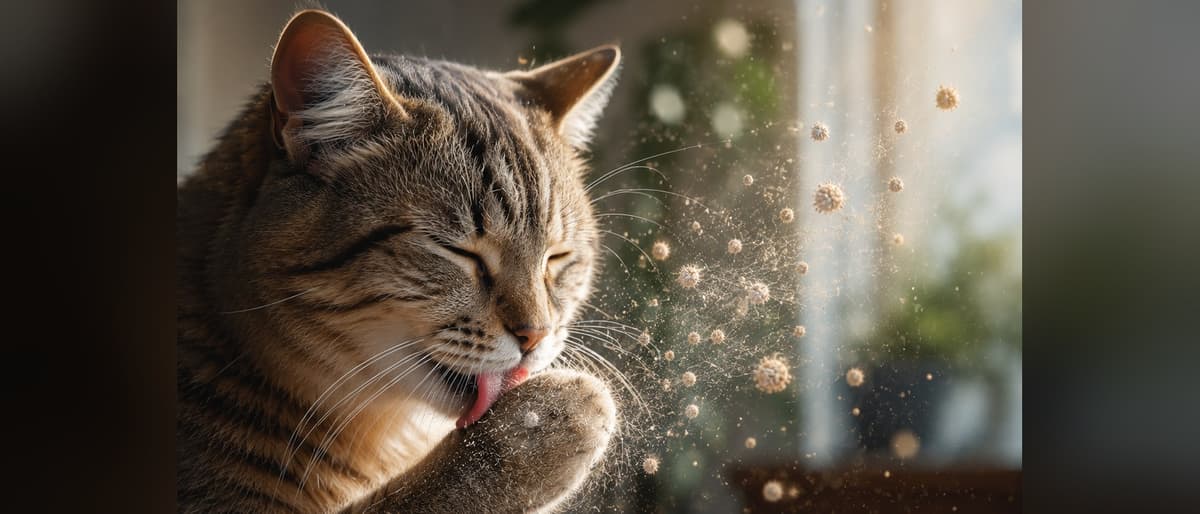
So how does the allergen end up on the coat? A cat devotes a substantial part of its day to grooming. With every lick it transfers saliva onto the hair, where the protein mixes with sebum and sticks. The coat becomes a store and a carrier of the allergen, though it does not produce any of it. Removing the fur therefore solves nothing — the source stays in the skin.
What does this protein do for the cat itself? The most intriguing lead comes from a 2020 study that examined Fel d 1's binding capacity. It turned out that the protein binds steroids and fatty acids (among them androstenone, pregnenolone, progesterone, lauric acid and oleic acid). This is a profile typical of proteins that transport scent molecules, which suggests a role in chemical communication between cats. In other words: the allergen that produces disease symptoms in humans is probably an element of the feline language of scent.
Why this allergen is everywhere
Fel d 1 has two properties that make it exceptionally troublesome: it is light and it is sticky.
A substantial part of it travels on very fine particles — the kind that do not settle quickly onto the floor but stay airborne for hours and penetrate deep into the airways. At the same time the protein readily adheres to textiles: to clothes, upholstery, carpets and curtains. The consequence is that the allergen travels without the cat. It has been detected in homes, cars and classrooms where it had been carried in solely on the clothes of people who own animals.
Rehoming the cat is not the end of the allergen
A classic 1989 study examined what happens in homes after a cat is given away. Fel d 1 levels in dust fell to those typical of homes without cats only after 20–24 weeks — and in only eight of the fifteen homes studied. In the rest it took longer, and in three the elevated level persisted beyond twenty weeks.
This matters enormously in practice: no improvement in the first month after parting with the animal does not rule the cat out as the cause of the allergy.
The myth of the hypoallergenic cat
„Hypoallergenic” is not a defined term — neither legally nor veterinarily. There is no standard a cat would have to meet in order to be called one. It is a purely marketing label.
And what do the measurements say? The strongest current data come from research published in 2024 (Cleveland et al.), which analysed the Fel d 1 genes in 276 domestic cats and wild felids. The results were clear:
- Variation in the sequence of this protein between individual domestic cats is enormous.
- Fel d 1 is built from two chains (encoded by two different genes). It turned out that it was the second chain of the protein that differed between individuals across a substantial part of its length — 58% of its amino acid residues were variable, against 41% in the first chain.
The authors also note, citing earlier work, that the level of Fel d 1 production fluctuates within the same cat over time. That phenomenon means a single measurement taken from a kitten at a cattery gives no guarantee whatsoever about production levels in the adult animal.
The paper most often invoked in the context of breeds (Satorina et al., 2014) compared „normal” cats with „hypoallergenic” ones. The latter group did indeed show lower average Fel d 1 levels in samples taken from the face and chest. Three things need spelling out, though. The study covered fourteen cats: six ordinary and eight „hypoallergenic”. Lower values did not mean zero. And the work itself is only a short conference abstract — a poster from a symposium, not a full peer-reviewed article — so it gives neither measurement ranges nor the spread of results within either group.
That last point matters, because we know from elsewhere just how much cats differ from one another — and with a spread like that, a group average says very little about an individual animal.
Where the belief about Siberian cats came from
The belief that Siberian cats suit allergy sufferers was born in the United States in the 1990s as a breeders' observation, which rapidly turned into a marketing device. Scientific backing came later, and it is far weaker than is generally supposed.
The best-known study, from 2017 (Sartore et al.), sequenced the Ch1 and Ch2 genes (which encode the Fel d 1 chains) in Siberian cats. Its details are worth a look:
- A total of just four Siberian cats were examined and compared with 35 cats of other breeds, in which specific genetic variants were found.
- The level of the protein itself (in saliva) was measured in only three of them.
- The measurements came out at 2.19, 1.66 and 0.48 µg/ml. Which means that in only one case out of three was the level genuinely low.
- The authors closed the publication with a cautious conclusion: further research is needed to prove whether the identified mutations really do lower allergen production.
Tellingly, the researchers justified taking up the subject in the first place by noting that Siberians are considered low-allergen „according to the opinion of some breeders”. The circle closes — breeders cite a study which cites hearsay from breeders. (Note: the Neva Masquerade is a colour variety of the Siberian cat, so exactly the same applies to it.)
Three cats, a more than fourfold difference
It is worth pausing on those three measurements: 2.19, 1.66 and 0.48 µg/ml. These are cats of the same breed, and the difference between the extremes is more than fourfold.
That is precisely the point of this whole article. Even if a breed genuinely did shift the average downwards, you are not buying an average but one particular animal — and that animal may land anywhere within that range.
What actually varies the allergen level
If breed membership is not a reliable indicator, what does allergen production depend on?
Hormones. This is the best-documented factor. In studies from 1994, twelve male cats were observed. Six were castrated and six served as a control group. Two and four weeks later, sebum and Fel d 1 levels on the skin had fallen significantly in every cat that underwent the procedure. The castrated cats were then given long-acting testosterone, after which allergen levels rose again. Parallel microscopic work showed that sebaceous gland cells shrink after castration, and that testosterone reverses the process. So the drop in production is down to the withdrawal of testosterone, not to the procedure itself.
Sex. Jalil-Colome and colleagues (1996) compared secretion in five male and five female cats. The first skin wash showed significantly higher Fel d 1 levels in the males. Interestingly, production calculated over a 24-hour period no longer reached a statistically significant difference between the sexes. Sex therefore plays a role, but hormonal status (castration) matters enormously.
Individual variation. The largest factor and the hardest to predict. Kittens from a single litter can differ several-fold in allergen level.
Hair length. Hair is only a carrier. A long-haired cat simply leaves more carrier in the environment, but that does not mean higher physiological production of the protein itself.
And the Sphynx? Same story, different mechanism
A popular myth holds that the Sphynx — being a „hairless” cat — is the ideal choice for an allergy sufferer. It overlooks some basic biology.
A Sphynx has sebaceous and salivary glands like any other cat, and therefore produces Fel d 1 normally. The absence of a coat changes only the route by which the allergen spreads:
- The upside: with no hair, less allergen-carrying material floats in the air and settles on household fabrics.
- The downside: without a coat, the sebum (and with it the allergen) concentrates directly on the cat's skin. A single touch transfers the pure protein straight onto your hands. For the same reason a Sphynx's skin can be very greasy.
Claims circulate online that Sphynxes have „10–20 times less” Fel d 1 than other breeds, but there is no confirmation of this in peer-reviewed scientific literature. The official position of the allergy societies is simple: no cat breed is inherently hypoallergenic.
What works and what doesn't — according to the research
Bathing the cat. Avner and colleagues (1997) examined the effect of washing a cat on airborne allergen levels. Bathing lowered airborne allergen by an average of 79%, with each wash removing between 1 and 35 milligrams of protein. Unfortunately the effect is very short-lived — the research showed that a week later, before the next bath, levels were no longer reduced. A cat rebuilds its natural layer of sebum very quickly.
Food with the IgY antibody. Satyaraj's team tested a food containing an antibody from hen's egg which does not inhibit Fel d 1 production but binds it directly in the cat's saliva. In the study measuring the allergen in saliva alone, the drop came to between 24 and 29.6%, depending on the trial design. A second study examined what matters in practice — the coat: in 105 cats fed for twelve weeks, active allergen on the hair fell by an average of 47% by week 10, ranging from 33 to 71% — and the fall was greatest in the cats that started with the most allergen.
This is promising support for managing the problem at home; it reduces the pool of active protein, though it does not eliminate it.
Who funded this research
It has to be said plainly that both studies of the IgY food were funded and conducted directly by the manufacturer of that food — every author is its employee, as the publications themselves declare.
In science this does not invalidate a result in advance, but it is very important context to weigh when judging objectivity and the strength of the evidence. Independent confirmation of these figures by a team outside the company does not yet exist.
What this means for choosing a cat
The basic rule for an allergy sufferer should be: don't buy a breed, get to know the individual cat.
A pedigree tells you practically nothing about a promised „hypoallergenicity”. A person with a diagnosed allergy will make a far better decision after a longer visit with the cat in question, a consultation with an allergist, and in the knowledge that a neutered male will statistically offer an environment with less allergen than an intact one. Selling kittens under the marketing banner of „hypoallergenic” breeds is an enormous risk — and the highest price is paid by the animal, which, if the gamble fails, has to come back to the breeder.
A note from the author
I am a doctor of chemistry by training. In the text above I analyse only the biology of the animal and laboratory measurements. I do not give medical advice, and this article does not replace a consultation with an allergist.
References
- Cleveland, C.W., Davis, B.W., Khatri, K., Pomés, A., Chapman, M.D. & Brackett, N.F. (2024). Genetic diversity of the major cat allergen, Fel d 1, PNAS Nexus, 3(11), pgae447doi:10.1093/pnasnexus/pgae447
- Jalil-Colome, J., de Andrade, A.D., Birnbaum, J., Casanova, D., Mège, J., Lanteaume, A., Charpin, D. & Vervloet, D. (1996). Sex difference in Fel d 1 allergen production, Journal of Allergy and Clinical Immunology, 98(1), 165–168doi:10.1016/S0091-6749(96)70238-5
- Zielonka, T.M., Charpin, D., Berbis, P., Luciani, P., Casanova, D. & Vervloet, D. (1994). Effects of castration and testosterone on Fel dI production by sebaceous glands of male cats: I — Immunological assessment, Clinical and Experimental Allergy, 24(12), 1169–1173doi:10.1111/j.1365-2222.1994.tb03324.x
- Charpin, C., Zielonka, T.M., Charpin, D., Ansaldi, J.L., Allasia, C. & Vervloet, D. (1994). Effects of castration and testosterone on Fel dI production by sebaceous glands of male cats: II — Morphometric assessment, Clinical and Experimental Allergy, 24(12), 1174–1178doi:10.1111/j.1365-2222.1994.tb03325.x
- Bienboire-Frosini, C., Durairaj, R., Pelosi, P. & Pageat, P. (2020). The major cat allergen Fel d 1 binds steroid and fatty acid semiochemicals: a combined in silico and in vitro study, International Journal of Molecular Sciences, 21(4), 1365doi:10.3390/ijms21041365
- Satyaraj, E., Wedner, H.J. & Bousquet, J. (2019). Keep the cat, change the care pathway: a transformational approach to managing Fel d 1, the major cat allergen, Allergy, 74(S107), 5–17doi:10.1111/all.14013
- Satyaraj, E., Li, Q., Sun, P. & Sherrill, S. (2019). Anti-Fel d1 immunoglobulin Y antibody-containing egg ingredient lowers allergen levels in cat saliva, Journal of Feline Medicine and Surgery, 21(10), 875–881doi:10.1177/1098612X19861218
- Satyaraj, E., Gardner, C., Filipi, I., Cramer, K. & Sherrill, S. (2019). Reduction of active Fel d1 from cats using an anti-Fel d1 egg IgY antibody, Immunity, Inflammation and Disease, 7(2), 68–73doi:10.1002/iid3.244
- Avner, D.B., Perzanowski, M.S., Platts-Mills, T.A. & Woodfolk, J.A. (1997). Evaluation of different techniques for washing cats: quantitation of allergen removed from the cat and the effect on airborne Fel d 1, Journal of Allergy and Clinical Immunology, 100(3), 307–312doi:10.1016/S0091-6749(97)70242-2
- Wood, R.A., Chapman, M.D., Adkinson, N.F. & Eggleston, P.A. (1989). The effect of cat removal on allergen content in household-dust samples, Journal of Allergy and Clinical Immunology, 83(4), 730–734doi:10.1016/0091-6749(89)90006-7
- Sartore, S., Landoni, E., Maione, S., Tarducci, A., Borrelli, A., Soglia, D., Rasero, R. & Sacchi, P. (2017). Polymorphism analysis of Ch1 and Ch2 genes in the Siberian cat, Veterinary Sciences, 4(4), 63doi:10.3390/vetsci4040063
- Satorina, J., Szalai, K., Willensdorfer, A., Mothes-Luksch, N., Lukschal, A. & Jensen-Jarolim, E. (2014). Do hypoallergenic cats exist? — determination of major cat allergen Fel d 1 production in normal and hypoallergenic cat breeds, Clinical and Translational Allergy, 4(S2), P11doi:10.1186/2045-7022-4-S2-P11
Frequently asked
Do hypoallergenic cats exist?
No. „Hypoallergenic” is not a defined term, either legally or veterinarily — there is no standard a cat would have to meet to be called one. Every cat produces Fel d 1, the major cat allergen. Differences between individual animals are enormous, but they cannot be predicted from a pedigree: kittens from one litter can differ several-fold in allergen level. The position of the allergy societies is unambiguous — no breed is inherently hypoallergenic.
Is a Siberian cat good for an allergy sufferer?
That belief was born in the United States in the 1990s as a breeders' observation and quickly became a marketing device. The scientific backing is far weaker than is generally assumed: the best-known study, from 2017, examined four Siberian cats and measured the protein in three — the results were 2.19, 1.66 and 0.48 µg/ml, so in only one case out of three was the level genuinely low. The authors closed the paper by saying further research is needed. The Neva Masquerade is a colour variety of the Siberian cat, so exactly the same applies to it.
Does a Sphynx cause fewer allergies?
A Sphynx has sebaceous and salivary glands like any other cat, so it produces Fel d 1 normally. The absence of a coat changes only how the allergen spreads: less carrier floats in the air and settles on fabrics, but the sebum with the allergen concentrates directly on the skin — a single touch transfers the protein to your hands. Claims circulating online about „10–20 times less” in Sphynxes have no confirmation in peer-reviewed literature.
Does the allergen disappear once the cat is rehomed?
Not immediately. In a classic 1989 study, Fel d 1 levels in dust fell to those typical of homes without cats only after 20–24 weeks, and in only eight of the fifteen homes studied. In the rest it took longer, and in three the elevated level persisted beyond twenty weeks. The practical conclusion: no improvement in the first month after parting with the animal does not rule the cat out as the cause of the allergy.