Your cat does not cry, does not moan and does not limp — unless things are already serious. He sits on the sofa, looks normal, perhaps eats a little less, which we usually put down to simply not being hungry. Or perhaps he is in pain and you have no idea.
Cats are masters at hiding pain. Not because they are „tough” or „independent”, but because millions of years of evolution taught them that showing weakness means death. In the wild, a sick predator is an easy target for bigger animals. Evolution rewarded the cats that suffered in silence and eliminated those that gave their pain away. The result is that a cat with a broken tooth eats almost normally, a cat with arthritis still jumps, and a cat with bladder stones keeps using the litter box.
Veterinarians estimate that most caregivers only notice pain in their cat at a very advanced stage. Science, however, gives us concrete tools to change that.
The Feline Grimace Scale — a turning point in assessing feline pain
In 2019 a team of researchers published a paper in „Scientific Reports” that completely changed how veterinary medicine approaches pain in cats. They identified five facial features (action units) that change in cats experiencing acute pain:
- Ear position: In a healthy cat the ears point forward and are open. In a cat in pain they move sideways or backwards and flatten. Important: we mean a sustained position, or one the cat takes frequently at rest — not a momentary movement when it is simply listening to something.
- Orbital tightening: A relaxed cat has open eyes. A cat in pain squints, with visibly tense orbits.
- Muzzle tension: A pain-free muzzle is rounded and relaxed. Pain makes it tense, flattened and drawn.
- Whisker position: Naturally, whiskers are relaxed and curve gently downwards. In pain they straighten forwards or are pressed firmly against the face.
- Head position: A healthy cat holds its head above the shoulder line. A cat in pain lowers it below that line or hunches.
Each of these is scored from 0 to 2, giving a maximum total of 10 points. A score of 4 or higher is a clinical indication for pain relief. The scale has been rigorously validated: it correlates strongly with other methods of pain assessment, is highly repeatable between different assessors, and has high internal consistency.
The exact numbers from the validation study
For the record, here is what was actually measured in the study by Evangelista and colleagues (2019) on 35 cats in pain and 20 control cats:
- correlation with another validated pain-assessment method: rho = 0.86 — described by the authors as very strong;
- agreement between different assessors: ICC = 0.89, which the authors call good;
- agreement of the same person scoring twice: ICC > 0.91, that is, excellent;
- internal consistency: Cronbach's alpha = 0.89.
The „four” itself is worth a footnote too. In the source paper the threshold is given as 0.39 out of 1.0 — the sum of points divided by the maximum. The official scoring sheet from the Université de Montréal converts this to a ten-point scale and states it plainly: a score of 4 or higher means pain relief should be considered. Both numbers say the same thing.
Not all five items are equally easy
Monteiro and colleagues (2023) tested whether caregivers can use the scale the way veterinarians do. 1262 people from 66 countries responded, scoring the same ten photographs as a panel of eight clinicians. The overall result was good: caregivers' total scores did not differ significantly from the veterinarians', and agreement on the total was 0.65.
But the individual items varied enormously — the higher the number, the more consistently different people scored that item:
- eyes — 0.69
- ears — 0.65
- muzzle — 0.58
- head — 0.38
- whiskers — 0.37
The practical conclusion: score eyes and ears with confidence, whiskers and head position with caution. Those two are the hardest for someone without training, so if your score rests mainly on them, treat it as a prompt to keep watching rather than a verdict.
Artificial intelligence in the service of the cat
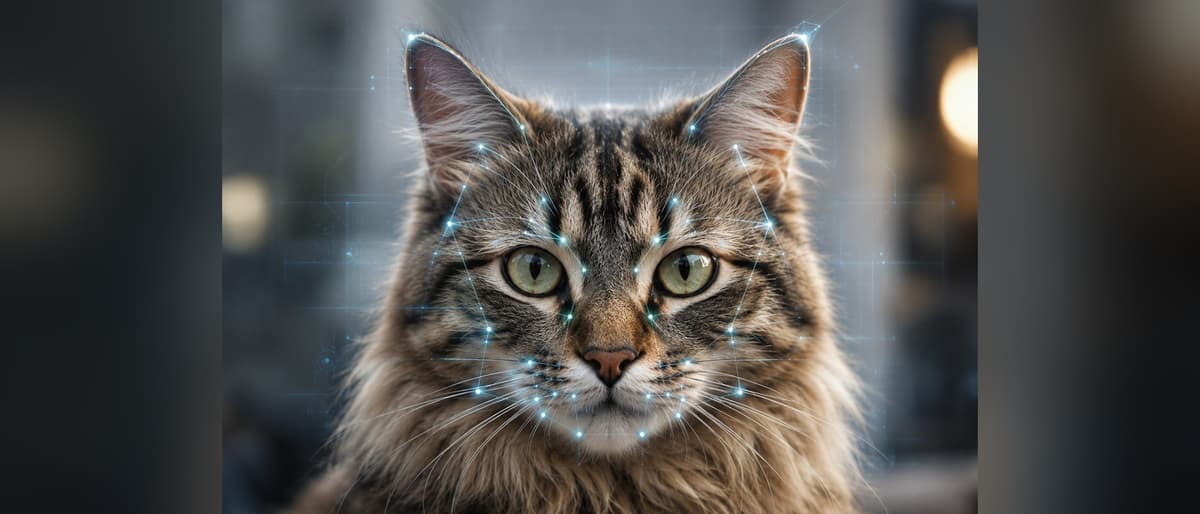
In 2023 researchers went a step further and developed an artificial-intelligence model (designed for use in a smartphone app) that scores a cat's pain automatically, straight from a photograph of its face. The model was trained by deep learning on thousands of images. The system can recognise the five FGS features, calculate the intensity of pain and tell the caregiver whether the cat needs medical attention. One thing needs saying clearly, though: such an app is only a supporting tool. If anything about your cat's behaviour worries you, always consult a veterinarian, even if the algorithm says everything is fine. Trusting your own intuition matters just as much as the technology.
What the app does today, and what is still being built
The app genuinely exists — it was created by Dr Paulo Steagall's team at the Faculty of Veterinary Medicine of the Université de Montréal, and it is available for iPhone and Android. Before you download it, though, it is worth knowing what to expect, because the study and the app are two different things.
The app in the store teaches you to use the scale (it includes learning material and a „test your knowledge” practice section), lets you score your cat in real time along with advice on what to do next, and lets you send a photograph of its face to your vet. You do the scoring in it, not an algorithm.
The model from the 2023 paper is the research groundwork: 3447 photographs of cats' faces annotated with 37 landmarks, with the best model predicting the scale's score at 95.5% accuracy. On the scale's official website, however, automated scoring is still listed as work in progress — the team states plainly that they are only now „working to bring this technology to you and your cat”.
So: by downloading the app you get a very good tool for scoring your cat yourself and for learning how to look — not an automaton that reads pain off a photograph. Which makes the point above matter even more: the decision belongs to your vet and to your own observation.
A further study published in 2024 demonstrated automated pain recognition from video recordings. It works by tracking specific facial landmarks on the cat's face. In other words, an ordinary smartphone can literally serve as an analyser of feline suffering under home conditions.
How often the automated system is actually right
This is the work of Martvel and colleagues (2024). The team used 48 landmarks positioned in line with the cat's facial musculature and built, for the first time, a pipeline that runs end to end automatically — without hand-picking good frames and without manually marking the landmarks.
Accuracy came out at over 70% on one dataset and 66% on another. That is clearly better than earlier approaches based on single photographs, which the authors sum up in the conclusion that, when it comes to recognising feline pain, movement matters more than a static pose.
The number is worth remembering, because it explains the caution in the paragraph above: 70% accuracy is roughly two mistakes in every seven assessments. Excellent for an automated system, and decidedly too weak to stop there.
Why do cats hide pain?
The domestic cat's ancestor, Felis silvestris lybica, lived in an environment teeming with predators such as eagles and jackals. A sick individual was an easy target for them, because predators always aim at the weakest to minimise the risk of injury to themselves. Cats that „advertised” their state of health by vocalising or limping simply died, while those that hid pain survived.
Millions of years of natural selection shaped the cat's default setting: suffer in silence. On top of that, under pain a cat's body releases endorphins, natural opioids that dampen the sensation of discomfort. It works like a physiological anaesthetic, making it easier for the animal to mask illness.
Pain signals we most often ignore
Owners frequently put signs of pain down to feline „whims”. What should you be watching for?
- A change in appetite: If your cat refuses dry food but eats wet, eats more slowly or drops food, it may be suffering from dental pain. Tooth resorption (FORL) affects as many as 20–60% of cats, and periodontal disease up to 73%.
- Cautious jumping: Degenerative joint disease affects over 25% of the cat population. These animals still jump, but they jump lower, less often and with visible hesitation.
- Grooming problems: A cat in general pain, or with oral pain, neglects its coat, which turns dull. Conversely, a cat with localised pain (in the abdomen, say) may lick that spot so intensively that bald patches appear.
- Peeing outside the litter box: This is not spite. Pain from cystitis, constipation, or joint pain that makes climbing over a high litter box rim no longer painless are the main causes of such behaviour.
- A change in personality: Irritability in a placid cat, or hiding in a formerly sociable one, are classic signals of suffering.
The strongest evidence that cats hide pain
If I had to point to one study that sums up this whole article, it would be Kimura and colleagues (2020). The team X-rayed 101 cats in two orthogonal views and counted degenerative joint changes.
Changes in the limb joints were found in 74% of the cats. The caregivers of two cats had noticed lameness. In none of the cats with limb-joint degeneration did palpation provoke a clear pain response.
The caveat, without which that number misleads: this was not a random sample of cats off the street, but animals whose caregivers had themselves asked for an arthritis work-up. The 74% applies to that particular group and is not a population prevalence — which is why figures quoted in the literature range from the mid-teens to over ninety per cent, depending on who is examined and how.
The core, though, stands untouched: the X-ray showed changes in three quarters of the animals, and the human living with the cat had seen a problem in two.
Why the numbers on dental disease vary so much
With dental disease the percentages quoted in the literature are so scattered that it helps to know where they come from — what decides is the method of diagnosis, not just the cat.
- A review of UK data covering 18,249 cats treated in first-opinion practice recorded periodontal disease in 15.2% of the animals. The authors note at the same time that published figures range from 13.9% all the way to 96%, depending on the criteria used (O'Neill et al. 2023).
- A Finnish study of 8115 cats reported tooth resorption diagnosed by a clinician in 3.9% of the whole group, but in 21% of the cats that underwent a dental examination under sedation (Vapalahti et al. 2024).
The practical conclusion is the same whichever number you take: diseased teeth cannot be seen from the outside, and the difference between 4% and 21% within the same study is the difference between looking at a cat and looking inside its mouth under anaesthesia. I have gathered more on what really goes on in a cat's mouth in the article on cat dental health.
Pain and eating habits
Chronic pain is strongly linked to diet. Obese cats are as much as 4.9 times more likely to develop painful lameness. It becomes a closed loop: joint pain limits movement, which increases obesity, which in turn generates still more pain.
Where the 4.9 figure comes from
This number has a specific source and it is worth knowing, because it is surprisingly solid. Scarlett and Donoghue (1998) followed 1457 cats from 27 practices for 4.5 years, having assigned each of them one of six body-condition categories at the outset.
Compared with cats of normal body weight, the risk of lameness requiring a veterinary visit was:
- with overweight — 2.9 times higher;
- with obesity — 4.9 times higher.
The same work found a 3.9 times higher risk of diabetes in obese cats. This is an observational study, so it speaks of co-occurrence rather than proven cause — but the direction is unambiguous, and the authors themselves link lameness to degenerative joint disease and soft-tissue injury. Where feline obesity comes from and what to do about it I have covered separately in the article on when love overfeeds.
Eating inedible things (pica), such as plastic or rubber, is in turn often a response to visceral pain. A recent study found that 100% of the biopsied patients with signs of pica taking part in that particular clinical study had chronic intestinal inflammation.
What that 100% actually means
The figure is striking, which is all the more reason to know who it applies to. The study (JAVMA 2025) reviewed the records of 133 dogs and cats admitted for endoscopic removal of a foreign body from the stomach. Gastrointestinal biopsies were taken in 41 of them — and it was in those 41 animals that chronic enteritis was found in all, and chronic gastritis in 80%.
Three things worth keeping in mind:
- This is a group of dogs and cats together, not cats alone.
- These are animals that swallowed something requiring endoscopy — not every cat that nibbles cling film.
- Biopsies were taken in selected animals, so the percentage applies to them, not to every case of pica.
The authors' conclusion, meanwhile, is exactly the one drawn above: in cases of pica, chronic intestinal disease should be considered and looked for, rather than treating plastic-eating as a quirk.
How to assess your cat's pain at home — a practical guide
- Watch the face: Check the ears, eyes, whiskers and muzzle tension according to the FGS. Three or more visible warning signs means it is time for a veterinary visit.
- Look for departures from the norm: You know your cat best. Any long-term change in behaviour (appetite, jumping, litter box) warrants observation.
- Don't wait for extremes: If a cat is limping obviously, crying out in pain or has stopped eating altogether, its suffering is already extreme.
How to look so that the score means something
Two pointers from the work on the scale itself that are easy to miss:
Watch a cat that is doing nothing. The animal is scored at rest — not while grooming, eating, sleeping or meowing. A cat washing itself will have different muzzle tension regardless of whether it is in pain.
Training helps less than you would think. Robinson and Steagall (2024) examined how novices' scores change after training in using the scale. Agreement with the reference was already good before training, and afterwards the spread of scores narrowed further. That is good news for a caregiver: the scale is designed to work in the hands of someone who is not a clinician.
Your cat will never admit on his own that he is in pain. But if you learn to observe his face and his habits properly, you will hear his call for help without a single word.
I am not a veterinarian
I am a doctor of chemistry and a former cat breeder, not a veterinarian. This article describes tools and research that help you notice pain — it does not replace an examination and is not for making diagnoses or choosing medication.
This matters especially: never give your cat human painkillers. Paracetamol is lethally toxic to cats, and non-steroidal anti-inflammatory drugs have a narrow safety margin in this species, with dosing set by a veterinarian alone. If the scale's score or your own observation says something is wrong, that is the signal to book a visit.
References
- Evangelista, M.C., Watanabe, R., Leung, V.S.Y., Monteiro, B.P., O'Toole, E., Pang, D.S.J. & Steagall, P.V. (2019). Facial expressions of pain in cats: the development and validation of a Feline Grimace Scale, Scientific Reports, 9(1), 19128doi:10.1038/s41598-019-55693-8
- Monteiro, B.P., Lee, N.H.Y. & Steagall, P.V. (2023). Can cat caregivers reliably assess acute pain in cats using the Feline Grimace Scale? A large bilingual global survey, Journal of Feline Medicine and Surgery, 25(1), 1098612X221145499doi:10.1177/1098612X221145499
- Steagall, P.V., Monteiro, B.P., Marangoni, S., Moussa, M. & Sautié, M. (2023). Fully automated deep learning models with smartphone applicability for prediction of pain using the Feline Grimace Scale, Scientific Reports, 13(1), 21584doi:10.1038/s41598-023-49031-2
- Martvel, G., Lazebnik, T., Feighelstein, M., Meller, S., Shimshoni, I., Finka, L., Luna, S.P.L., Mills, D.S., Volk, H.A. & Zamansky, A. (2024). Automated video-based pain recognition in cats using facial landmarks, Scientific Reports, 14(1), 28006doi:10.1038/s41598-024-78406-2
- Robinson, A.R. & Steagall, P.V. (2024). Effects of training on Feline Grimace Scale scoring for acute pain assessment in cats, Journal of Feline Medicine and Surgery, 26(10), 1098612X241275284doi:10.1177/1098612X241275284
- Kimura, T., Kimura, S., Okada, J., Suzuki, S. & Kitanaka, T. (2020). Retrospective radiographic study of degenerative joint disease in cats: prevalence based on orthogonal radiographs, Frontiers in Veterinary Science, 7, 138doi:10.3389/fvets.2020.00138
- Scarlett, J.M. & Donoghue, S. (1998). Associations between body condition and disease in cats, Journal of the American Veterinary Medical Association, 212(11), 1725–1731↗
- Saavedra, C., Pérez, C., Oyarzún, C. & Torres-Arévalo, Á. (2024). Overweight and obesity in domestic cats: epidemiological risk factors and associated pathologies, Journal of Feline Medicine and Surgery, 26(11), 1098612X241285519doi:10.1177/1098612X241285519
- Perez, J., Ford, S., Lynch, H. i wsp. (2025). Pica as a clinical sign of a chronic enteropathy in dogs and cats, Journal of the American Veterinary Medical Association, 263doi:10.2460/javma.25.02.0079
- O'Neill, D.G., Blenkarn, A., Brodbelt, D.C., Church, D.B. & Freeman, A. (2023). Periodontal disease in cats under primary veterinary care in the UK: frequency and risk factors, Journal of Feline Medicine and Surgery, 25(3), 1098612X231158154doi:10.1177/1098612X231158154
- Vapalahti, K., Neittaanmäki, H. & Lohi, H. (2024). A large case-control study indicates a breed-specific predisposition to feline tooth resorption, The Veterinary Journal, 305, 106133doi:10.1016/j.tvjl.2024.106133
- Bradshaw, J.W.S. (2013). Cat Sense: The Feline Enigma Revealed, Allen Lane
Frequently asked
How can I tell that my cat is in pain?
The simplest place to start is the face. The Feline Grimace Scale identifies five features: ear position, orbital tightening, muzzle tension, whisker position and head position. Each is scored from 0 to 2, and according to the scale's authors a total of 4 or more out of 10 indicates that pain relief should be given. Beyond the face, watch for departures from your cat's own normal: reduced appetite, eating more slowly or only wet food, more cautious jumping, a neglected coat, toileting outside the litter box and a change in temperament. In cats what counts is any persistent change in behaviour, not one dramatic symptom.
Why do cats hide pain?
Because for millions of years showing weakness cost them their lives. The domestic cat's ancestor, Felis silvestris lybica, lived among predators that targeted the weakest individuals. A cat that limped or cried out in pain was announcing itself as an easy target — and died. The ones that suffered in silence survived, and natural selection fixed this as the default setting. On top of that, pain triggers the release of endorphins, the body's own opioids, which dampen discomfort and make it easier to mask illness.
Is peeing outside the litter box spite?
No. Cats do not toilet outside the box out of revenge or to spite anyone. The most common causes are medical or pain-related: cystitis, constipation and very often joint pain, which makes climbing over a high litter box rim stop being painless. Before treating it as a behavioural problem, pain and disease have to be ruled out — and while you are at it, check whether the box simply isn't too high for an older cat.
Is an app that scores cat pain from a photo reliable?
It is a supporting tool, not a diagnosis. Models based on the Feline Grimace Scale work surprisingly well — the most recent one, which analyses video and tracks 48 facial landmarks, reaches over 70% accuracy on one dataset and 66% on another. That is a lot for an automated system, but it still amounts to roughly two errors in every seven assessments. If anything about your cat's behaviour worries you, the decision belongs to your vet and your own observation, not to an algorithm's output.