A cat on dry food takes in little water, and that's not an opinion, it's arithmetic. Wet food is about 75–80 percent moisture, dry food usually 3 to 11 percent. A cat switched from one to the other ought to make up the difference at the water bowl — and most of the time it simply doesn't.
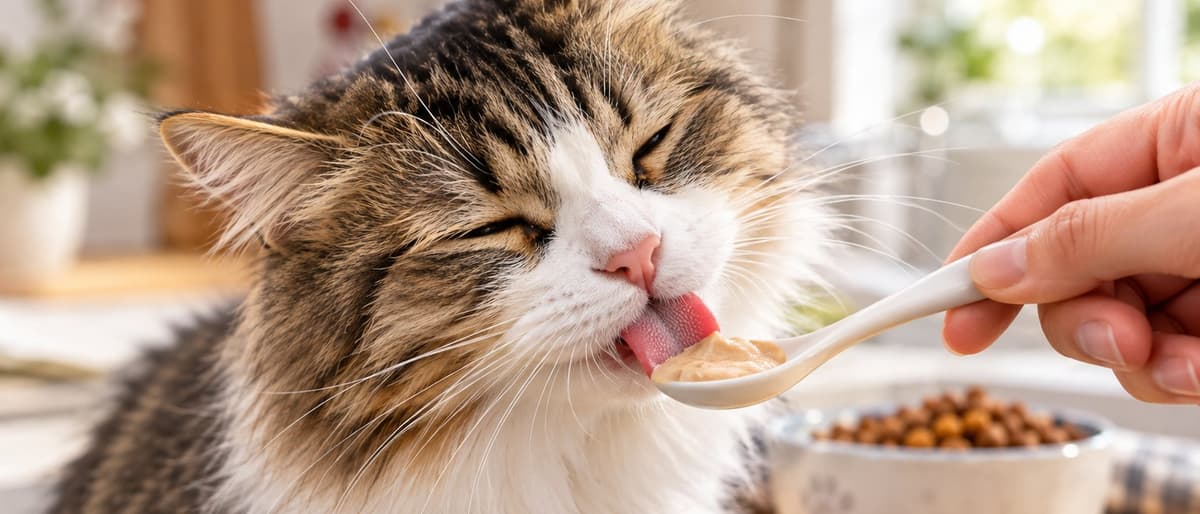
The industry responded with a separate product category: hydration treats. Moist, made for licking, with added amino acids and sodium — designed to make the cat drink more.
At the end of July 2026, a study came out that tested this (in the September issue of the Journal of Feline Medicine and Surgery). The authors themselves expected that after the treat the cats would drink more from the fountain. The result is positive, but completely different from what they expected.
What exactly was done
Twelve neutered male domestic shorthair cats from the University of Guelph research colony, aged 5–6 years, with an average weight of 4.51 kilograms. Eight days before the start they were switched from wet to dry food (40 percent protein, 0.43 percent sodium), and then split into three groups in a crossover design. In statistics this is called a Latin square design — in practice it simply means that each cat went through all three diet variants in turn, spending five days on each, so that each cat is compared with itself and the order of the variants doesn't skew the result.
There were three variants: dry food alone, dry food plus one 17-gram treat at 85 percent moisture with 0.99 percent sodium in dry matter, and the same with a treat containing 1.55 percent sodium. Food was given at seven in the morning, the treat at four in the afternoon.
Water was measured with seven fountains with readers that recognised each cat by a tag attached to its harness — the cats had been getting used to them for three months before the study. Urine was collected midstream, into a cup, at the litter box.
Water drunk: no significant change
Let's start with the result that takes up half a sentence in the abstract, yet matters most.
Water drunk from the fountain averaged 88 millilitres a day on the diet alone, 89 millilitres with the weaker treat and 97 millilitres with the stronger one. The difference was not statistically significant (p = 0.230).
The cats that got a hydration treat did not drink significantly more from the fountain.
Compute your cat's diet — BARF calculatorOpen calculatorWater taken in with food: that's where the whole difference is
Total water intake — what the cat drank from the fountain plus the estimated amount of water in its food — looks different: 91 millilitres on the diet alone, 107 millilitres with the weaker treat and 116 millilitres with the stronger one. This time the difference is clear (p below 0.001). Between the weaker and the stronger treat, the difference was no longer significant.
And now a simple multiplication worth doing yourself. The treat weighs 17 grams and is 85 percent moisture, so it contains about 14.5 millilitres of water.
14.5 ml
The total increase with the weaker treat was 16 millilitres (107 minus 91). With the stronger treat, total intake rose by 25 millilitres (116 minus 91) — of which about 14.5 millilitres is the water contained directly in the treat itself, and the remaining roughly 10 millilitres comes from that statistically non-significant increase in drinking from the fountain that did appear with the higher sodium.
In this study, the hydration treat did not make the cats keener to drink. It made them take in water along with an appealing treat — which is a perfectly decent idea, it just works differently from how most people think.
Urine diluted by three thousandths
Urine specific gravity is the parameter these products exist for in the first place. Here are the results: 1.045 on the diet alone, 1.043 with the weaker treat, 1.042 with the stronger one. The difference is statistically significant.
It is also clinically small — and that needs saying plainly. All three groups stayed clearly above 1.035 — and most healthy cats have urine above that value. For cats with urolithiasis, the ACVIM guidelines recommend aiming for a specific gravity below 1.030 (Lulich et al. 2016). Urine at 1.042 is still very concentrated urine. A shift of 0.003 can be measured, but not felt. (As an aside: the paper itself describes the drop as 0.02 and 0.03 — an error by an order of magnitude; the tables give 0.002 and 0.003.)
Urine protein fell, but that's a dilution effect
This part is a good example of why it's worth reading the whole paper, not just the conclusions.
The authors' conclusions state that with both treats the concentration of protein and creatinine in the urine fell, listed as an additional benefit. That's true. But the protein-to-creatinine ratio did not change (p = 0.598) — the abstract notes this but draws no conclusion from it.
And that ratio is used precisely because it is resistant to dilution. If both values fell and their quotient stayed the same, it means exactly this: the urine was slightly more watery — not that the cat is losing less protein. In the discussion, the authors themselves explain the drop by dilution. The benefit from this item disappears once you divide.
Who paid for it
The study was funded by Peturio Holdings, doing business as Cat Years — the maker of the tested treat. One of the co-authors is a paid consultant and advisory board member of the company. The authors declare that the funding did not influence the conduct of the study or the interpretation of the data, and the work was approved by the University of Guelph animal care committee.
It's worth knowing, because research in this area is often funded by manufacturers. Two 2018 studies on nutrient-enriched water and a 2021 paper on increasing water viscosity (carried out by employees of Hill's Pet Nutrition) describe a very similar idea: if the cat won't drink more, let's make the water more appealing. The results go the same way each time: more water in total intake and lower urine specific gravity.
Limitations
What this study doesn't tell us
Twelve cats, all neutered males. The authors themselves write that this is a starting point and that females and sick cats still need to be studied.
Research colony cats, not owned pets. They lived in a stable, controlled environment and had been using the same fountains for three months. In their conclusions, the authors explicitly call for the study to be repeated in owned cats, where there are far more variables.
The drinking measurement had a weak spot. When cats drank together, the total volume was split equally among all the cats involved. The authors explain why they consider this random noise, but it does mean that some individual readings aren't truly individual.
Five days per variant. That's enough to measure water balance, but not enough for anything to do with urinary stones or kidneys.
Only daytime samples were analysed. Evening samples — those taken after the treat was eaten — numbered 45 against 149 daytime ones and were judged too few. So exactly the window in which the effect would probably be largest was left out of the calculations.
Sodium. In healthy cats it caused no adverse effects over five days. But owners of cats with kidney disease or after a urinary tract episode also reach for products like this — and about that group the study says nothing.
What follows from this
Not that these treats are a scam. They work — they just work like a package for fourteen millilitres of water, and that's how to look at them on the shelf.
If your cat eats wet food, this product changes little. A spoonful of water mixed into the food adds about the same, costs nothing and adds no sodium. In fact, it's the best-documented way to hydrate a cat: water given with food, not next to it. The ACVIM guidelines for cats with urinary stones explicitly mention food with more than 75% moisture or adding water to dry kibble (Lulich et al. 2016).
If your cat eats only dry food and no persuasion works, it's a different story. Then a dozen or so millilitres a day is not nothing — it's about seventeen percent more water in the daily total (91 versus 107 millilitres), delivered in a form the cat will take willingly. For a healthy cat with no contraindications, it's a reasonable compromise.
And if you're wondering whether your cat eats what's best for it at all, I have a separate piece on why cats prefer food at body temperature, and another comparing how well cats digest raw, cooked and dry food.
References
- Kosmal, P.A.L., Shoveller, A.K., Banton, S., Cheer, K., Farentino, N. & Armstrong, L.E. (2026). Consuming treats with amino acids, osmolytes and sodium increased total water intake and decreased urine specific gravity of healthy cats, Journal of Feline Medicine and Surgery, 28(9), 1098612X261477044doi:10.1177/1098612X261477044
- Zanghi, B.M., Gerheart, L. & Gardner, C.L. (2018). Effects of a nutrient-enriched water on water intake and indices of hydration in healthy domestic cats fed a dry kibble diet, American Journal of Veterinary Research, 79(7), 733–744doi:10.2460/ajvr.79.7.733
- Zanghi, B.M., Wils-Plotz, E., DeGeer, S. & Gardner, C.L. (2018). Effects of a nutrient-enriched water with and without poultry flavoring on water intake, urine specific gravity, and urine output in healthy domestic cats fed a dry kibble diet, American Journal of Veterinary Research, 79(11), 1150–1159doi:10.2460/ajvr.79.11.1150
- Hall, J.A., Vanchina, M.A., Ogleby, B. & Jewell, D.E. (2021). Increased water viscosity enhances water intake and reduces risk of calcium oxalate stone formation in cats, Animals, 11(7), 2110doi:10.3390/ani11072110
- Lulich, J.P., Berent, A.C., Adams, L.G., Westropp, J.L., Bartges, J.W. & Osborne, C.A. (2016). ACVIM Small Animal Consensus Recommendations on the Treatment and Prevention of Uroliths in Dogs and Cats, Journal of Veterinary Internal Medicine, 30(5), 1564–1574doi:10.1111/jvim.14559
Frequently asked
Do hydration treats make cats drink more?
In the only study that has tested it, no. Kosmal and colleagues (2026) gave 12 cats on dry food one 17-gram treat a day. Water drunk from the fountain averaged 88 ml on the diet alone, 89 ml with the lower-sodium treat and 97 ml with the higher-sodium treat — the difference was not statistically significant. The cats took in more water, but mainly the water contained in the treat itself.
How much water does a hydration treat give a cat?
The treat tested in the study weighed 17 g and had 85% moisture, so it contained about 14.5 ml of water. Total daily water intake rose from 91 ml to 107 ml with the weaker and 116 ml with the stronger treat — roughly 17–27% more. A spoonful of water mixed into food gives about the same.
Does a hydration treat dilute a cat's urine?
Slightly. Urine specific gravity fell from 1.045 on dry food alone to 1.043 and 1.042 with the treats. That's statistically significant, but the urine was still very concentrated. For cats with urolithiasis, the ACVIM guidelines (Lulich et al. 2016) recommend aiming for a specific gravity below 1.030.
Are hydration treats good for a cat with kidney disease?
We don't know. The study included only healthy neutered male cats for five days per variant, and the treats contained added sodium. It says nothing about cats with kidney disease or after a urinary tract episode, so for such a cat, the decision to introduce a treat belongs to the vet.
What's the best way to hydrate a cat?
Give water with the food, not next to it. The ACVIM guidelines for cats with urinary stones explicitly mention food with more than 75% moisture or adding water to dry kibble (Lulich et al. 2016). A spoonful of water mixed into food costs nothing and adds no sodium. A hydration treat can be a reasonable compromise for a healthy cat that eats only dry food and won't accept other solutions.