Imagine you're about to choose a cat. You like Sphynxes — hairless, curious, so unlike the rest. Or Bengals — wild, eccentric, fascinating. Or an ordinary moggy off the street, a mix of everything. Each of these decisions carries emotional weight. It also carries a measurable weight: the average number of years you'll most likely spend together.
In 2024, Kendy T. Teng and colleagues from the Royal Veterinary College published an analysis of cat survival in the United Kingdom. It drew on the electronic medical records of 1.25 million veterinary patients, of which nearly 8,000 cats — those whose lives, sadly, could no longer be saved — were singled out for detailed analysis. The data look like this:
| Breed | Average lifespan |
|---|---|
| Burmese | 14.42 years |
| Birman | 14.39 years |
| Mixed breed | 11.89 years |
| Siamese | 11.69 years |
| Persian | 10.93 years |
| British | 9.58 years |
| Bengal | 8.51 years |
| Sphynx | 6.68 years |
The difference between a Burmese and a Sphynx is almost eight years. That is more than the entire average lifespan of many a smaller animal. Where do such enormous differences come from?
Let me be very clear up front: my goal in this article is absolutely not to build rankings or point fingers at which breed statistically fares worse. I want to show you something far more important — the real factors that decide that lifespan. We must approach the figures above with a cool head. They rest on clinical statistics that are not equally reliable in every case. For some breeds, such as common moggies, the sample was gigantic, while for rarer cats (like Sphynxes) it was relatively small. What's more, how long a cat lives depends enormously on preventive decisions, environment and lifestyle. Breed is only one piece of this complicated puzzle.
Why moggies live longer on paper
The table above may at first glance suggest that pedigree cats live shorter lives by definition. I want to stress this very strongly: drawing such categorical conclusions is a mistake, and one that can be deeply unfair to dedicated breeders.
The higher average lifespan of non-pedigree cats is largely the effect of so-called hybrid vigour (heterosis) — a broad, unrestricted gene pool naturally strengthens their overall vitality. In pedigree cats, by contrast, the gene pool is closed by design. Equally important, medical statistics can be merciless for a simple reason: informed owners of pedigree cats, and breeders themselves, diagnose their animals far more often, run specialist tests and treat them in modern clinics. A pedigree cat's death is precisely described and entered into the system. Meanwhile, many departed "street" cats never saw a vet, and the cause of their death remains uninvestigated.
Compute your cat's diet — BARF calculatorOpen calculatorA pedigree is not a sentence of a shorter life. It merely means the animal may have specific, scientifically studied predispositions that must be managed skilfully.
Genetics and targeted prevention
It is genetics and inborn predispositions that differentiate the lifespan of individual breeds the most. The good news is that modern veterinary medicine knows exactly what we're dealing with.
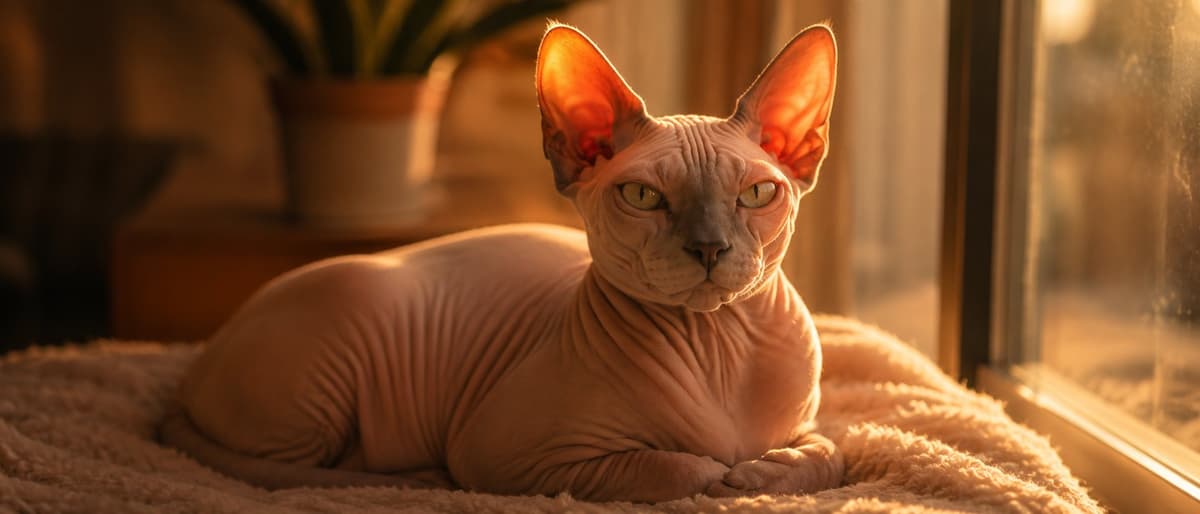
In Sphynxes, for example, which sit at the bottom of the table, a huge problem shortening the breed average is hypertrophic cardiomyopathy (HCM) — a dangerous disease of the heart muscle. We now know this breed carries a specific defect in the ALMS1 gene. The situation is similar for Persian cats and the polycystic kidney disease (PKD) that burdens them.
This does not mean helplessness, however. Armed with this knowledge, a responsible breeder knows the key to success is genetic testing and regular imaging (e.g. an annual heart echo in breeds at risk of HCM, or kidney ultrasound). The high positions of breeds like the Burmese and Birman prove, moreover, that animals bred with the right genetic background — where the accumulation of severe monogenic defects is avoided — can break longevity records.
The effect of body shape (extreme looks)
How a cat looks has a direct impact on the health challenges it will face day to day. Breeds bred without extreme exaggerations of the skull or skeleton generally fare far better in the statistics.
Extreme brachycephaly (a shortened muzzle), seen in some lines of Persians or Exotics, brings breathing difficulties, a higher risk of lung infections and dental problems. The complete lack of a coat in Sphynxes, in turn, means they are constantly exposed to chilling, sunburn (a risk of skin cancer) and dermatological infections. Understanding these weak points lets the owner put in place the right everyday care to offset them.
Temperament deserves a mention too — in Bengals, for instance, high energy and strongly preserved primal hunting instincts simply raise the risk of serious injuries, which unfortunately shows up in the survival statistics for young animals.
Neutering and spaying — the single most important longevity decision
If we care about a long life for our cat, neutering and spaying are an absolute priority, as the hardest clinical data confirm. The 2024 analysis showed it bluntly: unneutered cats had almost 4.3 times higher risk of dying before reaching the age of 3.
4.3×
The procedure protects females completely from a fatal pyometra, and done early it cuts the risk of mammary cancer by 86–91%.
The mechanisms here are very simple. The procedure protects females completely from a fatal pyometra, and done at an early age it can reduce the risk of mammary gland cancer by an impressive 86–91%. In males, neutering not only removes the risk of reproductive-tract cancers but also curbs the urge for dangerous roaming and fights with other toms, and minimises the risk of fatal viral infections (FeLV, FIV). The longest-lived group of cats in general population studies is consistently spayed females.
Obesity — the silent life-shortener
According to researchers, something we have fully under control leaves an enormous mark on lifespan: the bowl. Findings from 2018 showed the relationship between lifespan and body condition score (BCS).
Slightly overweight cats (scored a "6" on the 9-point BCS scale, where 5 is ideal weight) achieved the longest lifespan — 15.9 years on average. In obese middle-aged animals, the risk of death rose by as much as 2.27-fold compared with their leaner peers.
Obesity acts as a trigger for many other problems: it multiplies the risk of taxing type 2 diabetes, leads to painful osteoarthritis and creates ideal conditions for hepatic lipidosis. Wise prevention also means daily calorie awareness and making sure the cat keeps a trim silhouette.
Summary
The average lifespan calculated for individual breeds is an excellent starting point for finding answers in a cat's biology, but it is never a sentence. Breeding is the conscious management of a breed's inborn tendencies, and responsible care at home is the work on everything else. So what do we know for sure?
- A rich gene pool (a low inbreeding coefficient) and a moderate, natural anatomical build favour a longer life without medical intervention.
- As owners, we have a duty to examine our cats regularly, and in breeds with particular disease predispositions, heightened vigilance and targeted diagnostics are required (ultrasound, cardiac echo, genetic tests of breeding animals).
- Failing to neuter or spay more than quadruples the odds of an animal's premature death from infectious disease, injury or reproductive-tract cancers.
- Obesity robs a cat of concrete months, even years, of life, exposing it to painful chronic disease.
The time you ultimately spend with your animal is, to some degree, a matter of chance and genes. But the lion's share of that time is ruled by your wise decisions, preventive check-ups and knowledge — and that shapes the life of every cat, regardless of what is written in its pedigree.
References
- Teng, K.T., Brodbelt, D.C., Church, D.B. & O'Neill, D.G. (2024). Life tables of annual life expectancy and risk factors for mortality in cats in the UK, Journal of Feline Medicine and Surgery, 26(5)doi:10.1177/1098612X241234556
- O'Neill, D.G., Church, D.B., McGreevy, P.D., Thomson, P.C. & Brodbelt, D.C. (2015). Longevity and mortality of cats attending primary care veterinary practices in England, Journal of Feline Medicine and Surgery, 17(2), 125–133doi:10.1177/1098612X14536176
- Teng, K.T., McGreevy, P.D., Toribio, J.L., Raubenheimer, D., Kendall, K. & Dhand, N.K. (2018). Strong associations of nine-point body condition scoring with survival and lifespan in cats, Journal of Feline Medicine and Surgery, 20(12), 1110–1118doi:10.1177/1098612X17752198
- Mata, F. (2025). Life expectancy of cats in Britain: moggies and mollies live longer, PeerJ, 13, e18869doi:10.7717/peerj.18869
- Scarlett, J.M. & Donoghue, S. (1998). Associations between body condition and disease in cats, Journal of the American Veterinary Medical Association, 212(11), 1725–1731↗
- Samaha, G., Wade, C.M., Beatty, J., Lyons, L.A., Fleeman, L.M. & Haase, B. (2020). Mapping the genetic basis of diabetes mellitus in the Australian Burmese cat, Scientific Reports, 10, 19194doi:10.1038/s41598-020-76166-3
- Banfield Pet Hospital (2013). State of Pet Health Report 2013, Banfield Pet Hospital (industry report, 460,000+ cats)
- Lyons, L.A. et al. (2004). Feline polycystic kidney disease mutation identified in PKD1, Journal of the American Society of Nephrology, 15(10), 2548–2555↗
- Saavedra, C., Pérez, C., Oyarzún, C. & Torres-Arévalo, Á. (2024). Overweight and obesity in domestic cats: epidemiological risk factors and associated pathologies, Journal of Feline Medicine and Surgerydoi:10.1177/1098612X241285519
- Overley, B., Shofer, F.S., Goldschmidt, M.H., Sherer, D. & Sorenmo, K.U. (2005). Association between ovarihysterectomy and feline mammary carcinoma, Journal of Veterinary Internal Medicine, 19(4), 560–563doi:10.1111/j.1939-1676.2005.tb02727.x
Frequently asked
Which cat breed lives the longest, and which the shortest?
According to Teng et al. (2024), drawing on 1.25 million cats in the UK, the longest-lived are Burmese (14.42 years) and Birman (14.39 years), and the shortest-lived are Sphynxes (6.68 years) and Bengals (8.51 years). Mixed-breed cats sit in the middle (11.89 years). Remember, though, that for rarer breeds the sample was small, and a breed average is never a sentence for an individual cat.
Do pedigree cats live shorter lives than moggies?
Statistically, mixed-breed cats have a higher average, but that is largely down to hybrid vigour (heterosis) and a data artefact: informed owners of pedigree cats diagnose and treat their animals more often, so their deaths are precisely recorded, whereas many moggies never enter the statistics at all. A pedigree means specific, studied predispositions to manage skilfully — not a shorter life by definition.
What most extends a cat's life?
Three things you can actually control. First, neutering/spaying — unneutered cats had almost 4.3× higher risk of dying before age 3. Second, keeping a healthy weight — mid-life obesity raised the risk of death 2.27×. Third, targeted prevention in breeds with predispositions (cardiac ultrasound for HCM, kidney ultrasound for PKD).
Why do Sphynxes and Persians have a lower average lifespan?
In Sphynxes a major issue is hypertrophic cardiomyopathy (HCM) linked to a defect in the ALMS1 gene, and the lack of a coat exposes them to chilling, sunburn and skin infections. In Persians the burden is often polycystic kidney disease (PKD) and extreme brachycephaly (a shortened muzzle) with its breathing and dental problems. Knowing these weak points lets you prevent them effectively.
Does obesity really shorten a cat's life?
Yes. In Teng et al. (2018), slightly overweight cats (BCS 6 on a 9-point scale) lived longest — 15.9 years on average — but in obese middle-aged animals the risk of death rose 2.27-fold. Obesity is a trigger for type 2 diabetes, osteoarthritis and hepatic lipidosis. It is a factor fully within the owner's control.